USS Satterlee (DD-626)
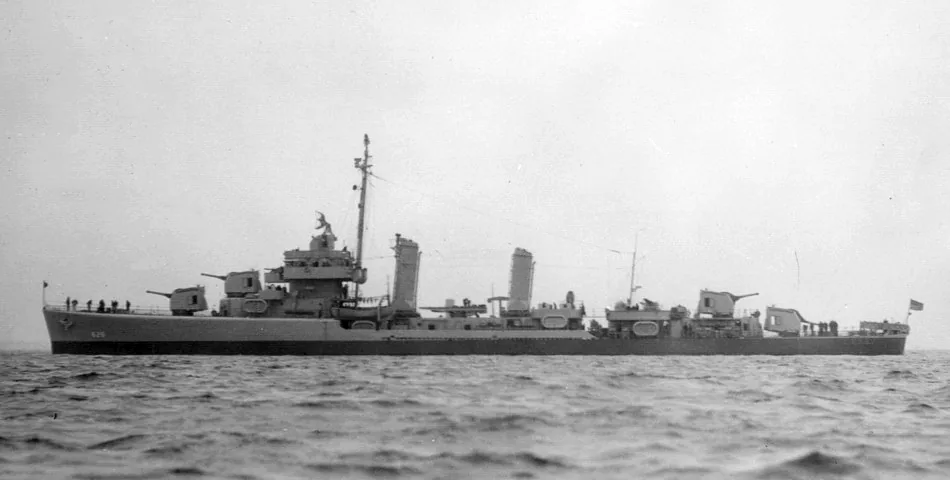
Service
- as Satterlee1 July 1943 — 16 March 1946794 days of the war
- Name
- USS Satterlee
- Pennant / hull number
- DD-626
- Namesake
- Charles Satterlee
- Builder
- Seattle-Tacoma Shipbuilding Corporation
- Laid down
- 10 September 1941
- Launched
- 17 July 1942
- Commissioned
- 1 July 1943
- Decommissioned
- 16 March 1946
- Struck
- 1 December 1970
- Fate
- Sold 8 May 1972 and
broken up for scrap (1972) - Status
- Scrapped
Specifications
- Displacement, standard
- 1,630 long tons (1,656 t)
- Length
- 106.07 m (348 ft)
- Beam
- 10.97 m (36 ft)
- Draught
- 3.35 m (11 ft)
- Speed
- 37.4 knots (69.3 km/h, 43 mph)
- Range
- 6,500 nmi (12,038 km)
- Complement
- 276
- Main gun
- 127 mm (5 in)
Charles Satterlee, born on 14 September 1875 in Essex, Conn., was appointed a cadet in the Revenue Cutter Service on 19 November 1895. In 1908, he was assigned as supervisor of anchorages at Sault Ste. Marie, Mich. This duty included command of the cutter, Machinate. In 1909, he was ordered to Tahoma, then fitting out at Baltimore, Md., for a cruise to the Pacific. From 1910 to 1913, he was assistant inspector of lifesaving stations; and, on 1 September 1915, he was promoted to Captain in the Coast Guard. Capt. Satterlee was in command of the cutter, Tampa, when that vessel was torpedoed and sunk with all hands on 26 September 1918 in the Bristol Channel while escorting a convoy.
The second Satterlee (DD-626) was laid down on 10 September 1941 by the Seattle-Tacoma Shipbuilding Corp., Seattle, Wash.; launched on 17 July 1942; sponsored by Miss Rebecca E. Satterlee, niece of Capt. Satterlee; and commissioned on 1 July 1943, Lt. Comdr. Joseph F. Witherow, Jr., in command.
Satterlee escorted the British aircraft carrier, HMS Victorious, from the Western Seaboard to the Atlantic coast, where the new destroyer joined the U.S. Atlantic Fleet on 26 August 1943. After two convoy escort voyages to Casablanca, and training out of Casco Bay, Maine, she escorted the battleships Texas and Arkan sas to Belfast, Northern Ireland, in April 1944.
Continue to the full service history About 509 words
From the Dictionary of American Naval Fighting Ships, compiled by the Naval History and Heritage Command (Satterlee II (DD-626)). A work of the United States Government, in the public domain.
Armament and machinery
Armament and machinery
- Propulsion
- 2 propellers
- Power
- 50000 shp
- 4 boilers
- Armament
- 4 × 5 in/38 caliber DP guns
- 4 × 40 mm guns (2×2)
- 7 × 20 mm (7×1) AA guns
- 5 × 21 in torpedo tubes (5 Mark 15 torpedoes)
- 6 × depth charge projectors
- 2 × depth charge tracks
Sister ships
- USS Aaron Ward (DD-483)
- USS Baldwin
- USS Beatty (DD-640)
- USS Bristol (DD-453)
- USS Buchanan (DD-484)
- USS Butler
- USS Carmick
- USS Corry (DD-463)
- USS Cowie
- USS Davison
- USS Doran (DD-634)
- USS Doyle (DMS-34)
- USS Duncan (DD-485)
- USS Earle
- USS Eberle
- USS Edison (DD-439)
- USS Edwards (DD-619)
- USS Ellyson
- USS Emmons
- USS Endicott
- USS Ericsson (DD-440)
- USS Fitch
- USS Forrest
- USS Frankford
Sources
- Facts harvested from USS Satterlee (DD-626) on Wikipedia. Figures only — no wording is taken from it.
- Service history reproduced verbatim from Satterlee II (DD-626) , Dictionary of American Naval Fighting Ships — public domain, a work of the United States Government.
- Photograph: USN — Official U.S. Navy Bureau of Ships photo 19-N-51146 available at Destroyerhistory.org — Public domain — Wikimedia Commons