USS Sigourney (DD-81)
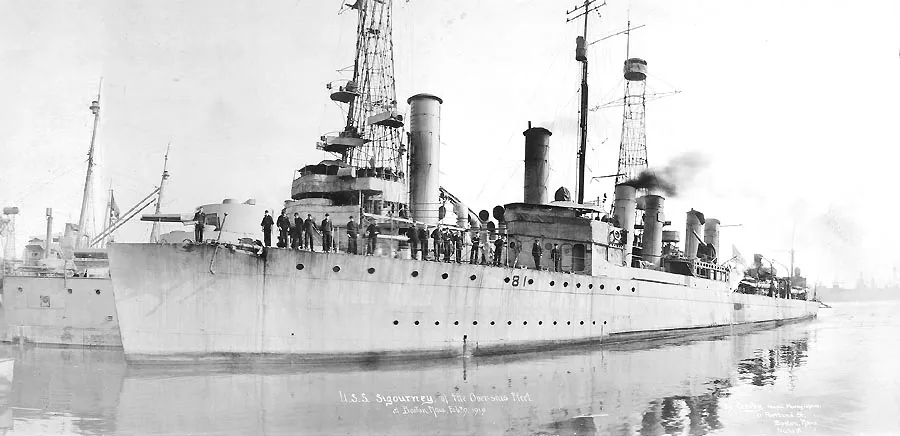
Service
- as Sigourney15 May 1918 — 26 November 1940452 days of the war
- as HMS Newport5 December 1940 — January 19451,515 days of the war
- as HNoMS NewportMarch 1941 — June 1942484 days of the war
- Name
- USS Sigourney
- Pennant / hull number
- DD-81
- Namesake
- James Butler Sigourney
- Builder
- Fore River Shipyard, Quincy, Massachusetts
- Laid down
- 25 August 1917
- Launched
- 16 December 1917
- Commissioned
- 15 May 1918
- Decommissioned
- 26 June 1922
- Recommissioned
- 23 August 1940
- Struck
- 8 January 1941
- Fate
- Transferred to United Kingdom June 1942 (1942)
- Status
- Unknown
Specifications
- Displacement, standard
- 1,191 long tons (1,210 t)
- Length
- 95.71 m (314 ft)
- Beam
- 9.14 m (30 ft)
- Draught
- 2.74 m (9 ft)
- Speed
- 35 knots (64.8 km/h, 40.3 mph)
- Complement
- 122
- Main gun
- 102 mm (4 in)
James Butler Sigourney, born in Boston, Mass., was appointed Midshipman on 16 January 1809. He served in Wasp and then became sailing master of Nautilus. He was captured with his ship shortly after the outbreak of the War of 1812; and, after his exchange had been effected, he was placed in command of Asp, a schooner fitted out to defend the Chesapeake Bay. On 14 July 1813, Asp was attacked by three British barges but succeeded in driving them off. On a second attack, however, Asp was boarded, and Sigourney was killed at his post on deck.
The first Sigourney (Destroyer No. 81) was laid down on 25 August 1917 at Quincy, Mass., by the Fore River Shipbuilding Co.; launched on 16 December 1917; sponsored by Mrs. Granville W. [Jeannette] Johnson, wife of Granville W. Johnson of Boston, Mass. ; and commissioned on 15 May 1918, Cmdr. Walter N. Vernou in command.
On 27 May 1918, Sigourney sailed from the United States escorting a troop transport to France. On arrival at Brest, she was assigned to Commander Naval Forces, France; and, for the remainder of the Great War [World War I], she escorted convoys through the submarine danger zone extending approximately 500 miles west of Brest. During most of her convoys, Sigourney operated as the flagship of the screen commander but did not herself have any confirmed submarine contacts.
Continue to the full service history About 424 words
From the Dictionary of American Naval Fighting Ships, compiled by the Naval History and Heritage Command (Sigourney I (Destroyer No. 81)). A work of the United States Government, in the public domain.
Armament and machinery
Armament and machinery
- Armament
- 4 x 4 in/50 caliber guns
- 1 x 3 in/23 caliber AA gun
- 12 x 21 inch (533 mm) torpedo tubes
Sister ships
- HMCS Annapolis (I04)
- HMCS Caldwell (I20)
- HMCS Chelsea (I35)
- HMCS Columbia (I49)
- HMCS Georgetown (I40)
- HMCS Hamilton (I24)
- HMCS Leamington (G19)
- HMCS Lincoln (G42)
- HMCS Mansfield (G76)
- HMCS Montgomery (G95)
- HMCS Niagara (I57)
- HMCS Richmond (G88)
- HMCS Salisbury (I52)
- HMCS St. Clair (I65)
- HMS Bath (I17)
- HMS Brighton (I08)
- HMS Caldwell (I20)
- HMS Campbeltown (I42)
- HMS Castleton (I23)
- HMS Charlestown (I21)
- HMS Chelsea (I35)
- HMS Georgetown (I40)
- HMS Hamilton (I24)
- HMS Lancaster (G05)
Sources
- Facts harvested from USS Sigourney (DD-81) on Wikipedia. Figures only — no wording is taken from it.
- Service history reproduced verbatim from Sigourney I (Destroyer No. 81) , Dictionary of American Naval Fighting Ships — public domain, a work of the United States Government.
- Photograph: J.C. Crosby, Naval Photographer, 11 Portland Street, Boston, Massachusetts (USA) — U.S. Naval History and Heritage Command photo NH 41809 — Public domain — Wikimedia Commons