USS Snook (SS-279)
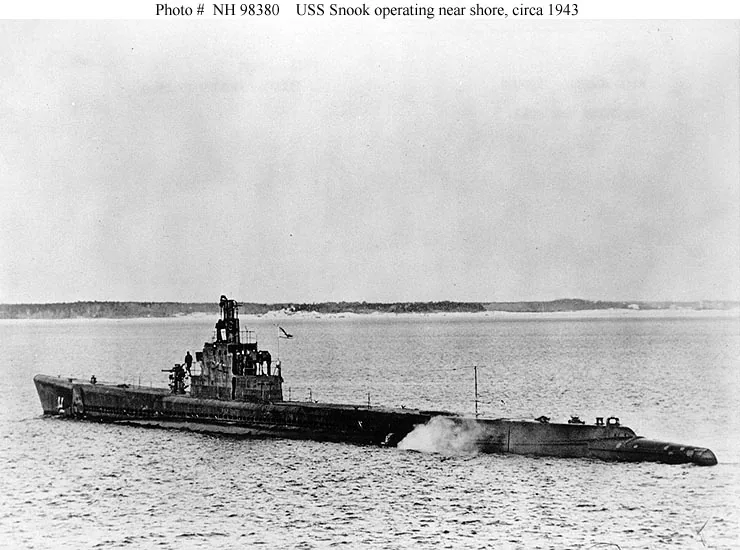
Service
- as USS Snook24 October 1942 — 8 April 1945897 days of the war
- Name
- USS Snook
- Pennant / hull number
- SS-279
- Builder
- Portsmouth Naval Shipyard, Kittery, Maine
- Laid down
- 17 April 1942
- Launched
- 15 August 1942
- Commissioned
- 24 October 1942
- Fate
- Missing since 8 April 1945 east of Taiwan (1945)
- Status
- Unknown
Specifications
- Length
- 94.79 m (311 ft)
- Beam
- 8.23 m (27 ft)
- Draught
- 5.18 m (17 ft)
- Speed
- 21 knots (38.9 km/h, 24.2 mph)
- Range
- 11,000 nmi (20,372 km)
- Complement
- 60
- Main gun
- 102 mm (4 in)
A robalo of the Atlantic that is bluish-gray above and silvery below a black lateral line. The snook attains a length of about four feet and a weight of from 15 to 20 pounds.
The first Snook (SS-279) was laid down by the Portsmouth (N.H.) Navy Yard on 17 April 1942; launched on 15 August 1942; sponsored by Mrs. James C. Dempsey, wife of Lt. Dempsey who had been awarded the Navy Cross for heroism as commanding officer of the submarine S-27; and commissioned on 24 October 1942, Lt. Comdr. C. O. Triebel in command.
After shakedown training off the New England coast, Snook departed New London on 3 March 1943 and set sail for the Pacific. Following a 12-day stopover at Pearl Harbor, the submarine put to sea on 11 April and headed for the Yellow and East China seas for her first war patrol. Upon completion of mine planting in the Shanghai area, Snook continued on up the coast of China to the Yellow Sea. On the afternoon of 5 May, she sighted two freighters standing out of Dairen and took up the chase. She trailed both until after nightfall, then let go with a spread of three torpedoes that quickly sank Kinko Maru. The lead freighter continued on, oblivious to the fate that had befallen her companion, until someone on the sinking ship sounded a whistle. At that point, the freighter began a series of frantic maneuvers to dodge two of Snook's torpedoes; then opened fire with her guns, forcing the submarine to race out of range. Snook quickly returned to the action, however, firing three torpedoes, with one hit amidships, that sent Daifuku Maru to the bottom. With two "kills" to her credit, Snook resumed patrol.
Continue to the full service history About 1,140 words
From the Dictionary of American Naval Fighting Ships, compiled by the Naval History and Heritage Command (Snook I (SS-279)). A work of the United States Government, in the public domain.
Armament and machinery
Armament and machinery
- Propulsion
- 4 × Fairbanks-Morse Model 38D8-⅛ 9-cylinder opposed piston diesel engines driving electrical generators
- 2 × 126-cell Sargo batteries
- 4 × high-speed General Electric electric motors with reduction gears
- two propellers
- 5,400 shp (4.0 MW) surfaced
- 2,740 shp (2.0 MW) submerged
- Armament
- 10 × 21-inch (533 mm) torpedo tubes
- 6 forward, 4 aft
- 24 torpedoes
- 1 × 4-inch (102 mm) / 50 caliber deck gun
- Bofors 40 mm and Oerlikon 20 mm cannon
Sister ships
- USS Albacore (SS-218)
- USS Amberjack (SS-219)
- USS Angler
- USS Barb (SS-220)
- USS Bashaw
- USS Blackfish
- USS Bluefish (SS-222)
- USS Bluegill
- USS Bonefish (SS-223)
- USS Bream
- USS Cavalla (SS-244)
- USS Cero (SS-225)
- USS Cobia
- USS Cod
- USS Corvina
- USS Croaker
- USS Dace (SS-247)
- USS Darter (SS-227)
- USS Dorado (SS-248)
- USS Drum (SS-228)
- USS Finback (SS-230)
- USS Flasher (SS-249)
- USS Flier
- USS Flounder
Sources
- Facts harvested from USS Snook (SS-279) on Wikipedia. Figures only — no wording is taken from it.
- Service history reproduced verbatim from Snook I (SS-279) , Dictionary of American Naval Fighting Ships — public domain, a work of the United States Government.
- Photograph: Unknown author — Unknown source — Public domain — Wikimedia Commons