USS Thorn (DD-647)
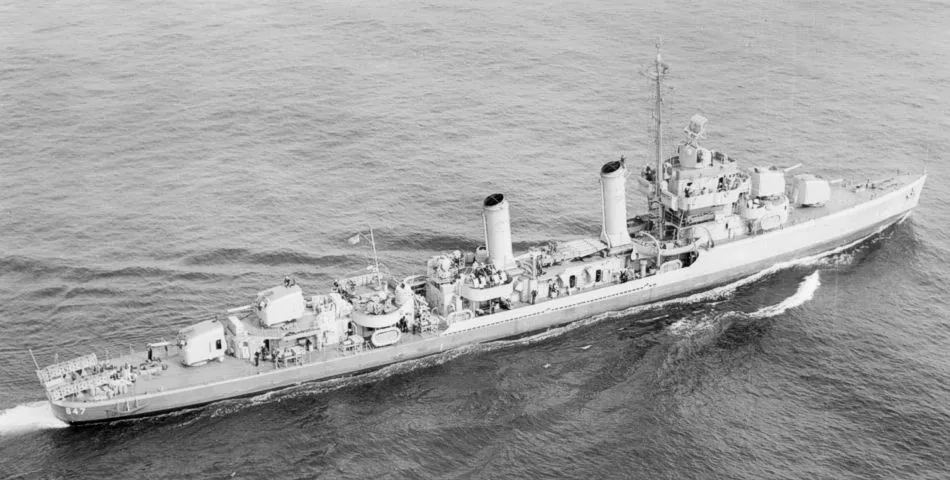
Service
- as Thorn1 April 1943 — 6 May 1946885 days of the war
- Name
- USS Thorn
- Pennant / hull number
- DD-647
- Namesake
- Jonathan Thorn
- Builder
- Federal Shipbuilding and Drydock Company
- Laid down
- 15 November 1942
- Launched
- 28 February 1943
- Commissioned
- 1 April 1943
- Decommissioned
- 6 May 1946
- Struck
- 1 July 1971
- Fate
- Sunk as target, 22 August 1974 (1974)
- Status
- Wreck
Specifications
- Displacement, standard
- 1,630 long tons (1,656 t)
- Length
- 106.07 m (348 ft)
- Beam
- 10.97 m (36 ft)
- Draught
- 3.35 m (11 ft)
- Speed
- 37.4 knots (69.3 km/h, 43 mph)
- Range
- 6,500 nmi (12,038 km)
- Complement
- 276
- Main gun
- 127 mm (5 in)
Jonathan Thorn, born on 8 January 1779 at Schenectady, N.Y., was appointed a midshipman on 28 April 1800. Subsequently serving with the Navy during the Tripolitan War, Thorn volunteered to take part in the hazardous expedition to destroy the captured frigate Philadelphia, which lay beneath the guns of the shore batteries in heavily defended Tripoli harbor. On 16 February 1804, Lt. Stephen Decatur, Jr., led a party of these volunteers in the ketch Intrepid into Tripoli and burned the erstwhile American frigate.
Attached to the schooner Enterprise, Thorn was then assigned to Gunboat No. 4, under Decatur's command. In this vessel, he participated in the attack on Tripoli, with Commodore Edward Preble's squadron on 3 August 1804. Specially commended by Decatur for his conduct in this battle, Thorn received command of one of the Tripolitan gunboats captured and commanded this vessel in the engagement with the Tripolitan pirates on 7 August.
Commissioned a lieutenant on 16 February 1807, Thorn became the first commandant of the New York Navy Yard at age 27. In 1810, he was granted a two-year furlough to command John Jacob Astor's sailing bark Tonquin in a voyage slated to take the ship to the Pacific Northwest to establish a fur trading post. Anchoring off Nootka on 5 June 1811, after a voyage which had taken the ship around Cape Horn to the Hawaiian Islands and to the mouth of the Columbia River, Thorn soon began trading with the local Indians. Angered by what they considered a bad business deal, the Indians came on board Tonquin and, in a brief, bloody action, massacred Thorn and his crew.
Continue to the full service history About 1,728 words
From the Dictionary of American Naval Fighting Ships, compiled by the Naval History and Heritage Command (Thorn I (DD-647)). A work of the United States Government, in the public domain.
Armament and machinery
Armament and machinery
- Propulsion
- 50000 shp
- 4 boilers
- 2 propellers
- Armament
- 4 × 5 in/38 caliber DP guns
- 4 × 40 mm guns
- 5 × 20 mm AA guns
- 5 × 21 in torpedo tubes (5 Mark 15 torpedoes)
- 6 × depth charge projectors
- 2 × depth charge tracks
Sister ships
- USS Aaron Ward (DD-483)
- USS Baldwin
- USS Beatty (DD-640)
- USS Bristol (DD-453)
- USS Buchanan (DD-484)
- USS Butler
- USS Carmick
- USS Corry (DD-463)
- USS Cowie
- USS Davison
- USS Doran (DD-634)
- USS Doyle (DMS-34)
- USS Duncan (DD-485)
- USS Earle
- USS Eberle
- USS Edison (DD-439)
- USS Edwards (DD-619)
- USS Ellyson
- USS Emmons
- USS Endicott
- USS Ericsson (DD-440)
- USS Fitch
- USS Forrest
- USS Frankford
Sources
- Facts harvested from USS Thorn (DD-647) on Wikipedia. Figures only — no wording is taken from it.
- Service history reproduced verbatim from Thorn I (DD-647) , Dictionary of American Naval Fighting Ships — public domain, a work of the United States Government.
- Photograph: USN — Official U.S. Navy photo 80-G-419691 available at Destroyerhistory.org — Public domain — Wikimedia Commons