USS Tillman (DD-135)
Service
- as USS Tillman10 April 1921 — 26 November 1940452 days of the war
- as HMS Wells5 December 1940 — 24 July 19451,692 days of the war
- Name
- USS Tillman
- Pennant / hull number
- DD-135
- Namesake
- Benjamin Tillman
- Builder
- Charleston Navy Yard
- Laid down
- 29 July 1918
- Launched
- 7 July 1919
- Commissioned
- 10 April 1921
- Decommissioned
- 3 July 1922
- Recommissioned
- 1 May 1930
- Struck
- 8 January 1941
- Fate
- Scrapped, 24 July 1945 (1945)
- Status
- Scrapped
Specifications
- Displacement, standard
- 1,191 long tons (1,210 t)
- Length
- 95.71 m (314 ft)
- Beam
- 9.45 m (31 ft)
- Draught
- 2.74 m (9 ft)
- Speed
- 35 knots (64.8 km/h, 40.3 mph)
- Complement
- 122
- Main gun
- 102 mm (4 in)
Benjamin Ryan Tillman was born on 11 August 1847 in Edgefield County, S.C. In July 1864, Tillman left school to enter the Confederate Army, but his service to the South during the Civil War was prevented by serious illness. He served as governor of South Carolina from 1890 to 1894; and, during his administration, he founded Clemson Agricultural and Mechanical College. He entered the United States Senate on 4 March 1895, and he held the position of senator for the remainder of his life. During World War I, Tillman was chairman of the Senate Committee on Naval Affairs until his death on 3 July 1918.
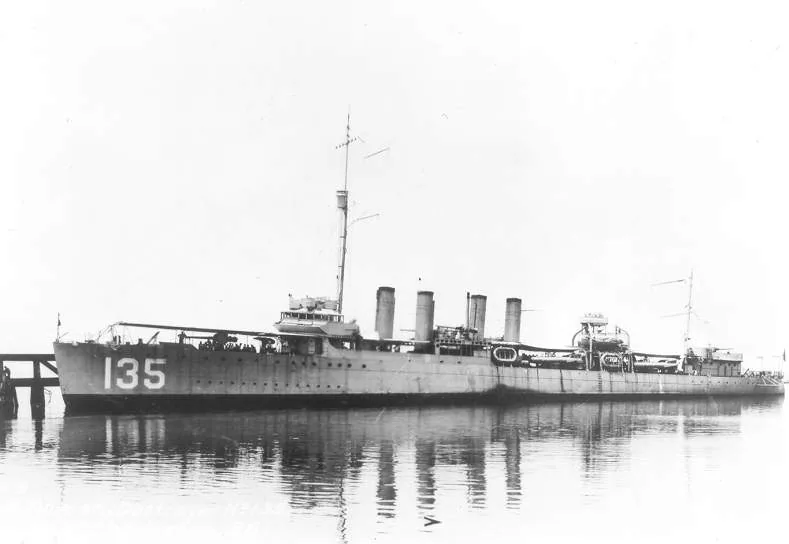
The first Tillman (Destroyer No. 135) was laid down on 29 July 1918 by the Charleston (S.C.) Navy Yard; launched on 7 July 1918; sponsored by Miss Mary Y. Tillman, the granddaughter of Senator Tillman; reclassified DD-135 on 17 July 1920, during the Navy-wide assignment of alphanumeric hull numbers; and commissioned on 10 April 1921, Lt. Louis R. Vail in command.
Following shakedown, Tillman operated out of Charleston with Division 20, Squadron 9, Destroyer Flotilla 1, Atlantic Fleet, until the summer of 1921. Operating with half of her normal complement by the following winter, the destroyer trained and cruised with Division 33, Squadron 8, Atlantic Fleet Destroyer Squadrons into the spring of 1922. Soon thereafter, Tillman was decommissioned on 3 July 1922 and laid up at the Philadelphia Navy Yard.
Continue to the full service history About 1,039 words
From the Dictionary of American Naval Fighting Ships, compiled by the Naval History and Heritage Command (Tillman I (Destroyer No. 135)). A work of the United States Government, in the public domain.
Armament and machinery
Armament and machinery
- Propulsion
- Twin screws, four steam boilers with superheat, four funnels
- Armament
- 4 × 4 in/50 guns
- 2 × 3 in/23 gun
- 12 × 21 inch (533 mm) torpedo tubes
- 1 × Y-gun depth charge projector
Sister ships
- HMCS Annapolis (I04)
- HMCS Caldwell (I20)
- HMCS Chelsea (I35)
- HMCS Columbia (I49)
- HMCS Georgetown (I40)
- HMCS Hamilton (I24)
- HMCS Leamington (G19)
- HMCS Lincoln (G42)
- HMCS Mansfield (G76)
- HMCS Montgomery (G95)
- HMCS Niagara (I57)
- HMCS Richmond (G88)
- HMCS Salisbury (I52)
- HMCS St. Clair (I65)
- HMS Bath (I17)
- HMS Brighton (I08)
- HMS Caldwell (I20)
- HMS Campbeltown (I42)
- HMS Castleton (I23)
- HMS Charlestown (I21)
- HMS Chelsea (I35)
- HMS Georgetown (I40)
- HMS Hamilton (I24)
- HMS Lancaster (G05)
Sources
- Facts harvested from USS Tillman (DD-135) on Wikipedia. Figures only — no wording is taken from it.
- Service history reproduced verbatim from Tillman I (Destroyer No. 135) , Dictionary of American Naval Fighting Ships — public domain, a work of the United States Government.
- Photograph: Photographer notified. — Transferred from en.wikipedia to Commons. Original uploader was ScottyBoy900Q at en.wikipedia — Public domain — Wikimedia Commons