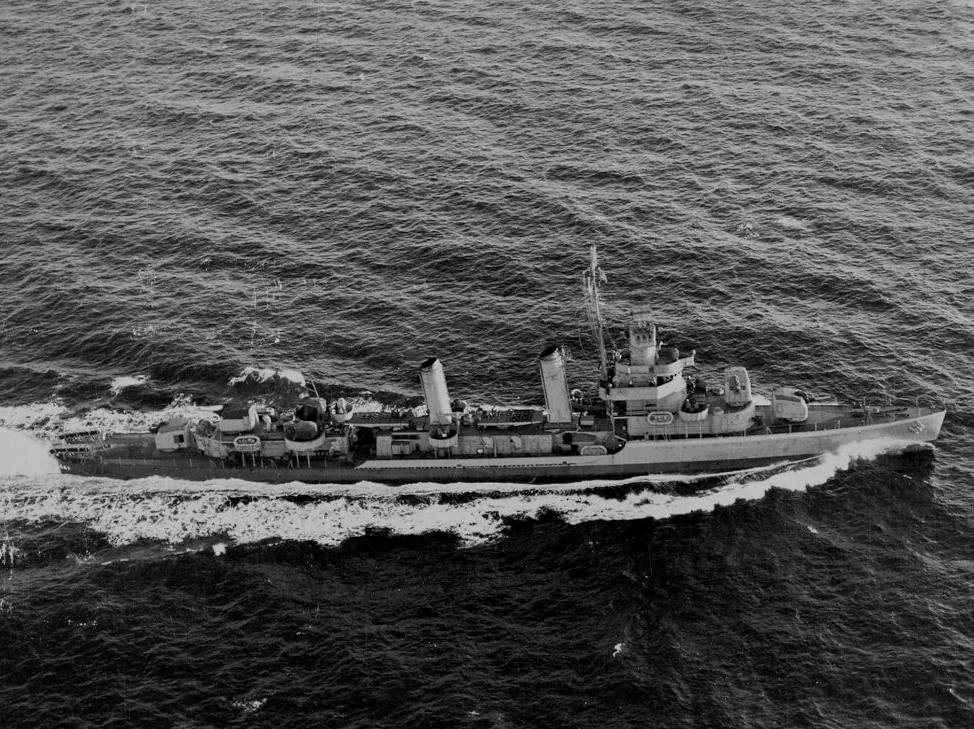
USS Wilkes (DD-441)
Service
- as Wilkes22 April 1941 — 4 March 19461,594 days of the war
- Name
- USS Wilkes
- Pennant / hull number
- DD-441
- Namesake
- Charles Wilkes
- Builder
- Boston Navy Yard
- Laid down
- 1 November 1939
- Launched
- 31 May 1940
- Commissioned
- 22 April 1941
- Decommissioned
- 4 March 1946
- Struck
- 16 September 1968
- Fate
- Sold for scrap, 29 June 1972 (1972)
- Status
- Scrapped
Specifications
- Displacement, standard
- 1,630 long tons (1,656 t)
- Length
- 106.07 m (348 ft)
- Beam
- 10.97 m (36 ft)
- Draught
- 3.35 m (11 ft)
- Speed
- 37.4 knots (69.3 km/h, 43 mph)
- Range
- 6,500 nmi (12,038 km)
- Complement
- 276
- Main gun
- 127 mm (5 in)
Charles Wilkes, born on 3 April 1798 in New York City, served in merchant ships between 1815 and 1817 before being appointed a midshipman in the United States Navy on New Year's Day 1818. Following initial training in Independence, he transferred to Guerriere in July 1818 for a cruise in the Baltic and Mediterranean Seas. After a two-month assignment in Wash ington between March and May 1821, Midshipman Wilkes received orders to Franklin, in which ship hevoyaged to South America. During that cruise, Wilkes briefly commanded Franklin's tender, Waterwitch, before being detached from Franklin on 3 March 1823 to command the American merchant ship Ocain on her way back to Boston, where he arrived on 15 October. From there, he reported to Washington for duty in conjunction with the court-martial of Capt. Stewart, his former commanding officer in Franklin. On 28 April 1827, Wilkes was promoted to lieutenant. Apparently at home awaiting orders between 1826 and 1830, Lt. Wilkes requested surveying duty in March of 1827 but withdrew his application in July 1828 in favor of one for duty with a proposed exploring expedition. Late that fall, he received orders to New York where he set about the task of procuring the necessary instruments for that expedition.
In April 1830, Lt. Wilkes resumed sea duty. Assigned to Boston, he made a cruise in her to the Mediterranean. On 15 November, he transferred to Fair field in which ship he served until May 1831 at which time he was detached and ordered home to await orders. Late in the spring of 1832, Wilkes returned to active duty as a member of the team which surveyed Narragansett Bay. In February 1833, he received orders to duty in charge of the Depot of Charts and Instruments (forerunner both of the Naval Oceanographic Office and of the Naval Observatory). In August of 1836, Wilkes briefly took leave of that post when he sailed to Europe to acquire additional equipment for the exploring expedition. He returned to the Depot of Charts and Instruments after that trip; and, in March 1837, Secretary of the Navy Mahlon Dicker-son requested Wilkes to take a position in the astronomy department of the exploring expedition. That fall, he participated in an oceanographic survey of the Carolina coast.
The following spring, Wilkes learned that he had been chosen to command the South Seas Exploring Expedition. President Van Buren approved his appointment on 20 April, and Wilkes assumed command of Vincennes at Norfolk on 7 July. He received his final orders on 11 August and set sail in Vincennes, in company with Peacock, Porpoise, Sea Gull, Flying Fish, and Relief, on the 18th. After stops at Rio de Janeiro, Brazil, and Tierra del Fuego located at the southern tip of South America, Wilkes took his expedition on its first cruise through Antarctic waters in February and March of 1839. He returned to Tierra del Fuego and then later headed through the south seas to Sydney, Australia, where he arrived on 29 November. On the day after Christmas, he embarked upon his second voyage to the Antarctic. In January 1840, he sighted the actual land mass which constitutes Antarctica, though it took later explorations to vindicate his assertions that the continent existed.
Continue to the full service history About 4,326 words
From the Dictionary of American Naval Fighting Ships, compiled by the Naval History and Heritage Command (Wilkes III (DD-441)). A work of the United States Government, in the public domain.
Armament and machinery
Armament and machinery
- Propulsion
- 50000 shp
- 4 boilers
- 2 propellers
- Armament
- 5 × 5 in DP guns
- 6 × 0.5 in guns
- 6 × 20 mm AA guns
- 10 × 21 in torpedo tubes
- 2 × depth charge tracks
Sister ships
- USS Aaron Ward (DD-483)
- USS Baldwin
- USS Beatty (DD-640)
- USS Bristol (DD-453)
- USS Buchanan (DD-484)
- USS Butler
- USS Carmick
- USS Corry (DD-463)
- USS Cowie
- USS Davison
- USS Doran (DD-634)
- USS Doyle (DMS-34)
- USS Duncan (DD-485)
- USS Earle
- USS Eberle
- USS Edison (DD-439)
- USS Edwards (DD-619)
- USS Ellyson
- USS Emmons
- USS Endicott
- USS Ericsson (DD-440)
- USS Fitch
- USS Forrest
- USS Frankford
Sources
- Facts harvested from USS Wilkes (DD-441) on Wikipedia. Figures only — no wording is taken from it.
- Service history reproduced verbatim from Wilkes III (DD-441) , Dictionary of American Naval Fighting Ships — public domain, a work of the United States Government.
- Photograph: ENS W. Bjerie, USN, from blimp ZNP-K-10. — U.S. Navy photo [1] from Navsource.org — Public domain — Wikimedia Commons