USS Cushing (DD-797)
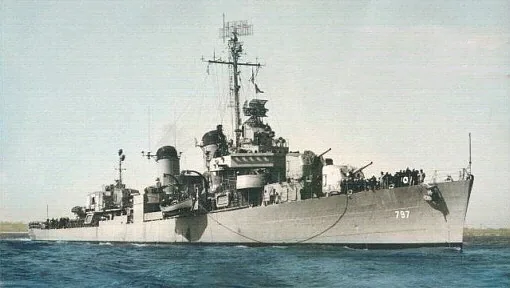
Service
- as USS Cushing (DD-797)17 January 1944 — 8 November 1960594 days of the war
- as Paraná (D29)20 July 1961 — 1 August 1973
- Name
- USS Cushing
- Pennant / hull number
- DD-797
- Namesake
- William B. Cushing
- Builder
- Bethlehem Mariners Harbor, Staten Island
- Laid down
- 3 May 1943
- Launched
- 30 September 1943
- Commissioned
- 17 January 1944
- Decommissioned
- 3 February 1947
- Recommissioned
- 17 August 1951
- Struck
- 1 August 1973
- Fate
- Scrapped, 1982 (1982)
- Status
- Scrapped
Specifications
- Displacement, standard
- 2,050 long tons (2,083 t)
- Displacement, full load
- 2,500 long tons (2,540 t)
- Length
- 114.76 m (376.5 ft)
- Beam
- 12.04 m (39.5 ft)
- Draught
- 3.81 m (12.5 ft)
- Speed
- 36.5 knots (67.6 km/h, 42 mph)
- Range
- 5,500 nmi (10,186 km)
- Complement
- 329
- Main gun
- 127 mm (5 in)
William Barker Cushing, born 24 November 1842 in Delafield, Wis., rendered gallant service during the Civil War, unsurpassed for daring and courage. He was four times commended by the Navy Department, and received the thanks of Congress for his boldest and most successful exploit, the destruction of the Confederate ironclad ram Albemarle at Plymouth, N.C., 27 October 1864. Commander Cushing died 17 December 1874 while serving at the Washington Navy Yard.
The fourth Cushing (DD-797) was launched 30 September 1943 by Bethlehem Steel Co., Staten Island, N.Y.; sponsored by Miss K. A. Cushing; and commissioned 17 January 1944, Commander L. F. Volk in command.
Cushing sailed from Norfolk 5 May 1944, for training at San Diego and Pearl Harbor, and escorted a convoy to Eniwetok before returning to Bremerton, Wash., to have her antisubmarine equipment modernized. She joined the 5th Fleet at Eniwetok 24 August to sortie for the invasion of the Palau Islands. She screened the carriers during their strikes on Mindanao, Samar, Cebu, and Negros in the Philippines, then supported the ground forces as they assaulted Angaur 17 September. She returned to the carriers' screen for raids on Formosa, Manila, and northern Luzon which neutarilzed Japanese bases for the scheduled invasion of the Philippines, rescuing numerous downed aviators. Her antiaircraft fire accounted for at least one Japanese plane during the heavy air attacks of 24 October in the epic Battle for Leyte Gulf. She returned to Ulithi 22 November to replenish.
Sortieing with TF 38 on 10 December 1944 for air strikes on Luzon, Cushing weathered the typhoon of 18 December and rescued survivors of less fortunate ships before returning to Ulithi 24 December for storm repairs. She sailed with the task force 1 January 1945 for air strikes on Formosa, Indo-China, China coast, and the Philippines until 28 January. Joining TF 58 for the strikes on the Japanese home islands, Cushing served as radar picket ship at the launching point and successfully directed the destruction of many Japanese aircraft trying to break through to attack the carriers. She screened the carriers for the preinvasion strikes on Iwo Jima and Okinawa and fired in softening-up bombardment on Okinawa. Serving as radar picket ship during the struggle for Okinawa, she provided fighter direction which accounted for many Japanese aircraft. After replenishing at Leyte in June, she rejoined the carriers for strikes on the Tokyo area until the end of the war. Anchoring in Sagami Wan 27 August 1945, she served as harbor entrance control vessel for the occupation forces until sailing for home. She arrived at Bremerton, Wash., 20 November 1945 and Cushing was placed out of commission in reserve at Long Beach 3 February 1947.
Recommissioned 17 August 1951, Cushing sailed from Long Beach 15 November and arrived at Norfolk 30 November to join the Atlantic Fleet. She conducted exercises in the North Atlantic and in the Caribbean, and cleared Norfolk 7 January 1953 to join TF 77 off Korea for duty as plane guard. On 2 and 3 June she fired in the bombardment of Hodo Pando. She visited Manila, Singapore, Colombo, Aden, Piraeus, Genoa, Cannes, and Algiers, before returning to Norfolk 22 August from this cruise around the world. She cruised the east coast in antisubmarine exercises and reserve training, and in 1954 sailed to the Mediterranean for duty. Transferred to the Pacific Fleet, she arrived at Long Beach 26 January 1955.
In tours of duty in the Far East in 1955, 1956, 1957-58, and 1959-60 Cushing served as plane guard and joined in hunter-killer exercises with TF 77, patrolled in the Taiwan Straits, and visited various ports strengthening national ties in the President's "People to People" program. While "stateside" she operated along the west coast in antisubmarine and antiaircraft warfare exercises, and midshipmen and reserve training. Cushing's home port was changed to Charleston, S.C., in October 1960, and the destroyer sailed to the east coast. Cushing was placed out of commission in reserve at Norfolk, Va., on 8 November 1960.
From the Dictionary of American Naval Fighting Ships, compiled by the Naval History and Heritage Command (Cushing IV (DD-797)). A work of the United States Government, in the public domain.
Armament and machinery
Armament and machinery
- Propulsion
- 4 Babcock & Wilcox oil-fired boilers; 2 General Electric geared steam turbines; 2 screws; =60,000shp (45 MW)
- Armament
- 5 × single 5 inch/38 caliber guns guided by a Mark 37 Gun Fire Control System with Mk25 fire control radar linked by a Mark 1A Fire Control Computer stabilized by a Mk6 8,500 rpm gyro.
- 6–10 × 40 mm Bofors AA guns (early ships carried 4 × 1.1 inch/75 caliber guns)
- 7–10 × 20 mm Oerlikon cannons
- 10 × 21 inch torpedo tubes (2×5)
- 6 × K-guns
- 2 × depth charge racks
Sister ships
- USS Abbot (DD-629)
- USS Abner Read (DD-526)
- USS Albert W. Grant
- USS Ammen (DD-527)
- USS Anthony (DD-515)
- USS Aulick (DD-569)
- USS Bache (DD-470)
- USS Beale (DD-471)
- USS Bearss
- USS Bell (DD-587)
- USS Benham (DD-796)
- USS Bennett
- USS Bennion
- USS Black
- USS Boyd
- USS Bradford
- USS Braine
- USS Brown (DD-546)
- USS Brownson (DD-518)
- USS Bryant
- USS Bullard
- USS Burns (DD-588)
- USS Bush (DD-529)
- USS Callaghan (DD-792)
Sources
- Facts harvested from USS Cushing (DD-797) on Wikipedia. Figures only — no wording is taken from it.
- Service history reproduced verbatim from Cushing IV (DD-797) , Dictionary of American Naval Fighting Ships — public domain, a work of the United States Government.
- Photograph: U.S. Navy — U.S. Navy photo [1] from Navsource.org — Public domain — Wikimedia Commons