USS Isherwood (DD-520)
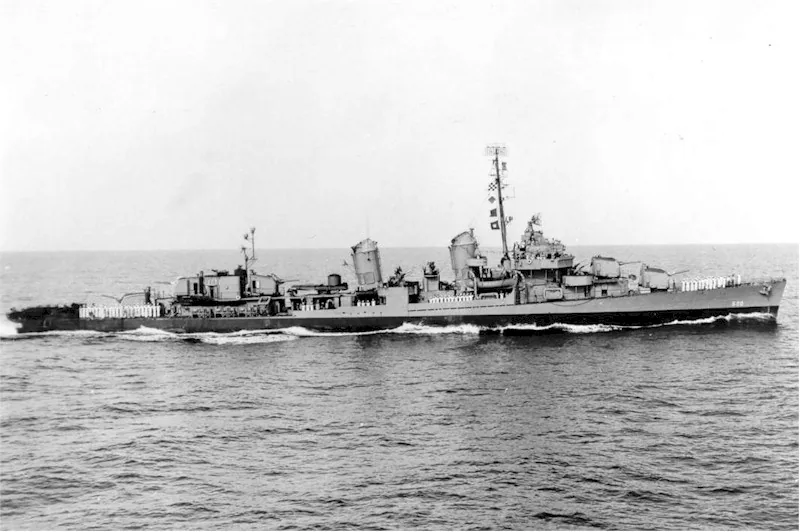
Service
- 12 April 1943 — 11 September 1961874 days of the war
- as Almirante Guise (DD-72)8 October 1961 — 1981
- Name
- USS Isherwood
- Pennant / hull number
- DD-520
- Namesake
- Benjamin F. Isherwood
- Builder
- Bethlehem Mariners Harbor, Staten Island
- Laid down
- 12 May 1942
- Launched
- 24 November 1942
- Commissioned
- 12 April 1943
- Decommissioned
- 11 September 1961
- Struck
- 15 January 1974
- Fate
- Scrapped in 1981 (1981)
- Status
- Scrapped
Specifications
- Displacement, standard
- 2,050 long tons (2,083 t)
- Length
- 114.6 m (376 ft)
- Beam
- 11.89 m (39 ft)
- Draught
- 5.18 m (17 ft)
- Speed
- 35 knots (64.8 km/h, 40.3 mph)
- Range
- 6,500 nmi (12,038 km)
- Complement
- 336
- Main gun
- 127 mm (5 in)
Benjamin F. Isherwood was born in New York City 6 October 1822, and was appointed First Assistant Engineer in the Navy 23 May 1844, During the Mexican War, he served in Princeton and later was senior engineer of Spitfire. While on a cruise of more than 3 years on the Asiatic Station, Isherwood served as Chief Engineer of the steam frigate San Jacinto. Shortly after the outbreak of the Civil War, he was appointed Engineer-in-Chief of the Navy, and so important were his services considered that the Bureau of Steam Engineering was created under his direction. He was a pioneer in the production of fast cruisers, producing this class against strong opposition. Following a tour of European dockyards, he became president of the Experimental Board under the Bureau of Steam Engineering until his retirement 6 October 1884. He died in New York City 19 June 1915.
The second Isherwood (DD-520) was launched by Bethlehem Shipbuilding Co., Staten Island, N.Y., 24 November 1942; sponsored by Mrs. A. J. Kerwin, granddaughter of Rear Admiral Isherwood; and commissioned 12 April 1943 at New York Navy Yard, Comdr. R. E. Gadrow in command.
The new destroyer conducted her shakedown training in Casco Bay, Maine, and off Guantanamo Bay, Cuba, through April and May. During the next 2 months she operated with a patrol and escort group out of Argentia, Newfoundland, and on 5 August 1943 departed for England with troop ship Queen Mary. Isherwood arrived Scapa Flow 19 August to carry out combined operations with the British Home Fleet, including a search toward Spitzbergen for German battleship Tirpitz. Sailing 14 September, the destroyer returned to Boston with a convoy 29 September 1943.
Continue to the full service history About 1,183 words
From the Dictionary of American Naval Fighting Ships, compiled by the Naval History and Heritage Command (Isherwood II (DD-520)). A work of the United States Government, in the public domain.
Armament and machinery
Armament and machinery
- Propulsion
- 60,000 shp (45 MW); 2 propellers
- Armament
- 5 × single Mk 12 5 in (127 mm)/38 guns
- 5 × twin 40 mm (1.6 in) Bofors AA guns
- 7 × single 20 mm (0.8 in) Oerlikon AA guns
- 2 × quintuple 21 in (533 mm) torpedo tubes
- 6 × single depth charge throwers
- 2 × depth charge racks
Sister ships
- USS Abbot (DD-629)
- USS Abner Read (DD-526)
- USS Albert W. Grant
- USS Ammen (DD-527)
- USS Anthony (DD-515)
- USS Aulick (DD-569)
- USS Bache (DD-470)
- USS Beale (DD-471)
- USS Bearss
- USS Bell (DD-587)
- USS Benham (DD-796)
- USS Bennett
- USS Bennion
- USS Black
- USS Boyd
- USS Bradford
- USS Braine
- USS Brown (DD-546)
- USS Brownson (DD-518)
- USS Bryant
- USS Bullard
- USS Burns (DD-588)
- USS Bush (DD-529)
- USS Callaghan (DD-792)
Sources
- Facts harvested from USS Isherwood (DD-520) on Wikipedia. Figures only — no wording is taken from it.
- Service history reproduced verbatim from Isherwood II (DD-520) , Dictionary of American Naval Fighting Ships — public domain, a work of the United States Government.
- Photograph: U.S. Navy — U.S. Navy photo [1] from Navsource.org — Public domain — Wikimedia Commons