USS Stevens (DD-479)
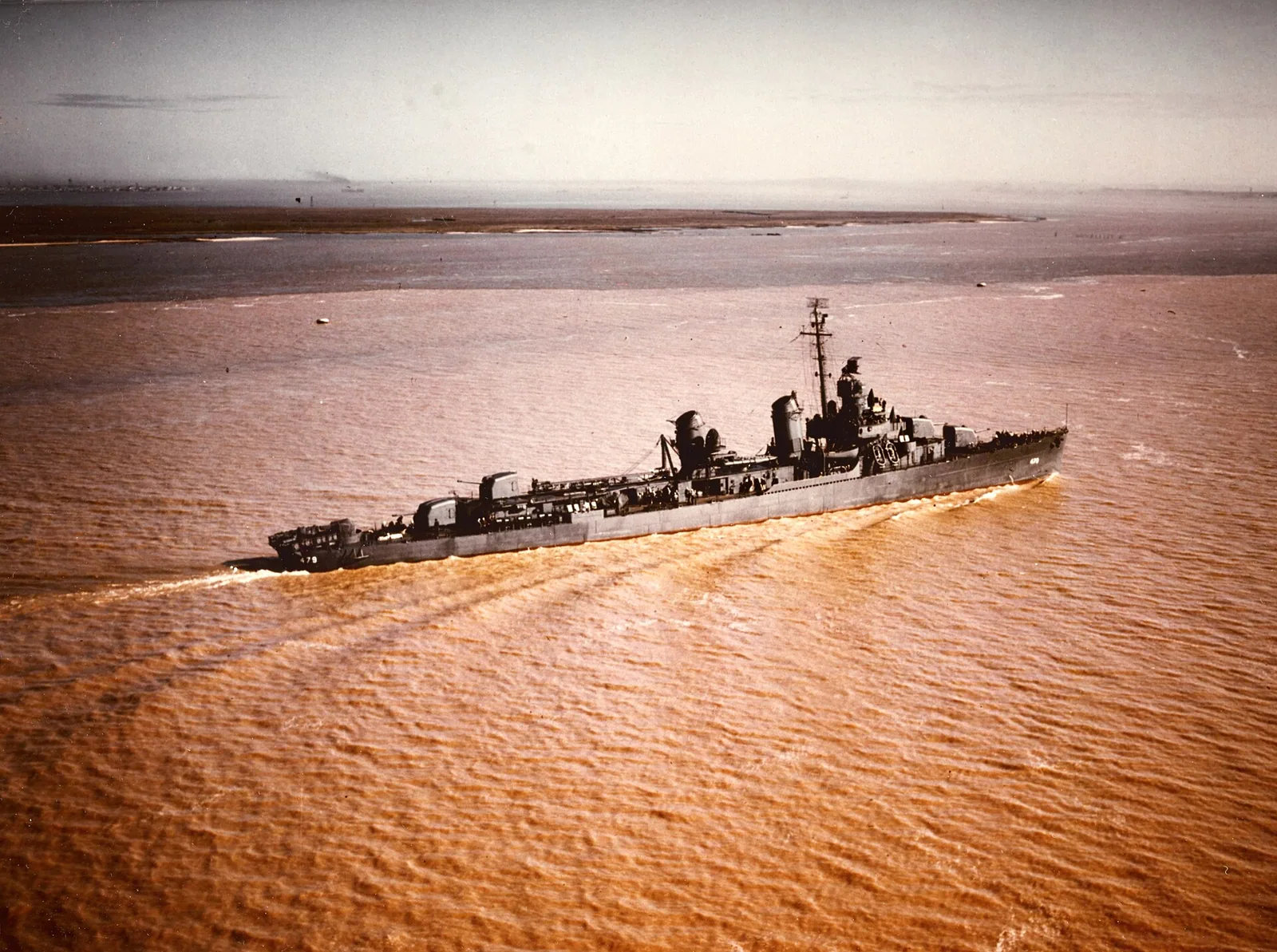
Service
- 1 February 1943 — 2 July 1946944 days of the war
- Name
- USS Stevens
- Pennant / hull number
- DD-479
- Namesake
- Thomas Holdup Stevens and Thomas H. Stevens, Jr.
- Builder
- Charleston Navy Yard
- Laid down
- 30 December 1941
- Launched
- 24 June 1942
- Commissioned
- 1 February 1943
- Decommissioned
- 2 July 1946
- Struck
- 27 November 1973
- Fate
- Sold for scrap, 27 November 1973 (1973)
- Status
- Scrapped
Specifications
- Displacement, standard
- 2,050 long tons (2,083 t)
- Length
- 114.6 m (376 ft)
- Beam
- 11.89 m (39 ft)
- Draught
- 5.18 m (17 ft)
- Speed
- 35 knots (64.8 km/h, 40.3 mph)
- Range
- 6,500 nmi (12,038 km)
- Complement
- 336
- Main gun
- 127 mm (5 in)
Born in Charleston, S.C., on 22 February 1795, Thomas Holdup was orphaned at an early age and was adopted by General Daniel Stevens. On 8 February 1809, he was appointed midshipman on board Hornet. From then until 1812, he served successively in Consti tution, President, and John Adams. Late in 1812, he was assigned to duty with Commodore Chauncey and distinguished himself in the attack on Black Rock on November 28th. Commodore Chauncey appointed him acting lieutenant in January 1813 and his permanent commission in that rank, to date from 24 July, was confirmed by the Senate on 3 August. On 10 September, he again distinguished himself as captain of the sloop, Trippe, during the Battle of Lake Erie. In 1815, an Act of the Legislature of South Carolina enabled him to add General Stevens' surname to his own. Following the War of 1812, Thomas Holdup Stevens held many posts, both ashore and afloat, including tours of duty at the Norfolk and Washington Navy yards. He was promoted to master commandant on 3 March 1825 and, in 1829, he embarked on a two-year tour as commanding officer of Ontario, serving in the Mediterranean Sea. In 1832, he was assigned to the Navy Yard at Pensacola and in 1836 he was appointed captain, to date from 27 January 1836. After waiting two years for orders, he was appointed to command of the Washington Navy Yard on 29 February 1840. He served in that capacity until his death there early on the morning of 21 January 1841.
Thomas Holdup Stevens, Jr., the son of Thomas Holdup Stevens (above) was born in Middletown, Conn., on 27 May 1819. He was appointed acting midshipman on 14 December 1836 and, after two years at sea in Independence, was warranted midshipman. After three months leave, from April to June 1840, he served at the Depot of Charts and Instruments. Following a tour at the Washington Navy Yard and coast survey duty at New York, he attended the Naval School at Philadelphia, stood his examination on 2 June 1842, and was warranted a passed midshipman on 2 July. Between 1842 and 1855, Stevens served at various posts ashore, among which were two tours on coast survey duty, one tour as acting master of Michi gan during her construction and 30 months as storekeeper in Honolulu, Hawaii. In September 1855, Lt. Stevens was dropped from the Navy under an Act of 28 February 1855.
On 29 January 1858, he was recommissioned a lieutenant. From then until the outbreak of the Civil War, Lt. Stevens served with the Home Squadron, principally in Roanoke, Colorado, and Michigan. On 4 September 1861, he assumed command of Ottawa. In November, he fought at Port Royal and helped capture Forts Beauregard and Walker. Between New Year's Day and 4 March 1862, he blockaded the coast of Florida and helped to capture Fort Clinch, and the towns of Fernandina and St. Mary's. He also commanded the first expedition up the St. John's River in March and April.
Continue to the full service history About 2,845 words
From the Dictionary of American Naval Fighting Ships, compiled by the Naval History and Heritage Command (Stevens II (DD-479)). A work of the United States Government, in the public domain.
Armament and machinery
Armament and machinery
- Propulsion
- 60,000 shp (45 MW); 2 propellers
- Armament
- 1942:
- 4 × 5 in/38 cal. guns (4 × 1)
- 2 × Bofors 40 mm AA guns (1 × 2)
- 8 × Oerlikon 20 mm AA guns (8 × 1)
- 5 × 21 in torpedo tubes (1 × 5)
- 6 × depth charge projectors
- 2 × depth charge tracks
- 1944:
- 5 × 5 in/38 cal. guns (5 × 1)
- 6 × Bofors 40 mm AA guns (3 × 2)
- 11 × Oerlikon 20 mm AA guns (11 × 1)
- 10 × 21 in torpedo tubes (2 × 5)
- 6 × depth charge projectors
- 2 × depth charge tracks
- Aircraft
- 1, one catapult (removed 1943)
Sister ships
- USS Abbot (DD-629)
- USS Abner Read (DD-526)
- USS Albert W. Grant
- USS Ammen (DD-527)
- USS Anthony (DD-515)
- USS Aulick (DD-569)
- USS Bache (DD-470)
- USS Beale (DD-471)
- USS Bearss
- USS Bell (DD-587)
- USS Benham (DD-796)
- USS Bennett
- USS Bennion
- USS Black
- USS Boyd
- USS Bradford
- USS Braine
- USS Brown (DD-546)
- USS Brownson (DD-518)
- USS Bryant
- USS Bullard
- USS Burns (DD-588)
- USS Bush (DD-529)
- USS Callaghan (DD-792)
Sources
- Facts harvested from USS Stevens (DD-479) on Wikipedia. Figures only — no wording is taken from it.
- Service history reproduced verbatim from Stevens II (DD-479) , Dictionary of American Naval Fighting Ships — public domain, a work of the United States Government.
- Photograph: Unknown author — U.S. Navy photo 80-G-K-13835 — Public domain — Wikimedia Commons