HMS H28
Service
- as H2829 June 1918 — 18 August 19441,813 days of the war
- Name
- HMS H28
- Builder
- Vickers Limited, Barrow-in-Furness
- Laid down
- 18 March 1917
- Launched
- 12 March 1918
- Commissioned
- 29 June 1918
- Fate
- Scrapped, 18 August 1944 (1944)
- Status
- Scrapped
Specifications
- Displacement, surfaced
- 423 long tons (430 t)
- Displacement, submerged
- 510 long tons (518 t)
- Length
- 52.12 m (171 ft)
- Beam
- 4.57 m (15 ft)
- Speed
- 11.5 knots (21.3 km/h, 13.2 mph)
- Range
- 2,985 nmi (5,528 km)
- Complement
- 22
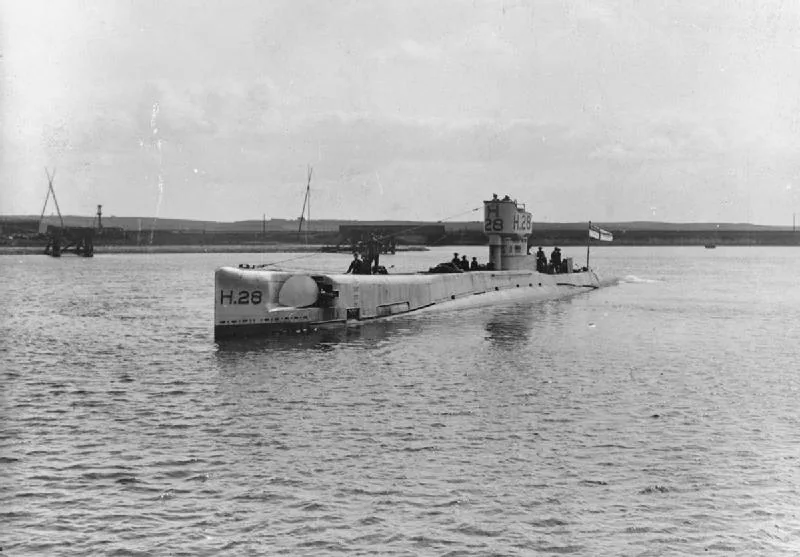
HMS H28 was a H-class submarine, operated by the Royal Navy. Her keel was laid at Vickers Limited, Barrow-in-Furness on 18 March 1917. Launched on 12 March 1918, she entered service on 29 June 1918.
23 ships of the class were built. The class followed the E and F-class destroyer and was succeeded by the I-class destroyer.
The boat displaced 423 long tons surfaced and 510 long tons submerged. She measured 52.1 m (171 ft) long with a beam of 4.6 m (15 ft). Her designed speed was 11.5 knots, and she carried a complement of 22.
Her main battery was four 533 mm (21 in) guns.
She was in commission for 1,813 days of the Second World War.
She was broken up for scrap on 18 August 1944.
Written from the harvested record. Every figure above is sourced; the wording is this site's own.
Armament and machinery
Armament and machinery
- Propulsion
- 1 × 480 hp diesel engine
- 2 × 620 hp electric motors
- Armament
- 4 × 21 in bow torpedo tubes
- 8 × 21-inch torpedoes
Sister ships
- German destroyer Hermes (ZG3)
- Greek destroyer Vasilefs Georgios
- Greek destroyer Vasilissa Olga
- HMCS Chaudière (H99)
- HMS H31
- HMS H32
- HMS H33
- HMS H34
- HMS H43
- HMS H44
- HMS H49
- HMS H50
- HMS H6
- HMS Hasty (H24)
- HMS Havock (H43)
- HMS Hereward (H93)
- HMS Hero (H99)
- HMS Hostile
- HMS Hotspur (H01)
- HMS Hunter (H35)
- HMS Hyperion (H97)
- HNLMS O 8
Sources
- Facts harvested from HMS H28 on Wikipedia. Figures only — no wording is taken from it.
- Photograph: Photographer not identified. — This photograph SP 2556 comes from the collections of the Imperial War Museums (collection no. 1900-01) — Public domain — Wikimedia Commons