Soviet frigate EK-1
Service
- as Charlottesville10 April 1944 — 14 January 1953510 days of the war
- as EK-112 July 1945 — 17 October 194952 days of the war
- as Matsu14 January 1953 — 31 March 1969
- Name
- EK-1
- Namesake
- City of Charlottesville, Virginia
- Laid down
- 12 May 1943
- Launched
- 30 July 1943
- Commissioned
- 10 April 1944
- Decommissioned
- 12 July 1945
- Fate
- Returned to United States, 12 July 1972
Final disposition unknown (1972) - Status
- Unknown
Specifications
- Displacement, standard
- 2,415 long tons (2,454 t)
- Length
- 92.35 m (303 ft)
- Beam
- 11.28 m (37 ft)
- Draught
- 3.96 m (13 ft)
- Speed
- 20 knots (37 km/h, 23 mph)
- Complement
- 190
- Main gun
- 76 mm (3 in)
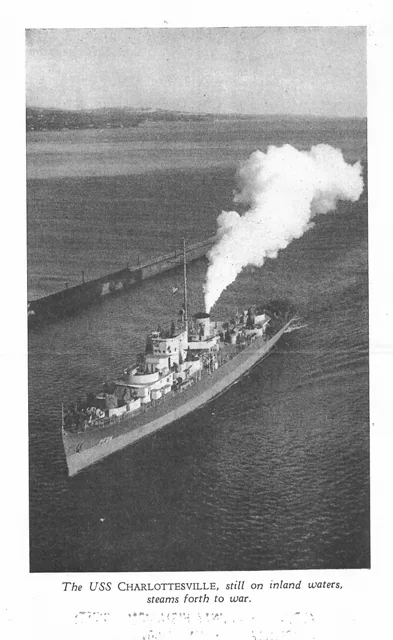
EK-1 was a Tacoma-class frigate in service with the United States Navy. The ship was named after City of Charlottesville. Her keel was laid on 12 May 1943. She entered service on 10 April 1944, having been launched on 30 July 1943.
Her class ran to 76 ships. The class followed the Asheville-class patrol frigate and was succeeded by the none.
She displaced 2,415 long tons. She measured 92.3 m (303 ft) long with a beam of 11.3 m (37 ft). Her designed speed was 20 knots, and she carried a complement of 190. Her main battery was of 76 mm (3.0 in) calibre.
She served with the United States Navy as Charlottesville until 14 January 1953. She then passed to the Soviet Navy, serving as EK-1 from 12 July 1945. She then passed to the Imperial Japanese Navy, serving as Matsu from 14 January 1953. She was in commission for 562 days of the Second World War. She was decommissioned on 12 July 1945.
She was transferred on 12 July 1972.
Written from the harvested record. Every figure above is sourced; the wording is this site's own.
Armament and machinery
Armament and machinery
- Propulsion
- 2 × 5500 shp turbines
- 3 boilers
- 2 shafts
- Armament
- 3 × 3"/50 dual purpose guns (3x1)
- 4 x 40 mm guns (2×2)
- 9 × 20 mm guns (9×1)
- 1 × Hedgehog anti-submarine mortar
- 8 × Y-gun depth charge projectors
- 2 × Depth charge tracks
Sister ships
- Soviet frigate EK-10
- Soviet frigate EK-11
- Soviet frigate EK-12
- Soviet frigate EK-13
- Soviet frigate EK-14
- Soviet frigate EK-15
- Soviet frigate EK-16
- Soviet frigate EK-17
- Soviet frigate EK-18
- Soviet frigate EK-19
- Soviet frigate EK-2
- Soviet frigate EK-20
- Soviet frigate EK-21
- Soviet frigate EK-22
- Soviet frigate EK-25
- Soviet frigate EK-26
- Soviet frigate EK-27
- Soviet frigate EK-28
- Soviet frigate EK-29
- Soviet frigate EK-3
- Soviet frigate EK-30
- Soviet frigate EK-4
- Soviet frigate EK-5
- Soviet frigate EK-6
Sources
- Facts harvested from Soviet frigate EK-1 on Wikipedia. Figures only — no wording is taken from it.
- Photograph: by Gertrude Dana Parlier and Others, Edited by W. Edwin Hemphill, published by the Albemarle Charlottesville Historical Society — "Pursuits of War: The People of Charlottesville and Albemarle County, Virginia, in the Second World War", by Gertrude Dana Parlier and Others, Edited by W. Edwin Hemphill, published by the Albemarle Charlottesville Historical Society, 1948 — Public domain — Wikimedia Commons