USS Baker (DE-190)
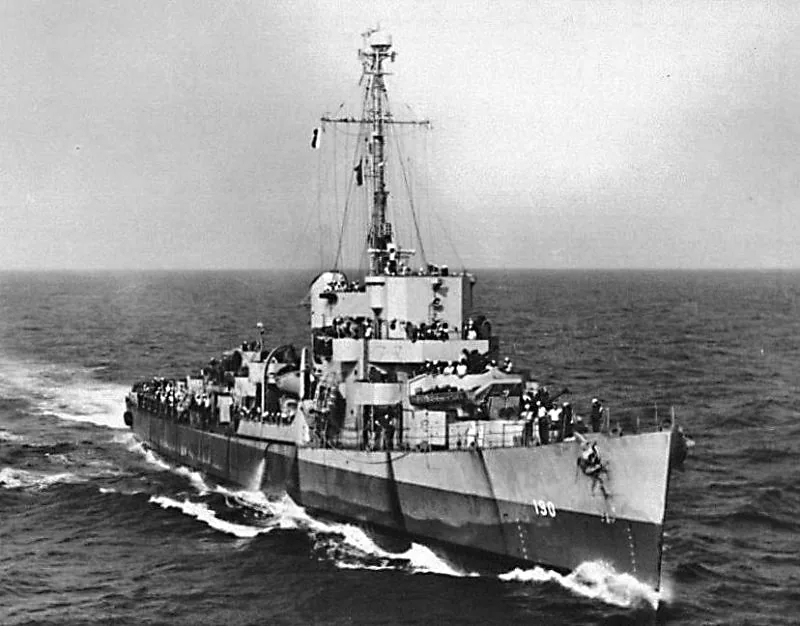
Service
- as USS Baker (DE-190)23 December 1943 — 4 March 1946619 days of the war
- as Malgache (F724)29 March 1952 — 1 January 1969
- Name
- USS Baker
- Pennant / hull number
- DE-190
- Namesake
- John Drayton Baker
- Builder
- Federal Shipbuilding and Drydock Company, Newark, New Jersey
- Laid down
- 9 September 1943
- Launched
- 28 November 1943
- Commissioned
- 23 December 1943
- Decommissioned
- 4 March 1946
- Struck
- 18 April 1952
- Fate
- Sunk as a target, 1970 (1970)
- Status
- Wreck
Specifications
- Displacement, standard
- 1,240 long tons (1,260 t)
- Length
- 93.27 m (306 ft) OA
- Beam
- 10.97 m (36 ft)
- Draught
- 3.35 m (11 ft)
- Speed
- 21 knots (38.9 km/h, 24.2 mph)
- Range
- 10,800 nmi (20,002 km)
- Complement
- 216
- Main gun
- 40 mm (1.6 in)
John Drayton Baker, born in Plainfield, N.J., on 31 May 1915, enlisted in the Naval Reserve as seaman 2d class on 21 January 1941 at Brooklyn, N.Y. After flight instruction at Miami and Jacksonville, he was appointed naval aviator on 26 August 1941 and received a reserve ensign’s commission on 18 September. After serving for two months in the Advanced Carrier Training Group, Atlantic, Baker joined Fighting Squadron (VF) 42 on 8 December 1941. Eight days later, the squadron, embarked in aircraft carrier Yorktown (CV-5), sailed for the Pacific.
On the morning of 7 May 1942, during the early phase of the Battle of the Coral Sea, Baker flew one of the Grumman F4F-3 Wildcat fighters that escorted the planes of Torpedo Squadron (VT) 5 in their attack on the Japanese carrier Shoho . He assisted in the destruction of three fighters from the enemy carrier’s combat air patrol and enabled VT-5 to escape unscathed after its successful attack and to return to Yorktown without loss.
Late that afternoon, planes from the Japanese carriers Zuikaku and Shokaku attempted a dusk attack on Task Force 17, but ran into inclement weather and the combat air patrols from Yorktown and Lexington (CV-2). One of the pilots who scrambled in the waning daylight to intercept the Japanese, Baker helped to break up the attack. Skillfully using his homing gear, Baker guided VF-42’s airborne pilots back to the ship.
Continue to the full service history About 1,715 words
From the Dictionary of American Naval Fighting Ships, compiled by the Naval History and Heritage Command (Baker (DE-190)). A work of the United States Government, in the public domain.
Armament and machinery
Armament and machinery
- Propulsion
- 4 × GM Mod. 16-278A diesel engines with electric drive, 6000 shp, 2 screws
- Armament
- 3 × single Mk.22 3-inch/50-caliber guns
- 1 × twin 40 mm Mk.1 AA gun
- 8 × 20 mm Mk.4 AA guns
- 3 × 21 inch (533 mm) torpedo tubes
- 1 × Hedgehog Mk.10 anti-submarine mortar (144 rounds)
- 8 × Mk.6 depth charge projectors
- 2 × Mk.9 depth charge tracks
Sister ships
- Brazilian destroyer Babitonga
- Brazilian destroyer Baependi
- Brazilian destroyer Bauru
- Brazilian destroyer Beberibe
- Brazilian destroyer Benevente
- Brazilian destroyer Bertioga
- Brazilian destroyer Bocaina
- Brazilian destroyer Bracui
- French frigate Algérien
- French frigate Hova
- French frigate Marocain
- French frigate Sénégalais
- French frigate Somali
- French frigate Tunisien
- USS Acree
- USS Alger
- USS Amick
- USS Atherton
- USS Bangust
- USS Baron
- USS Booth
- USS Bostwick
- USS Breeman
- USS Bright
Sources
- Facts harvested from USS Baker (DE-190) on Wikipedia. Figures only — no wording is taken from it.
- Service history reproduced verbatim from Baker (DE-190) , Dictionary of American Naval Fighting Ships — public domain, a work of the United States Government.
- Photograph: Joseph Uhelsky MoMM 3c, U.S. Navy — U.S. Navy photo [1] from Navsource.org — Public domain — Wikimedia Commons