USS Billfish (SS-286)
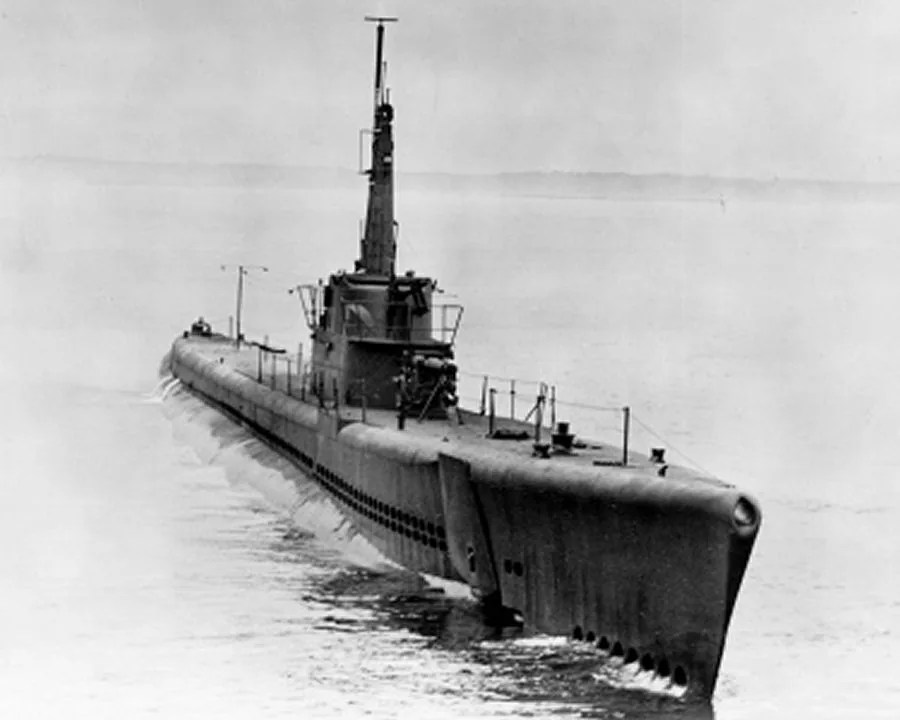
Service
- 20 April 1943 — 1 November 1946866 days of the war
- Name
- USS Billfish
- Pennant / hull number
- SS-286
- Builder
- Portsmouth Naval Shipyard, Kittery, Maine
- Laid down
- 23 July 1942
- Launched
- 12 November 1942
- Commissioned
- 20 April 1943
- Decommissioned
- 1 November 1946
- Struck
- 1 April 1968
- Fate
- Sold for scrap, 17 March 1971 (1971)
- Status
- Scrapped
Specifications
- Displacement, surfaced
- 1,526 long tons (1,550 t)
- Displacement, submerged
- 2,414 long tons (2,453 t)
- Length
- 94.79 m (311 ft)
- Beam
- 8.23 m (27 ft)
- Draught
- 4.88 m (16 ft)
- Speed
- 20.3 knots (37.5 km/h, 23.3 mph)
- Range
- 11,000 nmi (20,372 km)
- Complement
- 10
- Main gun
- 102 mm (4 in)
Any fish of many species (such as the sauty, gar, spearfish, and sailfish) which have long, narrow jaws that resemble a bird's bill.
The first Billfish (SS-286) was laid down by the Portsmouth (N.H.) Navy Yard on 23 July 1942; launched on 12 November 1942; sponsored by Mrs. Zelda L. Parks; and commissioned on 20 April 1943, Lt. Comdr. Frederic C. Lucas, Jr., in command.
Following shakedown training off the east coast, the new submarine sailed via the Panama Canal for the southwest Pacific. She reached Brisbane, Australia, on 1 August but departed that port on the 12th for her first war patrol that took her, via Darwin, to the waters of the Netherlands East Indies. Shortly after midnight on 29 August, she chased an unescorted tanker near Balobac Strait but that target's zigzag course enabled her to escape into the darkness before the submarine could reach a suitable attack position. That evening, Billfish encountered another ship, which she took to be the large tanker that had eluded her earlier, and fired a spread of torpedoes at this target. The "fish" passed under the stranger that then turned and revealed herself to be a small combatant rather than the expected deep-draft vessel for which the torpedoes had been set.
Continue to the full service history About 1,843 words
From the Dictionary of American Naval Fighting Ships, compiled by the Naval History and Heritage Command (Billfish I (SS-286)). A work of the United States Government, in the public domain.
Armament and machinery
Armament and machinery
- Propulsion
- 4 × General Motors Model 16-278A V16 diesel engines driving electrical generators
- 2 × 126-cell Sargo batteries
- 4 × high-speed General Electric electric motors with reduction gears
- 2 × propellers
- 5,400 shp (4.0 MW) surfaced
- 2,740 shp (2.0 MW) submerged
- Armament
- 10 × 21 inch (533 mm) torpedo tubes (six forward, four aft; 24 torpedoes)
- one 4 in/50 caliber deck gun
- one 40 mm Bofors antiaircraft cannon
- two .50 cal (12.7 mm) machineguns
Sister ships
- ARA Santa Fe (S-21)
- USS Apogon
- USS Archerfish (SS-311)
- USS Aspro (SS-309)
- USS Atule
- USS Balao
- USS Bang
- USS Barbel (SS-316)
- USS Barbero
- USS Batfish (SS-310)
- USS Baya
- USS Becuna
- USS Bergall (SS-320)
- USS Besugo
- USS Blackfin
- USS Blanquillo (SS-323)
- USS Blenny
- USS Blower
- USS Blueback (SS-326)
- USS Boarfish
- USS Bowfin
- USS Brill
- USS Bugara
- USS Bullhead
Sources
- Facts harvested from USS Billfish (SS-286) on Wikipedia. Figures only — no wording is taken from it.
- Service history reproduced verbatim from Billfish I (SS-286) , Dictionary of American Naval Fighting Ships — public domain, a work of the United States Government.
- Photograph: Unknown author — Public domain — Wikimedia Commons