USS De Haven (DD-469)
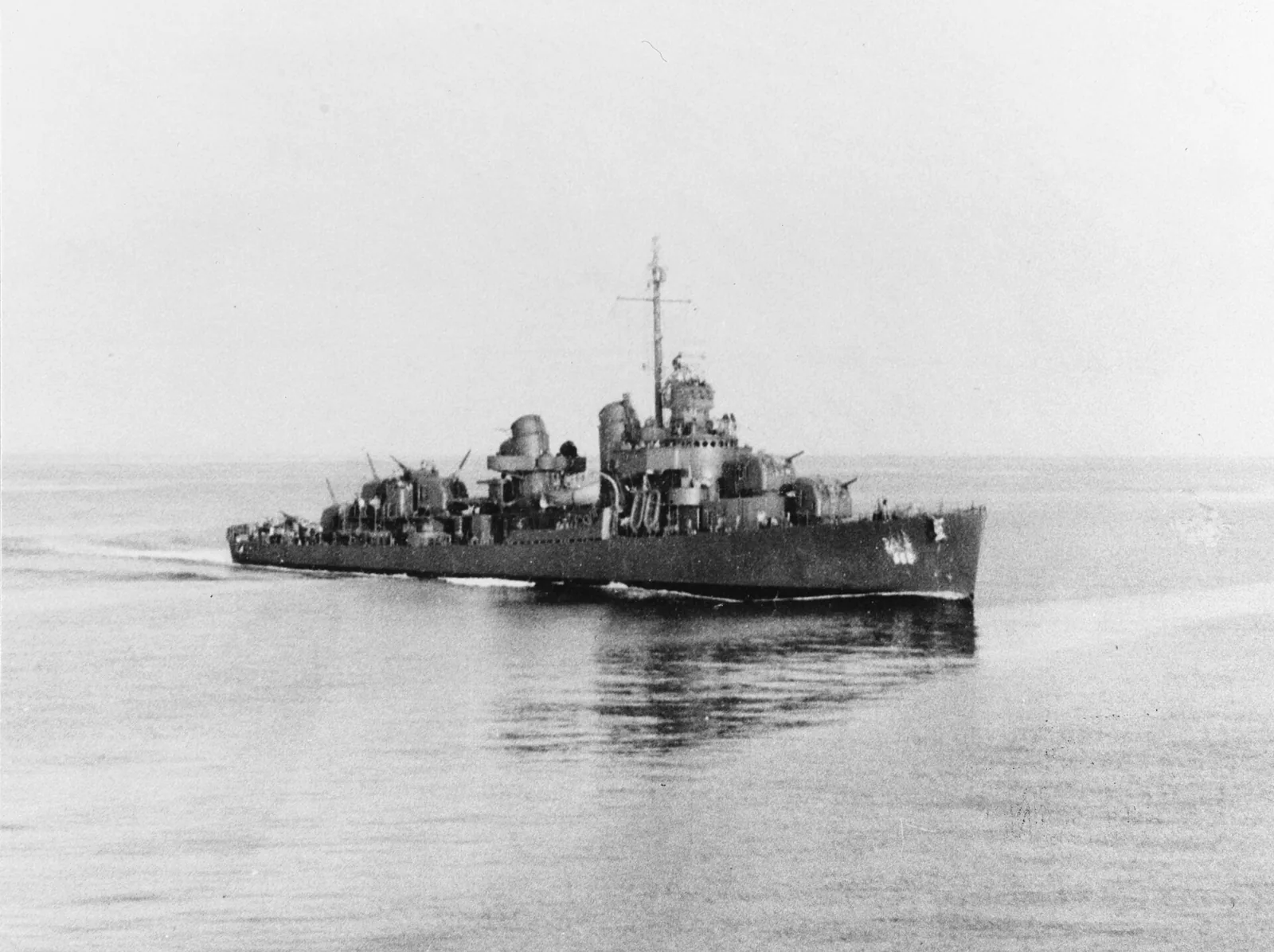
Service
- as De Haven21 September 1942 — 1 February 1943133 days of the war
- Name
- USS De Haven
- Pennant / hull number
- DD-469
- Namesake
- Edwin J. De Haven
- Builder
- Bath Iron Works
- Laid down
- 27 September 1941
- Launched
- 28 June 1942
- Commissioned
- 21 September 1942
- Fate
- Sunk by Japanese aircraft off Savo Island on 1 February 1943
By aircraft (1943) - Status
- Wreck
Specifications
- Displacement, standard
- 2,050 long tons (2,083 t)
- Length
- 114.6 m (376 ft)
- Beam
- 11.89 m (39 ft)
- Draught
- 5.18 m (17 ft)
- Speed
- 38 knots (70.4 km/h, 43.7 mph)
- Range
- 6,500 nmi (12,038 km)
- Complement
- 329
- Main gun
- 127 mm (5 in)
Edwin Jess De Haven, born in 1819 in Pennsylvania was appointed Acting Midshipman at the age of 10 and Passed Midshipman 5 years later. He served in Vin cennes, flagship of the Wilkes Exploring Expedition in its historic cruise of 1838 to 1842 to the Antarctic and among the Pacific Islands. De Haven served in the Mexican War, assisting in the capture of the Mexican schooner Creole. In command of the Grinnell Rescue Expedition in 1850, he led the search for Sir John Franklin lost in the Arctic. Only traces of the party were found, but De Haven discovered and named Grinnell Land, and was commended for the valuable scientific data he collected concerning the winds and currents of the ocean. He served in the Coast Survey Service until placed on the retired list in February 1862. He died at Philadelphia, Pa., 1 May 1865.
I De Haven (DD-469) was launched 28 June 1942 by Bath Iron Works Corp., Bath, Maine; sponsored by Miss H. N. De Haven, granddaughter of Lieutenant De Haven; and commissioned 21 September 1942, Commander C. E. Tolman in command. De Haven sailed from Norfolk and reached Tongatabu, Tonga Islands, 28 November 1942 to escort a convoy of troopships to Guadalcanal to relieve the Marines who had been there since the invasion landings in August. De Haven screened the transports off Guadalcanal from 7 to 14 December, then sailed out of Espiritu Santo and Noumea in the continuing Solomon Islands operations. She patrolled in the waters of the Southern Solomons to stop the "Tokyo Express," the nightly effort to supply the beleaguered Japanese troops still fighting on the invaded islands, and took part in two bombardments of Kolombangara Island during January 1943.
On 1 February 1943 De Haven screened six LCT's and a seaplane tender establishing a beachhead at Marovo on Guadalcanal. While escorting two of the landing craft back to their base in the afternoon, De Haven was warned of an impending air attack. She sighted nine unidentified planes and opened fire as six swung sharply toward her. She splashed three of these planes, but not before all six had dropped their bombs. De Haven was hit by three bombs and further damaged by a near miss. One bomb hit the superstructure squarely, killing the commanding officer at once. All way was lost after the first hit and the ship began to settle rapidly, sinking about 2 miles east of Savo Island. One of the LCT's she had escorted rescued the survivors. She lost 167 killed and 38 wounded.
From the Dictionary of American Naval Fighting Ships, compiled by the Naval History and Heritage Command (De Haven I (DD-469)). A work of the United States Government, in the public domain.
Armament and machinery
Armament and machinery
- Propulsion
- 60000 shp
- geared turbines
- 2 propellers
- Armament
- 5 × single Mk 12 5 in (127 mm)/38 guns
- 5 × twin 40 mm (1.6 in) Bofors AA guns
- 7 × single 20 mm (0.8 in) Oerlikon AA guns
- 2 × quintuple 21 in (533 mm) torpedo tubes
- 6 × single depth charge throwers
- 2 × depth charge racks
Sister ships
- USS Abbot (DD-629)
- USS Abner Read (DD-526)
- USS Albert W. Grant
- USS Ammen (DD-527)
- USS Anthony (DD-515)
- USS Aulick (DD-569)
- USS Bache (DD-470)
- USS Beale (DD-471)
- USS Bearss
- USS Bell (DD-587)
- USS Benham (DD-796)
- USS Bennett
- USS Bennion
- USS Black
- USS Boyd
- USS Bradford
- USS Braine
- USS Brown (DD-546)
- USS Brownson (DD-518)
- USS Bryant
- USS Bullard
- USS Burns (DD-588)
- USS Bush (DD-529)
- USS Callaghan (DD-792)
Sources
- Facts harvested from USS De Haven (DD-469) on Wikipedia. Figures only — no wording is taken from it.
- Service history reproduced verbatim from De Haven I (DD-469) , Dictionary of American Naval Fighting Ships — public domain, a work of the United States Government.
- Photograph: US Navy — NARA image 80-G-284578 ; Official U.S. Navy photo 80-G-284578 from the U.S. Navy Naval History and Heritage Command — Public domain — Wikimedia Commons