USS Farquhar (DE-139)
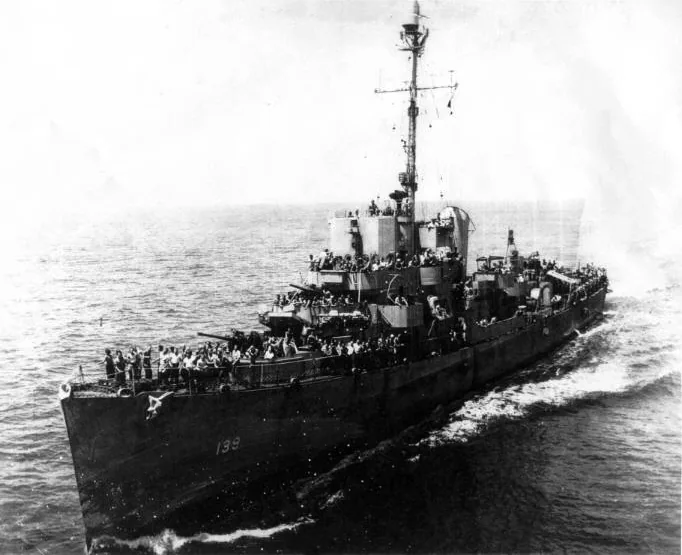
Service
- as USS Farquhar5 August 1943 — 14 June 1946759 days of the war
- Name
- USS Farquhar
- Pennant / hull number
- DE-139
- Namesake
- Norman von Heldreich Farquhar
- Builder
- Consolidated Steel Corporation, Orange, Texas
- Laid down
- 14 December 1942
- Launched
- 13 February 1943
- Commissioned
- 5 August 1943
- Decommissioned
- 14 June 1946
- Struck
- 1 October 1972
- Fate
- Scrapped 1974 (1974)
- Status
- Scrapped
Specifications
- Displacement, standard
- 1,253 long tons (1,273 t)
- Displacement, full load
- 1,590 long tons (1,616 t)
- Length
- 93.27 m (306 ft)
- Beam
- 11.15 m (36.6 ft)
- Draught
- 3.18 m (10.4 ft)
- Speed
- 21 knots (38.9 km/h, 24.2 mph)
- Range
- 9,100 nmi (16,853 km)
- Complement
- 209
- Main gun
- 76 mm (3 in)
Norman von Heldreich Farquhar, born 11 April 1840 in Pottsville, Pa., graduated from the Naval Academy in 1859. Serving on the African Station at the opening of the Civil War, he sailed a prize slaver home to the United States, and served actively during the war, at the close of which he was executive officer of Santiago de Cuba. His active career included many commands, one of which was Trenton in the Pacific. Farquhar was commended for his fine handling of his ship during the disastrous hurricane at Apia, Samoa, in 1889 in which she and a number of other American and foreign naval vessels were lost. He later commanded the navy yards at League Island and Norfolk, and climaxed his distinguished service as Commander of the North Atlantic Station. Rear Admiral Farquhar retired 11 April 1902, and died at Jamestown, R.I., 3 July 1907.
The second Farquhar (DE-139) was launched 13 February 1943 by Consolidated Steel Corp., Ltd., Orange, Tex.; sponsored by Miss S. B. Carton, great-granddaughter of Admiral Farquhar; and commissioned 5 August 1943, Lieutenant Commander L. E. Rosenberg, USNR, in command.
Farquhar arrived at Norfolk, Va., 3 October 1943, and next day sailed on the first of three convoy escort voyages to Casablanca. She returned from each to New York for replenishment and repairs before joining a new convoy at Norfolk. On 3 April 1944, she sailed for Casablanca once more, this time in a hunter-killer group formed around Core (CVE-13). The group guarded the passage of a convoy, hunting submarines in the general area through which the convoy sailed.
Returning to New York 9 June 1944, Farquhar trained in antisubmarine warfare at Bermuda with the Wake Island (CVE-65) hunter-killer group, then sailed on the Casablanca convoy route once more. Homeward bound, on 2 August she went to the rescue of Fiske (DE-143) who had been torpedoed while away from the group searching for a previously sighted target, and arrived in time to rescue 186 survivors. These she took into Argentia for medical attention and clothing, then on to Boston, where they were landed. In September, she began patrols and convoy escort duty in the South Atlantic with the Mission Bay (CVE-59) hunter-killer group. She voyaged from Bahia, Brazil, to Dakar, French West Africa, and Capetown, Union of South Africa, and during a submarine hunt off the Cape Verde Islands on 30 September, made a contact against which she and her sisters operated 6 days, finally sighting a large oil slick, but no other evidence of a sunken submarine.
During training exercises off Cuba in December 1944 Farquar rescued 10 aviators from liferafts after their patrol bomber splashed, and while in Florida waters as plane guard for carriers conducting operations to qualify aviators, rescued a downed pilot 3 February 1945. She returned to Guantanamo Bay for training with the Mission Bay group later in February, and with it arrived at Argentia 3 April for hunter-killer operations in the North Atlantic. While bound for New York 6 May, she made a sonar contact, very close, early in the morning. Just 5 minutes after it was reported, she dropped 13 depth charges, set shallow, and both she and her sisters could make no further contact with the target. Post-war evaluation revealed that she had been the last American ship to sink a submarine in the Atlantic in World War II, sending U-881 to the bottom.
Farquhar prepared at Boston and Guantanamo Bay for duty in the Pacific, and arrived at Pearl Harbor 8 August 1945. Escort duty took her to Eniwetok 5 September, and on 10 September she sailed in company with Hyman (DD-732) to receive the surrender of Ponape. There she served as station ship for several months, then sailed from Kwajalein early in January 1946 for the east coast. She was decommissioned and placed in reserve at Green Cove Springs, Fla., 14 June 1946.
From the Dictionary of American Naval Fighting Ships, compiled by the Naval History and Heritage Command (Farquhar II (DE-139)). A work of the United States Government, in the public domain.
Armament and machinery
Armament and machinery
- Propulsion
- 4 FM diesel engines
- 4 diesel-generators
- 6,000 shp (4.5 MW)
- 2 screws
- Armament
- 3 × single 3 in (76 mm)/50 guns
- 1 × twin 40 mm AA guns
- 8 × single 20 mm AA guns
- 1 × triple 21 in (533 mm) torpedo tubes
- 8 × depth charge projectors
- 1 × depth charge projector (hedgehog)
- 2 × depth charge tracks
Sister ships
- USS Blair
- USS Brister
- USS Brough
- USS Calcaterra
- USS Camp
- USS Chambers
- USS Chatelain
- USS Cockrill
- USS Dale W. Peterson
- USS Daniel
- USS Douglas L. Howard
- USS Falgout
- USS Fessenden
- USS Fiske (DE-143)
- USS Flaherty
- USS Forster
- USS Frederick C. Davis
- USS Frost
- USS Hammann (DE-131)
- USS Harveson
- USS Haverfield
- USS Herbert C. Jones
- USS Hill
- USS Holder (DE-401)
Sources
- Facts harvested from USS Farquhar (DE-139) on Wikipedia. Figures only — no wording is taken from it.
- Service history reproduced verbatim from Farquhar II (DE-139) , Dictionary of American Naval Fighting Ships — public domain, a work of the United States Government.
- Photograph: U.S. Navy — U.S. Navy photo [1] from Navsource.org — Public domain — Wikimedia Commons