USS Hammann (DE-131)
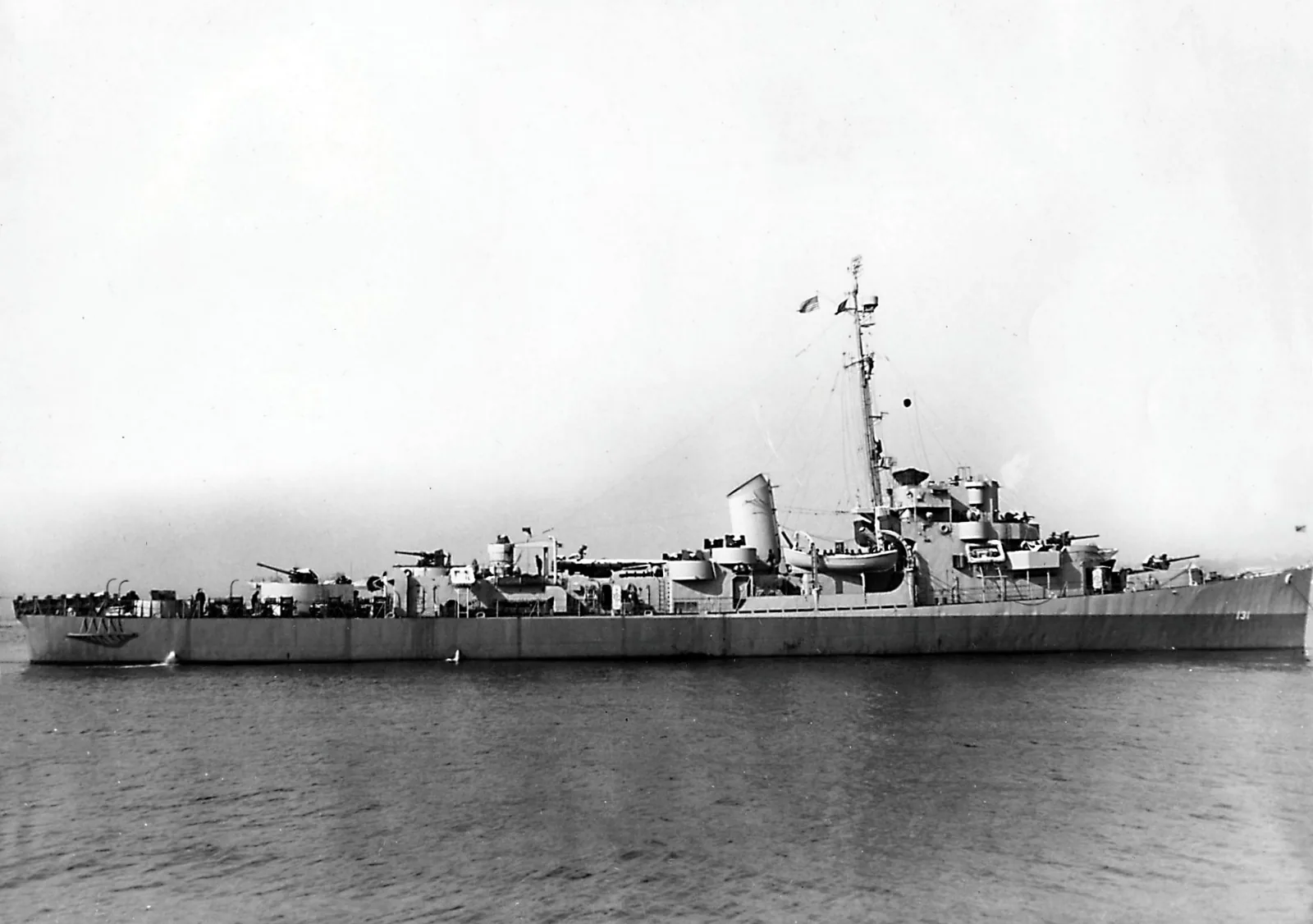
Service
- 17 May 1943 — 24 October 1945839 days of the war
- Name
- USS Hammann
- Pennant / hull number
- DE-131
- Namesake
- Charles Hazeltine Hammann
- Builder
- Consolidated Steel Corporation, Orange, Texas
- Laid down
- 10 July 1942
- Launched
- 13 December 1942
- Commissioned
- 17 May 1943
- Decommissioned
- 24 October 1945
- Struck
- 1 October 1972
- Fate
- Sold 18 January 1974, scrapped (1974)
- Status
- Scrapped
Specifications
- Displacement, standard
- 1,253 long tons (1,273 t)
- Displacement, full load
- 1,590 long tons (1,616 t)
- Length
- 93.27 m (306 ft)
- Beam
- 11.15 m (36.6 ft)
- Draught
- 3.18 m (10.4 ft)
- Speed
- 21 knots (38.9 km/h, 24.2 mph)
- Range
- 9,100 nmi (16,853 km)
- Complement
- 209
- Main gun
- 76 mm (3 in)
Charles Hazeltine Hammann was born in Baltimore, Md., 16 March 1892, and was appointed to the provisional rank of Ensign, Naval Reserve, Flying Corps, 14 October 1918, while serving overseas. Ens. Hammann was awarded the Medal of Honor, when, as a pilot of a seaplane 21 August 1918, off the coast of Italy, he dived down and landed next to a downed fellowpllot, brought him aboard, and although his plane was not designed for the double load, brought him to safety amid constant danger of attack by Austrian planes. Hazeltine was killed while on active duty at Langley Field, Va., 14 June 1919.
The second Hammann (DE-131), formerly Langley, was named 1 August 1942 after the first Hammann; launched by Consolidated Steel Corp., Orange, Tex., 13 December 1942; sponsored by Mrs. Lilliam Rohde; and commissioned 17 May 1943, Lt. Comdr. B. D. DeKay in command.
Hammann departed 5 June for Bermuda and shakedown operations, returning to Philadelphia 6 July. From there the ahip sailed to Norfolk and on 13 July began the first of her many transatlantic convoy voyages. Her first four passages to Casablanca, Morocco, covered the period 13 July 1943 to 10 March 1944. During this period she screened convoys in company with escort carriers. She made several attacks on submarine contacts, but recorded no kills.
Between 28 March 1944 and 29 November 1944 the busy ship made no less than six more voyages successfully convoying to and from Europe, stopping at ports in Northern Ireland. Starting 4 January the ship changed her convoy destination to Liverpool and made four more voyages protecting the vital flow of supplies for the end of the European war. During one passage, 2 March 1945, Hammann was called upon to aid one of the ships in the convoy, Lone Jack, after a torpedo attack. The destroyer escort picked up 70 survivors and sent salvage parties aboard the stricken ship to keep her afloat.
Her duties in the Atlantic completed, Hammann departed New York 7 July 1945 for training operations in the Guantanamo Bay, Cuba, area, departing 24 July for California. She arrived San Diego via the Panama Canal 4 August, and from there proceeded to Pearl Harbor. As the Pacific war was then over, the destroyer escort took on passengers at Pearl Harbor for California, and after discharging them sailed through the Canal again to Charleston, S.C., arriving 25 September. She decommissioned at Green Cove Springs, Fla., 24 October 1945, and was placed in reserve. She was later moved to the Texas Group at Orange, where she remains out of commission in reserve.
From the Dictionary of American Naval Fighting Ships, compiled by the Naval History and Heritage Command (Hammann II (DE-131)). A work of the United States Government, in the public domain.
Armament and machinery
Armament and machinery
- Propulsion
- 4 FM diesel engines
- 4 diesel-generators
- 6,000 shp (4.5 MW)
- 2 screws
- Armament
- 3 × single 3 in (76 mm)/50 guns
- 1 × twin 40 mm AA guns
- 8 × single 20 mm AA guns
- 1 × triple 21 in (533 mm) torpedo tubes
- 8 × depth charge projectors
- 1 × depth charge projector (hedgehog)
- 2 × depth charge tracks
Sister ships
- USS Blair
- USS Brister
- USS Brough
- USS Calcaterra
- USS Camp
- USS Chambers
- USS Chatelain
- USS Cockrill
- USS Dale W. Peterson
- USS Daniel
- USS Douglas L. Howard
- USS Falgout
- USS Farquhar (DE-139)
- USS Fessenden
- USS Fiske (DE-143)
- USS Flaherty
- USS Forster
- USS Frederick C. Davis
- USS Frost
- USS Harveson
- USS Haverfield
- USS Herbert C. Jones
- USS Hill
- USS Holder (DE-401)
Sources
- Facts harvested from USS Hammann (DE-131) on Wikipedia. Figures only — no wording is taken from it.
- Service history reproduced verbatim from Hammann II (DE-131) , Dictionary of American Naval Fighting Ships — public domain, a work of the United States Government.
- Photograph: U.S. Navy — U.S. Navy Bureau of Ships photo 19-N-64204 from Navsource.org — Public domain — Wikimedia Commons