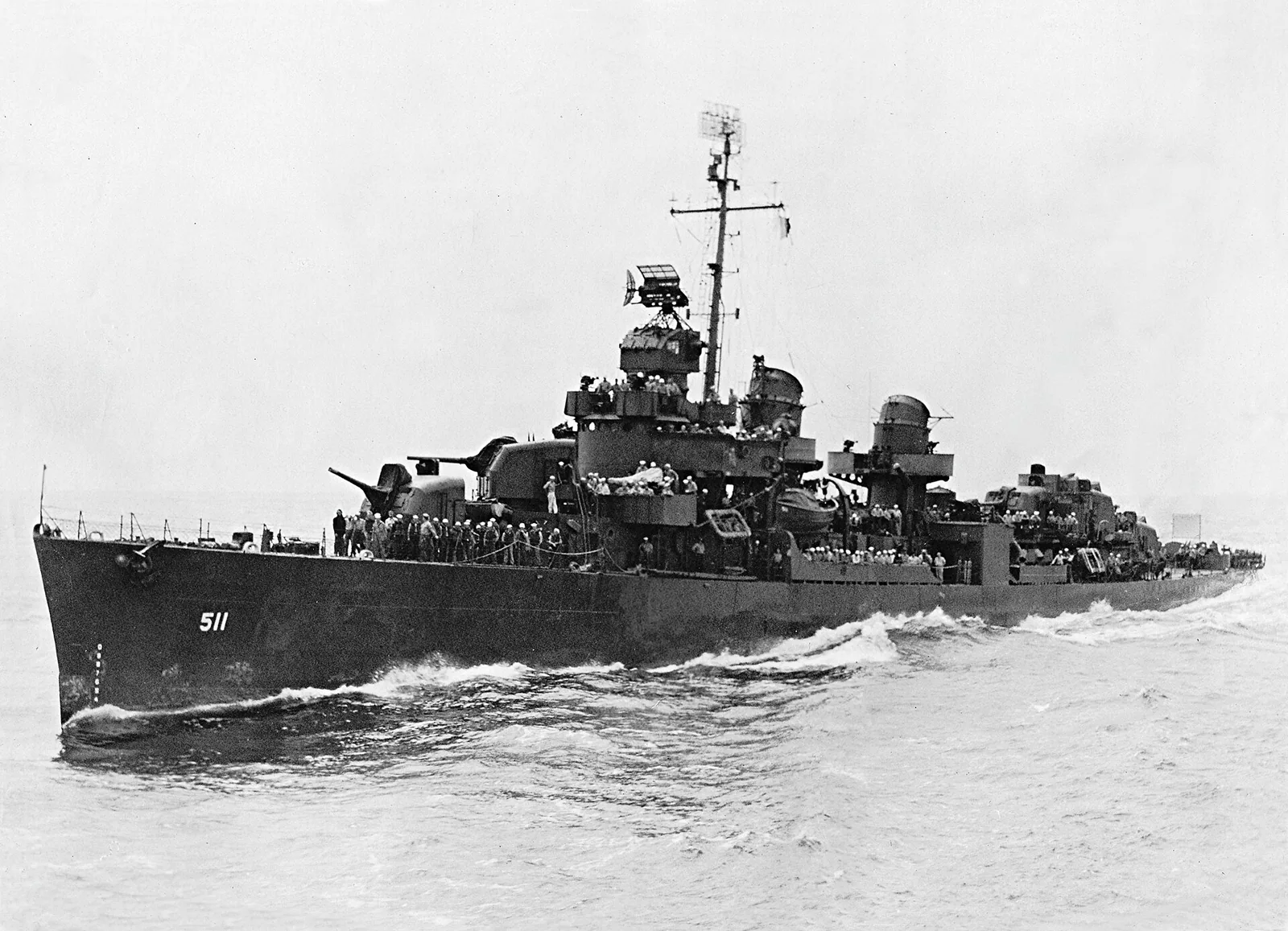
USS Foote (DD-511)
Service
- 22 December 1942 — 18 April 1946985 days of the war
- Name
- USS Foote
- Pennant / hull number
- DD-511
- Namesake
- Andrew Hull Foote
- Builder
- Bath Iron Works
- Laid down
- 14 April 1942
- Launched
- 11 October 1942
- Commissioned
- 22 December 1942
- Decommissioned
- 18 April 1946
- Struck
- 1 October 1972
- Fate
- Sold for scrap, 2 January 1974 (1974)
- Status
- Scrapped
Specifications
- Displacement, standard
- 2,050 long tons (2,083 t)
- Length
- 114.6 m (376 ft)
- Beam
- 11.89 m (39 ft)
- Draught
- 5.18 m (17 ft)
- Speed
- 35 knots (64.8 km/h, 40.3 mph)
- Range
- 6,500 nmi (12,038 km)
- Complement
- 336
- Main gun
- 127 mm (5 in)
Andrew Hull Foote, born 12 September 1806 at New Haven, Conn., entered the Navy 4 December 1822 as a midshipman. Commanding Portsmouth in the East India Squadron on 20 and 21 November 1856, Foote led a landing party which seized the barrier forts at Canton, China, in reprisal for attacks on American ships. From 30 August 1861 to 9 May 1862, Foote commanded the Naval Forces on Western Rivers with distinction, organizing and leading the gunboat flotilla in the capture of Forts Henry and Donelson and Island No. 10. Wounded in action at Fort Donelson, Foote was commissioned Rear Admiral 16 July 1862, and was on his way to take command of the South Atlantic Blockading Squadron when he died at New York 26 June 1863.
The third Foote (DD-511) was launched 11 October 1942 by Bath Iron Works, Bath, Maine; sponsored by Mrs. J. C. Aspinwall, granddaughter of Admiral Foote; and commissioned 22 December 1942, Commander Bernard L. Austin in command.
After escorting a convoy to Casablanca between 1 April 1943 and 9 May, Foote prepared for Pacific duty, and on 28 June arrived at Noumea, New Caledonia, to join Destroyer Squadron 23. Through the next 3 months, she escorted convoys from Noumea to Guadalcanal, Efate, Espiritu Santo, Vella Lavella, and Rendova. From 27 to 29 September, she hunted Japanese barges evacuating troops from Kolombangara, and on the last night, attacked such a group, probably sinking two. While McCalla (DD-488) was working to correct steering trouble that night, Foote drove off a lone Japanese aircraft, then stood by McCalla and Pat terson (DD-392) after the two collided, until a tug arrived on the scene.
Continue to the full service history About 745 words
From the Dictionary of American Naval Fighting Ships, compiled by the Naval History and Heritage Command (Foote III (DD-511)). A work of the United States Government, in the public domain.
Armament and machinery
Armament and machinery
- Propulsion
- 60,000 shp (45 MW); 2 propellers
- Armament
- 5 × single Mk 12 5 in (127 mm)/38 guns
- 5 × twin 40 mm (1.6 in) Bofors AA guns
- 7 × single 20 mm (0.8 in) Oerlikon AA guns
- 2 × quintuple 21 in (533 mm) torpedo tubes
- 6 × single depth charge throwers
- 2 × depth charge racks
Sister ships
- USS Abbot (DD-629)
- USS Abner Read (DD-526)
- USS Albert W. Grant
- USS Ammen (DD-527)
- USS Anthony (DD-515)
- USS Aulick (DD-569)
- USS Bache (DD-470)
- USS Beale (DD-471)
- USS Bearss
- USS Bell (DD-587)
- USS Benham (DD-796)
- USS Bennett
- USS Bennion
- USS Black
- USS Boyd
- USS Bradford
- USS Braine
- USS Brown (DD-546)
- USS Brownson (DD-518)
- USS Bryant
- USS Bullard
- USS Burns (DD-588)
- USS Bush (DD-529)
- USS Callaghan (DD-792)
Sources
- Facts harvested from USS Foote (DD-511) on Wikipedia. Figures only — no wording is taken from it.
- Service history reproduced verbatim from Foote III (DD-511) , Dictionary of American Naval Fighting Ships — public domain, a work of the United States Government.
- Photograph: U.S. Navy — U.S. Navy via James Edward Moran S1/c (I came upon this photo through my grandfather, James Edward Moran S1/c, who served aboard the ship during WWII.) — Public domain — Wikimedia Commons