USS Heywood L. Edwards
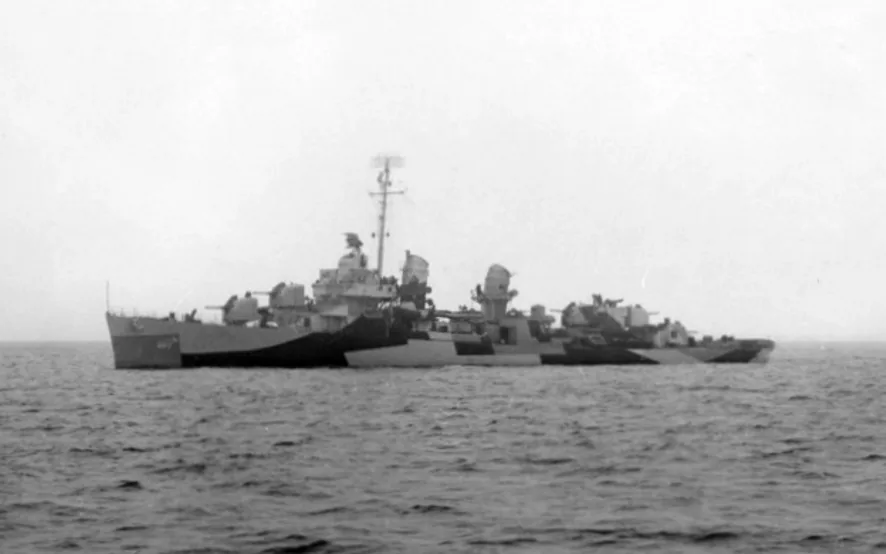
Service
- as Heywood L. Edwards26 January 1944 — 1 July 1946585 days of the war
- as Ariake10 March 1959 — 1974
- Name
- USS Heywood L. Edwards
- Pennant / hull number
- DD-663
- Namesake
- Heywood L. Edwards
- Builder
- Boston Navy Yard
- Laid down
- 4 July 1943
- Launched
- 6 October 1943
- Commissioned
- 26 January 1944
- Decommissioned
- 1 July 1946
- Struck
- 18 March 1974
- Fate
- Scrapped, 1976 (1976)
- Status
- Scrapped
Specifications
- Displacement, standard
- 2,050 long tons (2,083 t)
- Length
- 114.6 m (376 ft)
- Beam
- 11.89 m (39 ft)
- Draught
- 3.96 m (13 ft)
- Speed
- 35 knots (64.8 km/h, 40.3 mph)
- Range
- 6,500 nmi (12,038 km)
- Complement
- 319
- Main gun
- 127 mm (5 in)
Heywood Lane Edwards was born in San Saba, Tex., 9 November 1905 and graduated from the Naval Academy in 1926. After serving in battleship Florida, cruiser Reno and other ships, he underwent submarine instruction in 1931, served in several submarines, and was assigned to cruiser Detroit in 1935. Lt. Comdr. Edwards assumed command of destroyer Reuben James 6 April 1940. His ship became the first in the U.S. Navy to be sunk in the Battle of the Atlantic when it was torpedoed by a German submarine while on convoy duty west of Iceland 30-31 October 1941. Lt. Comdr. Edwards and 99 of his crew perished with the ship.
Heywood L. Edwards (DD-663) was launched by Boston Navy Yard 6 October 1943; sponsored by Mrs. Louise S. Edwards, mother of the namesake; and commissioned 26 January 1944, Comdr. J. W. Boulware in command.
Heywood L. Edwards conducted her shakedown beginning 25 February off Bermuda and after gunnery exercises off the Maine coast departed to join the Pacific Fleet. Sailing from Boston 16 April, she transited the Panama Canal, stopped at San Diego, and arrived Pearl Harbor 8 May. There Heywood L. Edwards, took part in training maneuvers with Task Force 52 under Vice Admiral R. K. Turner, helping to weld the coordinated amphibious force which was to sweep across the Pacific. The ships got underway from Pearl Harbor 29 May for the Marianas with Heywood L. Edwards acting as screening unit for the transport group, and during the initial landings on Saipan 15 June the destroyer took up patrol station to seaward of the invasion beaches. From 21-30 June she closed the beaches to deliver vital fire support for the advancing Marines, and continued that highly effective duty until 2 July. Heywood L. Edwards then joined cruiser Montpelier for the bombardment of Tinian, another island objective of the Marianas campaign.
Continue to the full service history About 1,352 words
From the Dictionary of American Naval Fighting Ships, compiled by the Naval History and Heritage Command (Heywood L. Edwards (DD-663)). A work of the United States Government, in the public domain.
Armament and machinery
Armament and machinery
- Propulsion
- 60000 shp
- 2 propellers
- Armament
- 5 × 5 in/38 caliber guns
- 4 × 40 mm AA guns
- 4 × 20 mm AA guns
- 10 × 21 inch (533 mm) torpedo tubes
- 6 × depth charge projectors
- 2 × depth charge tracks
Sister ships
- USS Abbot (DD-629)
- USS Abner Read (DD-526)
- USS Albert W. Grant
- USS Ammen (DD-527)
- USS Anthony (DD-515)
- USS Aulick (DD-569)
- USS Bache (DD-470)
- USS Beale (DD-471)
- USS Bearss
- USS Bell (DD-587)
- USS Benham (DD-796)
- USS Bennett
- USS Bennion
- USS Black
- USS Boyd
- USS Bradford
- USS Braine
- USS Brown (DD-546)
- USS Brownson (DD-518)
- USS Bryant
- USS Bullard
- USS Burns (DD-588)
- USS Bush (DD-529)
- USS Callaghan (DD-792)
Sources
- Facts harvested from USS Heywood L. Edwards on Wikipedia. Figures only — no wording is taken from it.
- Service history reproduced verbatim from Heywood L. Edwards (DD-663) , Dictionary of American Naval Fighting Ships — public domain, a work of the United States Government.
- Photograph: U.S. Navy — U.S. Navy Bureau of Ships photo BS 129485 from usndazzle.com — Public domain — Wikimedia Commons