USS Hoel (DD-533)
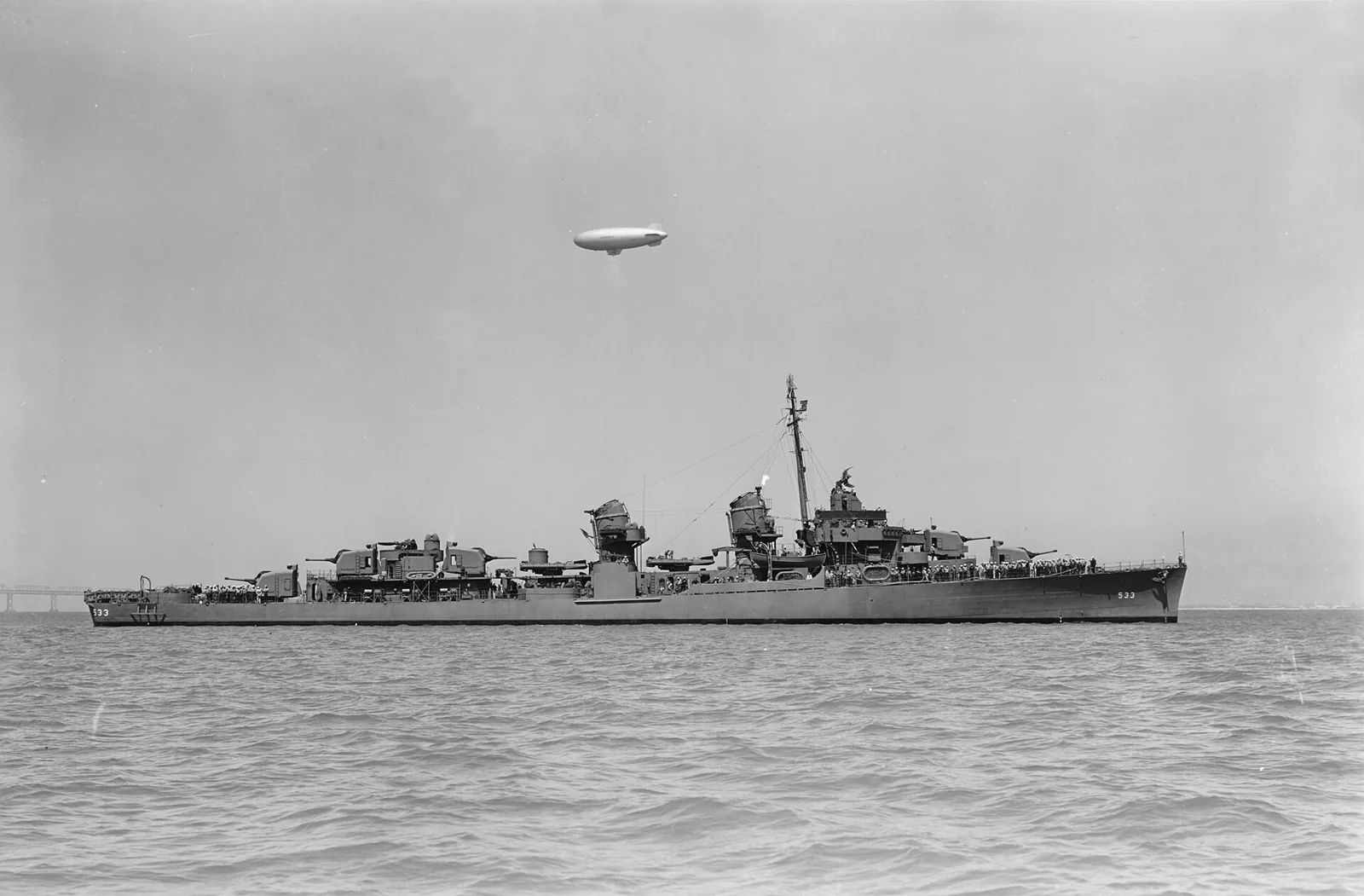
Service
- as Hoel19 July 1943 — 25 October 1944464 days of the war
- Name
- USS Hoel
- Pennant / hull number
- DD-533
- Namesake
- William R. Hoel
- Builder
- Bethlehem Shipbuilding Corporation, San Francisco, California
- Laid down
- 4 June 1942
- Launched
- 19 December 1942
- Commissioned
- 19 July 1943
- Fate
- Sunk by Japanese battleships Yamato and Nagato and heavy cruiser Haguro, 25 October 1944, Battle off Samar (1944)
- Status
- Wreck
Specifications
- Displacement, standard
- 2,100 long tons (2,134 t)
- Displacement, full load
- 2,544 long tons (2,585 t)
- Length
- 114.6 m (376 ft)
- Beam
- 11.89 m (39 ft)
- Draught
- 5.18 m (17 ft)
- Speed
- 38 knots (70.4 km/h, 43.7 mph)
- Range
- 6,500 nmi (12,038 km)
- Complement
- 273
- Main gun
- 127 mm (5 in)
William R. Hoel—son of Edmund and Sarah Ryan Hoel—was born on 7 March 1825 in Sharon, Ohio. Hoel began training as a riverboat pilot in late 1840, following his father into the profession. Within three years, the younger Hoel was considered to be a qualified pilot, and he earned his license within days of new certification requirements going into effect in early 1853.
Hoel married Mary Elizabeth Riley on 1 August 1849 in Cincinnati. Mrs. Hoel gave birth to a son, Edmund Riley Hoel, on 23 February 1853. Due to complications from the birth, Mary died nine days later on 4 March, just four days short of her 22nd birthday. Adding to Hoel’s personal tragedy, several months later on 11 August, his young son also passed away from dysentery.
During the first 20 years of his career, Hoel piloted numerous steamboats up and down the Mississippi and Ohio Rivers, amassing considerable experience and skill in navigating the hazards and ever-changing conditions of these vital waterways. With the outbreak of the Civil War in 1861, Hoel volunteered his services as a civilian pilot to the Union cause, commencing his military duty on 19 October. He resigned this position on 1 February 1862 and instead became the first master of the ironclad stern-wheel gunboat Cincinnati . Called to action immediately, Cincinnati along with six other vessels of the Western Gunboat Flotilla under the command of Flag Officer Andrew H. Foote bombarded Fort Henry on the eastern shore of the Tennessee River on 6 February, resulting in a Confederate surrender. Hoel was wounded in the engagement but recovered quickly.
Continue to the full service history About 10,804 words
From the Dictionary of American Naval Fighting Ships, compiled by the Naval History and Heritage Command (Hoel I (DD-533)). A work of the United States Government, in the public domain.
Armament and machinery
Armament and machinery
- Propulsion
- 2 × geared steam turbines
- 2 × shafts
- Power
- 60000 shp
- Armament
- 5 × single Mk 12 5 in (127 mm)/38 guns
- 5 × twin 40 mm (1.6 in) Bofors AA guns
- 7 × single 20 mm (0.8 in) Oerlikon AA guns
- 2 × quintuple 21 in (533 mm) torpedo tubes
- 6 × single depth charge throwers
- 2 × depth charge racks
Sister ships
- USS Abbot (DD-629)
- USS Abner Read (DD-526)
- USS Albert W. Grant
- USS Ammen (DD-527)
- USS Anthony (DD-515)
- USS Aulick (DD-569)
- USS Bache (DD-470)
- USS Beale (DD-471)
- USS Bearss
- USS Bell (DD-587)
- USS Benham (DD-796)
- USS Bennett
- USS Bennion
- USS Black
- USS Boyd
- USS Bradford
- USS Braine
- USS Brown (DD-546)
- USS Brownson (DD-518)
- USS Bryant
- USS Bullard
- USS Burns (DD-588)
- USS Bush (DD-529)
- USS Callaghan (DD-792)
Sources
- Facts harvested from USS Hoel (DD-533) on Wikipedia. Figures only — no wording is taken from it.
- Service history reproduced verbatim from Hoel I (DD-533) , Dictionary of American Naval Fighting Ships — public domain, a work of the United States Government.
- Photograph: Unknown author — U.S. Navy Bureau of Ships photo 19-N-49316 — Public domain — Wikimedia Commons