USS Hopewell (DD-681)
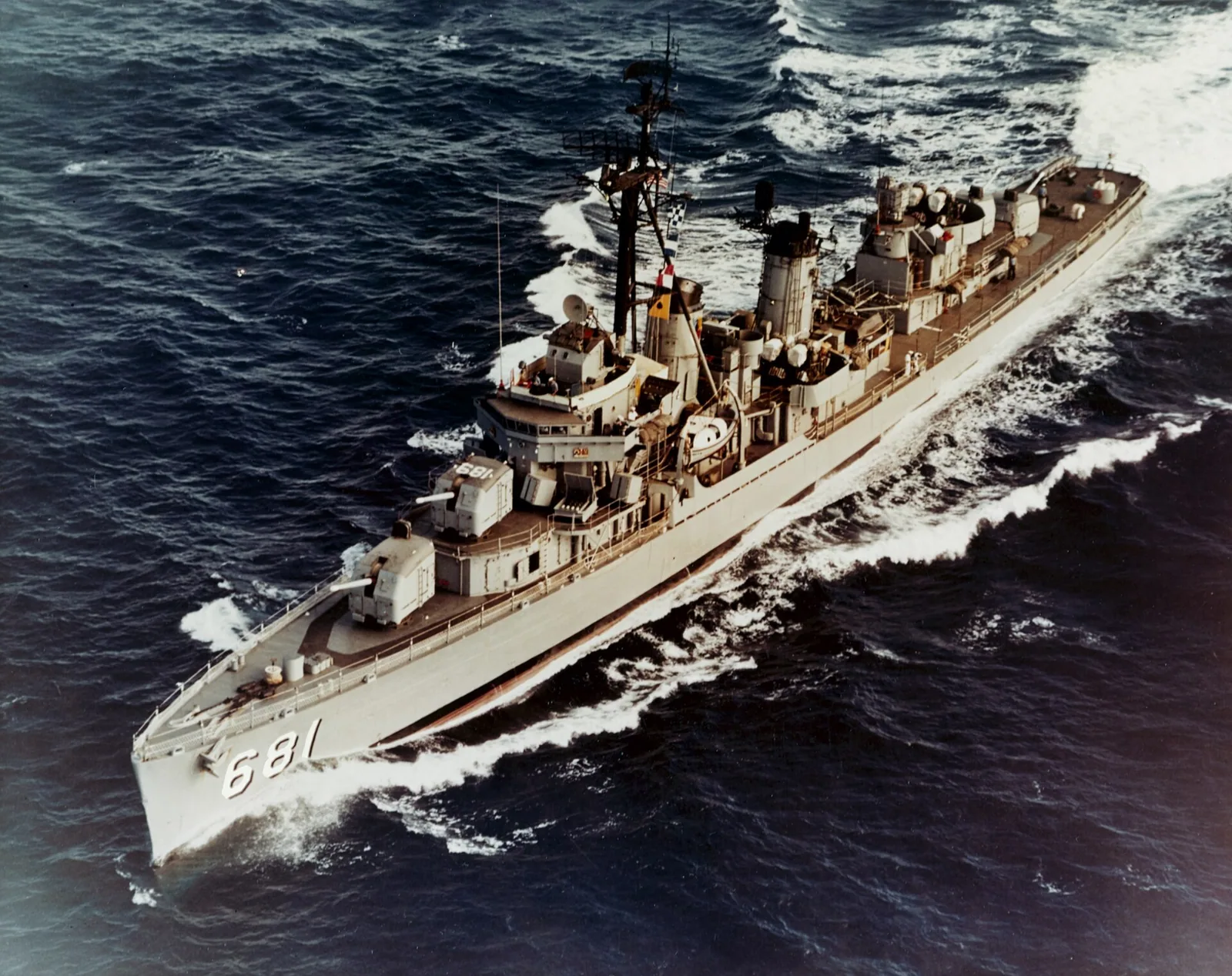
Service
- as Hopewell30 September 1943 — 2 January 1970705 days of the war
- Name
- USS Hopewell
- Pennant / hull number
- DD-681
- Namesake
- Pollard Hopewell
- Builder
- Bethlehem Shipbuilding, San Pedro, California
- Laid down
- 29 October 1942
- Launched
- 2 May 1943
- Commissioned
- 30 September 1943
- Decommissioned
- 2 January 1970
- Struck
- 2 January 1970
- Fate
- Sunk as target, 11 February 1972 (1972)
- Status
- Wreck
Specifications
- Displacement, standard
- 2,050 long tons (2,083 t)
- Length
- 114.6 m (376 ft)
- Beam
- 11.89 m (39 ft)
- Draught
- 5.18 m (17 ft)
- Speed
- 38 knots (70.4 km/h, 43.7 mph)
- Range
- 6,500 nmi (12,038 km)
- Complement
- 319
- Main gun
- 127 mm (5 in)
Pollard Hopewell entered the Navy as a Midshipman in June 1812, and reported to frigate Chesapeake 21 August. With a new crew Captain Lawrence put to sea to engage the crack British frigate Shannon 1 June 1913. Despite their captain's famous cry, "Don't give up the ship", the crew was overwhelmed and the ship taken. Midshipman Hopewell was among those killed, as was the gallant Lawrence.
The second Hopewell (DD-681) was launched by Bethlehem Steel Co., San Pedro, Calif., 2 May 1943; sponsored by Mrs. R. A. Spruance, wife of Admiral Spruance; and commissioned at Terminal Island 30 September 1943, Comdr. C. C. Shute in command.
Hopewell conducted shakedown training in the San Diego area before sailing for Hawaii 13 January 1944. She got underway 23 January for the invasion of the Marshalls, as American amphibious task forces picked up momentum in their drive toward Japan. Steaming as a forward picket ship, Hopewell arrived off Kwajalein 31 January and delivered destructive gunfire support during the initial assault. That night she bombarded Roi and Namur Islands and 1 February moved to screening and patrol duties off the other islands of the group. With the success of the landings assured, Hopewell sailed to Pearl Harbor, arriving 24 February.
Continue to the full service history About 1,187 words
From the Dictionary of American Naval Fighting Ships, compiled by the Naval History and Heritage Command (Hopewell II (DD-681)). A work of the United States Government, in the public domain.
Armament and machinery
Armament and machinery
- Propulsion
- 60000 shp
- Geared turbines
- 2 propellers
- Armament
- 5 × single Mk 12 5 in (127 mm)/38 guns
- 5 × twin 40 mm (1.6 in) Bofors AA guns
- 7 × single 20 mm (0.8 in) Oerlikon AA guns
- 2 × quintuple 21 in (533 mm) torpedo tubes
- 6 × single depth charge throwers
- 2 × depth charge racks
Sister ships
- USS Abbot (DD-629)
- USS Abner Read (DD-526)
- USS Albert W. Grant
- USS Ammen (DD-527)
- USS Anthony (DD-515)
- USS Aulick (DD-569)
- USS Bache (DD-470)
- USS Beale (DD-471)
- USS Bearss
- USS Bell (DD-587)
- USS Benham (DD-796)
- USS Bennett
- USS Bennion
- USS Black
- USS Boyd
- USS Bradford
- USS Braine
- USS Brown (DD-546)
- USS Brownson (DD-518)
- USS Bryant
- USS Bullard
- USS Burns (DD-588)
- USS Bush (DD-529)
- USS Callaghan (DD-792)
Sources
- Facts harvested from USS Hopewell (DD-681) on Wikipedia. Figures only — no wording is taken from it.
- Service history reproduced verbatim from Hopewell II (DD-681) , Dictionary of American Naval Fighting Ships — public domain, a work of the United States Government.
- Photograph: Unknown author — U.S. Navy photo NH 89658-KN — Public domain — Wikimedia Commons