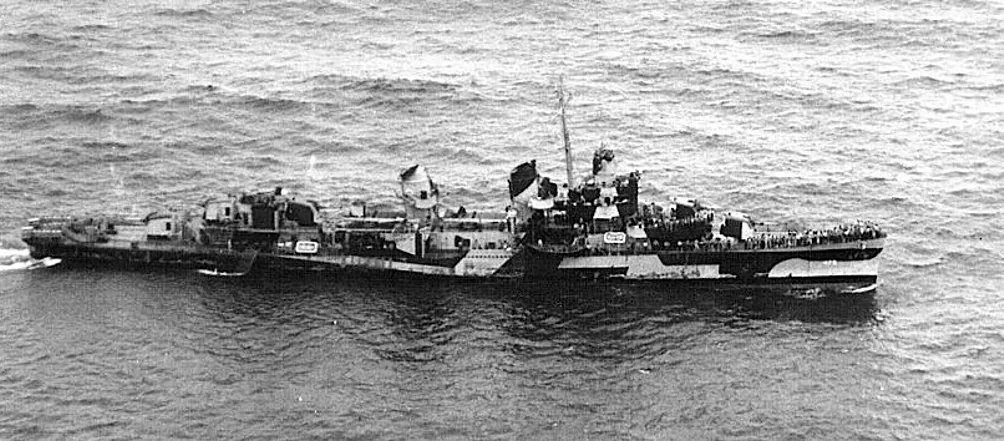
USS Hudson (DD-475)
Service
- 13 April 1943 — 31 May 1946873 days of the war
- Name
- USS Hudson
- Pennant / hull number
- DD-475
- Namesake
- William L. Hudson
- Builder
- Boston Navy Yard
- Laid down
- 20 February 1942
- Launched
- 3 June 1942
- Commissioned
- 13 April 1943
- Decommissioned
- 31 May 1946
- Struck
- 1 December 1972
- Fate
- Sold for scrap, 27 November 1973 (1973)
- Status
- Scrapped
Specifications
- Displacement, standard
- 2,050 long tons (2,083 t)
- Length
- 114.6 m (376 ft)
- Beam
- 11.89 m (39 ft)
- Draught
- 5.18 m (17 ft)
- Speed
- 35 knots (64.8 km/h, 40.3 mph)
- Range
- 6,500 nmi (12,038 km)
- Complement
- 336
- Main gun
- 127 mm (5 in)
William Levereth Hudson was born 11 May 1794 at Brooklyn, N.Y. His first service afloat was in the Mediterranean Squadron under Commodore William Bainbridge in the schooner Alert and sloop Ontario from 1815 to 1817. Hudson was appointed midshipman on 1 January 1816. In 1821-1823 he served in Dolphin on the Pacific coast of South America, and in Warren for a Mediterranean cruise 1826-1829. In 1830-1831 Hudson accompanied Lieutenant Ramsey on a tour to Russia, and then assumed duty at the New York Navy Yard. In June 1838 he was ordered to command Peacock, attached to the Wilkes Exploring Expedition. After strenuous service in the Antarctic, the South Seas, and along the coast of North America, Peacock was wrecked on 18 July 1841 while attempting to cross the bar and enter the Columbia River on Wilkes' orders. Commander Hudson made every effort to free his ship but was forced to leave her, fortunately saving all his men and the scientific papers. In September 1849, after shore and lighthouse duty, he was ordered to command Vincennes, cruising the Pacific until 1852. In March 1857 Hudson, appointed captain 8 October 1855, assumed command of Niagara. That August, in conjunction with British ships, he made the first attempt at laying a transatlantic cable. This try was unsuccessful, but a second attempt met with success 10 August 1858. After commanding the Boston Navy Yard 1858-1862, Captain Hudson was made Inspector of the Third Light House District. He died on 15 October 1862 in Brooklyn.
Hudson (DD-475) was laid down on 20 February 1942 at Boston, Mass., by the Boston Navy Yards; launched on 3 June 1942; sponsored by Mrs. Henry H. Hough, wife of Adm. Henry H. Hough (Ret.) ; and commissioned at her building yard on 13 April 1943, Cmdr. William R. Smedburg, III, in command.
After shakedown and escort duty along the Atlantic coast, Hudson sailed for Efate, New Hebrides, where she was just in time to provide fire support for the initial landings on Bougainville on 1 November 1943. As the Japanese staged a heavy air attack 8 November, Hudson helped repel them by splashing two "bogies" and assisting on a third. She then made antishipping sweeps in the Truk area and participated in operations against the Green Islands obn 1 February 1944. En route to the invasion Hudson attacked and sank a Japanese submarine on 31 January.
Continue to the full service history About 951 words
From the Dictionary of American Naval Fighting Ships, compiled by the Naval History and Heritage Command (Hudson III (DD-475)). A work of the United States Government, in the public domain.
Armament and machinery
Armament and machinery
- Propulsion
- 60,000 shp (45 MW); 2 propellers
- Armament
- 5 × single Mk 12 5 in (127 mm)/38 guns
- 5 × twin 40 mm (1.6 in) Bofors AA guns
- 7 × single 20 mm (0.8 in) Oerlikon AA guns
- 2 × quintuple 21 in (533 mm) torpedo tubes
- 6 × single depth charge throwers
- 2 × depth charge racks
Sister ships
- USS Abbot (DD-629)
- USS Abner Read (DD-526)
- USS Albert W. Grant
- USS Ammen (DD-527)
- USS Anthony (DD-515)
- USS Aulick (DD-569)
- USS Bache (DD-470)
- USS Beale (DD-471)
- USS Bearss
- USS Bell (DD-587)
- USS Benham (DD-796)
- USS Bennett
- USS Bennion
- USS Black
- USS Boyd
- USS Bradford
- USS Braine
- USS Brown (DD-546)
- USS Brownson (DD-518)
- USS Bryant
- USS Bullard
- USS Burns (DD-588)
- USS Bush (DD-529)
- USS Callaghan (DD-792)
Sources
- Facts harvested from USS Hudson (DD-475) on Wikipedia. Figures only — no wording is taken from it.
- Service history reproduced verbatim from Hudson III (DD-475) , Dictionary of American Naval Fighting Ships — public domain, a work of the United States Government.
- Photograph: U.S. Navy — U.S. Navy photo [1] / 80-G-248291 from Navsource.org / usndazzle.com — Public domain — Wikimedia Commons