USS Philip (DD-498)
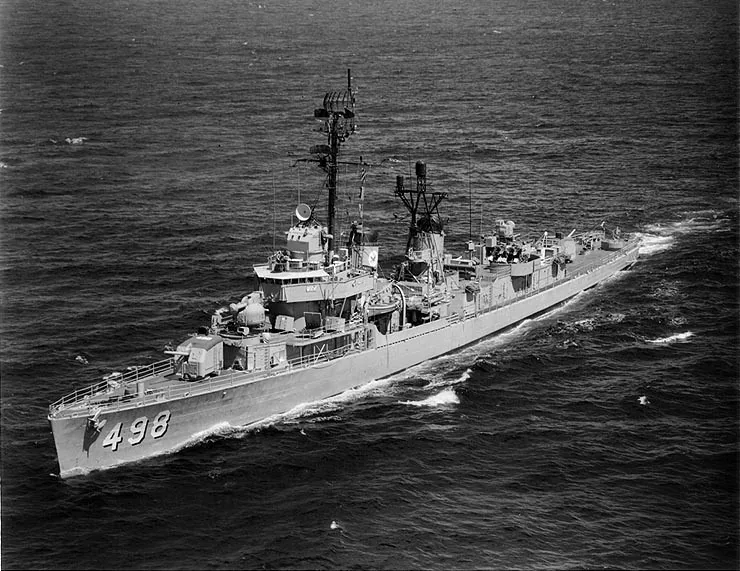
Service
- as USS Philip21 November 1942 — 30 September 19681,016 days of the war
- Name
- USS Philip
- Pennant / hull number
- DD-498
- Namesake
- John W. Philip
- Builder
- Federal Shipbuilding and Drydock Company, Kearny, New Jersey
- Laid down
- 7 May 1942
- Launched
- 13 October 1942
- Commissioned
- 21 November 1942
- Decommissioned
- 30 September 1968
- Struck
- 1 October 1968
- Fate
- Sank in a storm while under tow for scrapping, 2 February 1972.
By weather (1972) - Status
- Wreck
Specifications
- Displacement, standard
- 2,050 long tons (2,083 t)
- Length
- 114.6 m (376 ft)
- Beam
- 11.89 m (39 ft)
- Draught
- 5.18 m (17 ft)
- Speed
- 35 knots (64.8 km/h, 40.3 mph)
- Range
- 6,500 nmi (12,038 km)
- Complement
- 336
- Main gun
- 127 mm (5 in)
John Woodward Philip, born in Kinderhook, Columbia County, New York, 26 August 1840, was appointed Midshipman 20 September 1856 and graduated from the Naval Academy 1 June 1861. During the Civil War, he served in Santee, Marion and Sonoma until September 1862 when he was ordered to Chippewa, attached to the South Atlantic Blockading Squadron. While serving in Chippewa, he was wounded during operations against Charleston, S.C., July 1863. He commanded Texas from 18 October 1897 to 29 August 1898. During the Spanish-American War, his ship, with Marblehead, led the attack and silenced the fort on Cayo del Toro, Guantanamo Bay, 15 June 1898. On 3 July 1898, in command of Texas, he participated in the Battle of Santiago Bay, in which Cerevera-s Spanish Fleet was destroyed off Santiago de Cuba. He was advanced five numbers in grade 10 August 1898 for eminent and conspicuous service in battle. From 3 September 1898 until 28 December 1898, he served as Commander 2nd Squadron, North Atlantic Fleet, flying his broad pennant in New York. Commencing 14 January 1899, he was in command of the Navy Yard and Naval Station, New York and was promoted to Rear Admiral 3 March 1899. While serving in this duty, Admiral Philip died suddenly 30 June 1900.
The second Philip (DD-498) was laid down by the Federal Shipbuilding and Dry Dock Co., Kearny, N.J., 7 May 1942; launched 13 October 1942; sponsored by Mrs. Barrett Philip; and commissioned 21 November 1942, Comdr. Thomas C. Ragan in command.
Philip's first mission came during the early morning of 30 June 1943, when she bombarded installations in the Shortland Islands area in the southwest Pacific. Operating in the screen of the Second Transport Group, Philip, on 15 August 1943, made a good showing in her first scrape with the enemy. Several bomb splashes were seen near Barakoma Beach, Vella Lavella, indicating that Japanese bombers were attacking the LCI's unloading there. A few minutes later, two dive bombers headed for Philip to unload their explosives. Each plane dropped a bomb but both missed. The first plane, taken under fire by the ship's guns, kept getting closer until a friendly Corsair took over the fight. Guns were shifted to the second and they soon found their range, splashing the plane into the sea.
Continue to the full service history About 2,496 words
From the Dictionary of American Naval Fighting Ships, compiled by the Naval History and Heritage Command (Philip II (DD-498)). A work of the United States Government, in the public domain.
Armament and machinery
Armament and machinery
- Propulsion
- 60,000 shp (45 MW); 2 propellers
- Armament
- 5 × single Mk 12 5 in (127 mm)/38 guns
- 5 × twin 40 mm (1.6 in) Bofors AA guns
- 7 × single 20 mm (0.8 in) Oerlikon AA guns
- 2 × quintuple 21 in (533 mm) torpedo tubes
- 6 × single depth charge throwers
- 2 × depth charge racks
Sister ships
- USS Abbot (DD-629)
- USS Abner Read (DD-526)
- USS Albert W. Grant
- USS Ammen (DD-527)
- USS Anthony (DD-515)
- USS Aulick (DD-569)
- USS Bache (DD-470)
- USS Beale (DD-471)
- USS Bearss
- USS Bell (DD-587)
- USS Benham (DD-796)
- USS Bennett
- USS Bennion
- USS Black
- USS Boyd
- USS Bradford
- USS Braine
- USS Brown (DD-546)
- USS Brownson (DD-518)
- USS Bryant
- USS Bullard
- USS Burns (DD-588)
- USS Bush (DD-529)
- USS Callaghan (DD-792)
Sources
- Facts harvested from USS Philip (DD-498) on Wikipedia. Figures only — no wording is taken from it.
- Service history reproduced verbatim from Philip II (DD-498) , Dictionary of American Naval Fighting Ships — public domain, a work of the United States Government.
- Photograph: Photographer's Mate 2nd Class Robert F. Kinsey, U.S. Navy — U.S. Navy photo NH 98592 — Public domain — Wikimedia Commons