USS Prichett
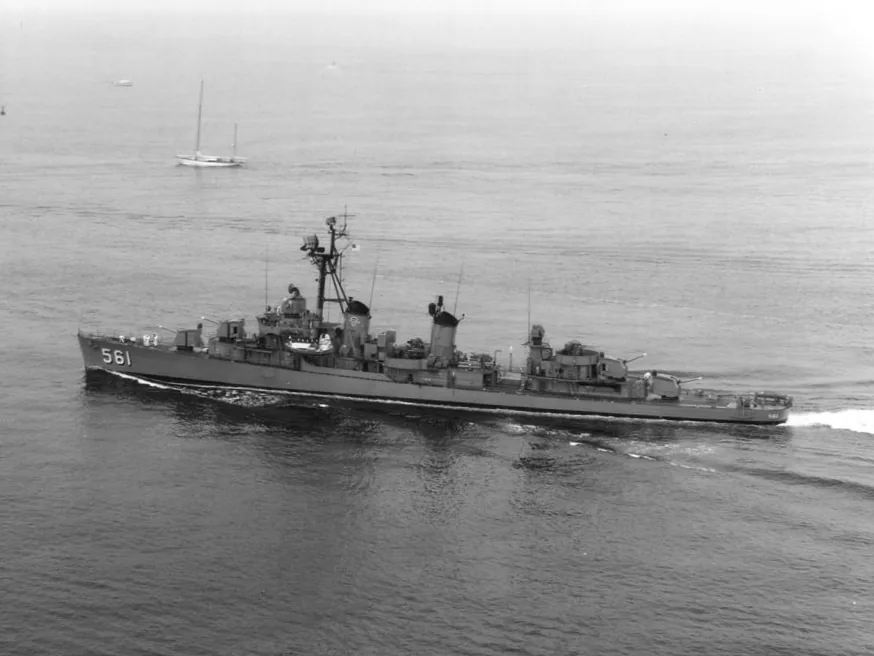
Service
- as Prichett15 January 1944 — 10 January 1970596 days of the war
- as Geniere17 January 1970 — 1975
- Name
- USS Prichett
- Pennant / hull number
- DD-561
- Namesake
- James M. Prichett
- Builder
- Seattle-Tacoma Shipbuilding Corporation
- Laid down
- 20 July 1942
- Launched
- 31 July 1943
- Commissioned
- 15 January 1944
- Decommissioned
- 10 January 1970
- Struck
- 10 January 1970
- Fate
- Scrapped in 1975 (1975)
- Status
- Scrapped
Specifications
- Displacement, standard
- 2,050 long tons (2,083 t)
- Length
- 114.6 m (376 ft)
- Beam
- 11.89 m (39 ft)
- Draught
- 5.18 m (17 ft)
- Speed
- 35 knots (64.8 km/h, 40.3 mph)
- Range
- 6,500 nmi (12,038 km)
- Complement
- 319
- Main gun
- 127 mm (5 in)
James M. Prichett, born in Centreville, Ind., in 1836, graduated from the Naval Academy in 1857. Prior to the Civil War he served aboard Mississippi on the China Station, and in Richmond on the Mediterranean Station. Assigned to the Washington Navy Yard in 1861, he joined the Naval forces on the Mississippi River in 1862. On 4 July 1863, while commanding gunboat Tyler, he participated in, and won praise for, effective action in repulsing a superior Confederate force during the battle of Helena, Ark. He also commanded monitor Mahopac during the war. After the war he sailed with Admiral Farragut's expedition to Russia and, in 1869, returned to the Pacific Squadron. Lt. Comdr. Prichett died in 1871 while attached to receiving ship Vermont at the Brooklyn Navy Yard.
Prichett (DD-561) was laid down 20 July 1942 by the Seattle-Tacoma Shipbuilding Co., Seattle, Wash.; launched 31 July 1943; sponsored by Mrs. Orville A. Tucker; and commissioned 15 January 1944, Comdr. Cecil T. Caulfield in command.
Following shakedown Prichett sailed, 1 April 1944, for Majuro, thence to Manus where she joined the battleships of Task Force (TF) 58. On the 28th, the seven battleships and 14 destroers of Task Group (TG) 58.3 sortied and, rendezvousing with the fast carriers of TG 58.1, steamed northeast. On the 29th and 30th, while carrier aircraft bombed and strafed Japanese held airfields in the Carolines, Prichett served in the screen, where she rescued two Lexington (CV-16) aviators who ditched their damaged Grumman TBF Avenger . The next day, the surface warships bombarded wharfs, seaplane bases and other installations on Ponape before the entire force retired to Majuro, whence Prichett returned to Pearl Harbor.
Continue to the full service history About 2,185 words
From the Dictionary of American Naval Fighting Ships, compiled by the Naval History and Heritage Command (Prichett (DD-561)). A work of the United States Government, in the public domain.
Armament and machinery
Armament and machinery
- Propulsion
- 60000 shp; 2 propellers
- Armament
- 5 × 5 in guns
- 4 × 40 mm AA guns
- 4 × 20 mm AA guns
- 10 × 21-inch (533 mm) torpedo tubes
- 6 × depth charge projectors
- 2 × depth charge tracks
Sister ships
- USS Abbot (DD-629)
- USS Abner Read (DD-526)
- USS Albert W. Grant
- USS Ammen (DD-527)
- USS Anthony (DD-515)
- USS Aulick (DD-569)
- USS Bache (DD-470)
- USS Beale (DD-471)
- USS Bearss
- USS Bell (DD-587)
- USS Benham (DD-796)
- USS Bennett
- USS Bennion
- USS Black
- USS Boyd
- USS Bradford
- USS Braine
- USS Brown (DD-546)
- USS Brownson (DD-518)
- USS Bryant
- USS Bullard
- USS Burns (DD-588)
- USS Bush (DD-529)
- USS Callaghan (DD-792)
Sources
- Facts harvested from USS Prichett on Wikipedia. Figures only — no wording is taken from it.
- Service history reproduced verbatim from Prichett (DD-561) , Dictionary of American Naval Fighting Ships — public domain, a work of the United States Government.
- Photograph: USN — Official U.S. Navy photo NH 70168 from the U.S. Navy Naval History and Heritage Command — Public domain — Wikimedia Commons