USS Van Valkenburgh
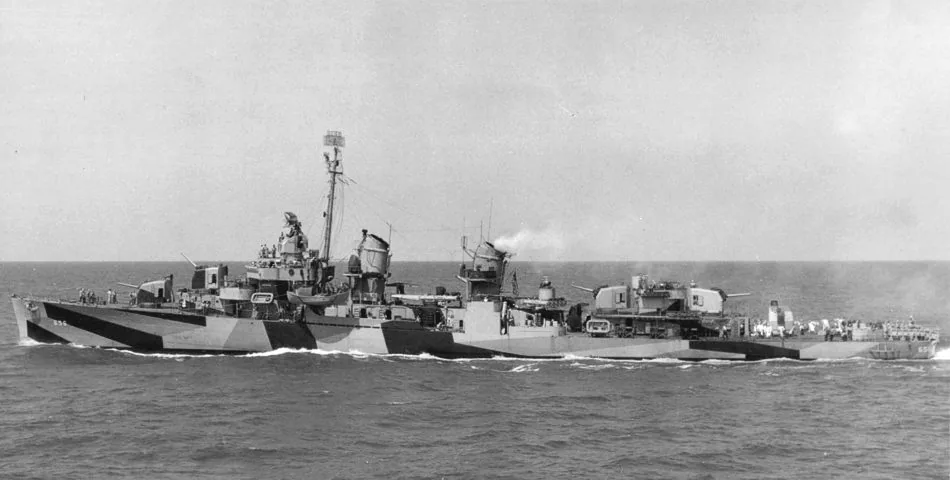
Service
- as Van Valkenburgh2 August 1944 — 1 February 1973396 days of the war
- as İzmir28 February 1967 — 1987
- Name
- USS Van Valkenburgh
- Pennant / hull number
- DD-656
- Namesake
- Franklin Van Valkenburgh
- Builder
- Gulf Shipbuilding Corporation, Chickasaw, Alabama
- Laid down
- 15 November 1942
- Launched
- 19 December 1943
- Commissioned
- 2 August 1944
- Decommissioned
- 26 February 1954
- Struck
- 1 February 1973
- Fate
- Scrapped, 1987 (1987)
- Status
- Scrapped
Specifications
- Displacement, standard
- 2,050 long tons (2,083 t)
- Length
- 114.6 m (376 ft)
- Beam
- 11.89 m (39 ft)
- Draught
- 3.96 m (13 ft)
- Speed
- 38 knots (70.4 km/h, 43.7 mph)
- Range
- 6,500 nmi (12,038 km)
- Complement
- 319
- Main gun
- 127 mm (5 in)
Franklin Van Valkenburgh, born on 5 April 1888 at Minneapolis, Minn., and appointed a midshipman on 15 September 1905, graduated from the Naval Academy on 4 June 1909. After service in Vermont (Battleship No. 20) and in South Carolina (Battleship No. 26), Van Valkenburgh was commissioned ensign on 5 June 1911. Traveling to the Asiatic Station soon thereafter, he joined Rainbow (Submarine Tender No. 7) at Olongapo, Philippine Islands, on 11 September. He reported to Pampanga (Gunboat No. 39) as executive officer on 23 June 1914 for a short tour in the southern Philippines before his detachment on 4 August.
After returning to the United States, Lt. (jg.) Van Valkenburgh joined Connecticut (Battleship No. 18) on 11 November. Following postgraduate work in steam engineering at the Naval Academy in September 1915, he took further instruction in that field at Columbia University before reporting to Rhode Island (Battleship No. 17) on 2 March 1917. The entry of the United States into World War I found Van Valkenburgh serving as the battleship's engineering officer. Subsequent temporary duty in the receiving ship at New York preceded his first tour as an instructor at the Naval Academy. On 1 June 1920, Van Valkenburgh reported on board Minnesota (Battleship No. 22) for duty as engineer officer, and he held that post until the battleship was decommissioned in November 1921.
He again served as an instructor at the Naval Academy, until 15 May 1925, before he joined Mary land (BB-46) on 26 June. Commissioned commander on 2 June 1927 while in Maryland, he soon reported for duty in the Office of the Chief of Naval Operations on 21 May 1928 and served there during the administrations of Admirals Charles F. Hughes and William V. Pratt. Detached on 28 June 1931, Van Valkenburgh received command of Talbot (DD-114) on 10 July and commanded Destroyer Squadron 5 from 31 March 1932.
Continue to the full service history About 4,002 words
From the Dictionary of American Naval Fighting Ships, compiled by the Naval History and Heritage Command (Van Valkenburgh (DD-656)). A work of the United States Government, in the public domain.
Armament and machinery
Armament and machinery
- Propulsion
- 60000 shp
- geared turbines
- 2 propellers
- Armament
- 5 × 5 in/38 caliber DP guns
- 6 × 40 mm AA guns
- 7 × 20 mm AA guns
- 10 × 21 in torpedo tubes
- 6 × depth charge projectors
- 2 × depth charge tracks
Sister ships
- USS Abbot (DD-629)
- USS Abner Read (DD-526)
- USS Albert W. Grant
- USS Ammen (DD-527)
- USS Anthony (DD-515)
- USS Aulick (DD-569)
- USS Bache (DD-470)
- USS Beale (DD-471)
- USS Bearss
- USS Bell (DD-587)
- USS Benham (DD-796)
- USS Bennett
- USS Bennion
- USS Black
- USS Boyd
- USS Bradford
- USS Braine
- USS Brown (DD-546)
- USS Brownson (DD-518)
- USS Bryant
- USS Bullard
- USS Burns (DD-588)
- USS Bush (DD-529)
- USS Callaghan (DD-792)
Sources
- Facts harvested from USS Van Valkenburgh on Wikipedia. Figures only — no wording is taken from it.
- Service history reproduced verbatim from Van Valkenburgh (DD-656) , Dictionary of American Naval Fighting Ships — public domain, a work of the United States Government.
- Photograph: USN — Official U.S. Navy photo 80-G-240717 available at Destroyerhistory.org — Public domain — Wikimedia Commons