USS Walker (DD-517)
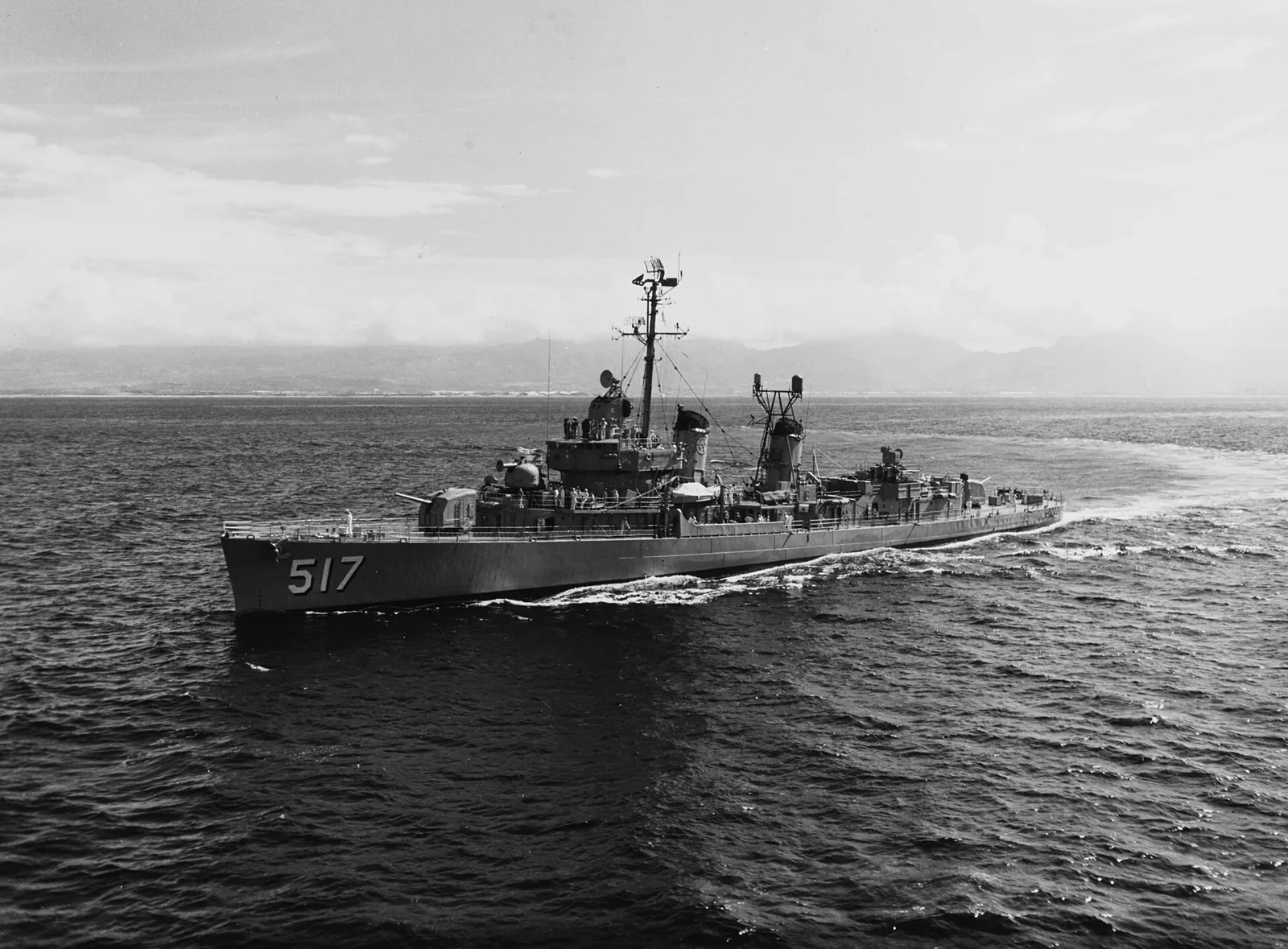
Service
- 3 April 1943 — 2 July 1969883 days of the war
- as Fante (D 561)2 July 1969 — 1977
- Name
- USS Walker
- Pennant / hull number
- DD-517
- Namesake
- John Grimes Walker
- Builder
- Bath Iron Works
- Laid down
- 31 August 1942
- Launched
- 31 January 1943
- Commissioned
- 3 April 1943
- Decommissioned
- 2 July 1969
- Struck
- 2 July 1969
- Fate
- Scrapped, 1977 (1977)
- Status
- Scrapped
Specifications
- Displacement, standard
- 2,050 long tons (2,083 t)
- Length
- 114.6 m (376 ft)
- Beam
- 11.89 m (39 ft)
- Draught
- 5.18 m (17 ft)
- Speed
- 35 knots (64.8 km/h, 40.3 mph)
- Range
- 6,500 nmi (12,038 km)
- Complement
- 336
- Main gun
- 127 mm (5 in)
John Grimes Walker, born in Hillsborough, N.H., on 20 March 1835, was appointed a midshipman on 5 October 1850 and graduated at the head of his class at the Naval Academy in 1856. He served in Falmouth and St. Lawrence in 1858 and 1859; in Susquehanna in 1860 and 1861; in Connecticut in 1861; and in Winona in 1861 and 1862.
He distinguished himself under Farragut during the Mississippi River campaigns while serving in Winona, Baron de Kalb (which he commanded), and Saco. He participated in the engagements with Forts St. Philip and Jackson, as well as the Chalmette batteries during the operations which resulted in the fall of New Orleans. He later took part in the Navy's operations against Vicksburg. During the winter of 1862 and 1863, Walker participated in the thrusts against Haines Bluff and Arkansas Post. He also took part in the Yazoo Pass expedition, the attack on Fort Pemberton, and the capture of Yazoo City. At the siege of Vicksburg, Walker commanded the naval gun battery attached to the 15th Army Corps. His subsequent war service included operations which resulted in the capture of Fort Fisher, and he participated in the ensuing bombardments of Forts Anderson and Caswell on the Cape Fear (N.C.) River and in the capture of Wilmington, N.C.
Promoted to commander in 1866, Walker served as Assistant Superintendent of the Naval Academy from 1866 to 1869. After commanding Sabine in 1869 and 1870-during which time he took the ship to Europe on a midshipman training cruise-he served as secretary to the Lighthouse Board from 1873 to 1878. From 1881 to 1889, Walker held the post of Chief of the Bureau of Navigation before he went to sea commanding the White Squadron in 1889, with his flag in Chi cago. Appointed rear admiral in 1894, he took the White Squadron to Hawaii in 1895 when a coup d'etat posed a threat to American interests. He received a commendation for his attitude of watchful waiting and his squadron's posture of readiness to respond to a possible emergency.
Continue to the full service history About 2,905 words
From the Dictionary of American Naval Fighting Ships, compiled by the Naval History and Heritage Command (Walker II (DD-517)). A work of the United States Government, in the public domain.
Armament and machinery
Armament and machinery
- Propulsion
- 60,000 shp (45 MW); 2 propellers
- Armament
- 5 × single Mk 12 5 in (127 mm)/38 guns
- 5 × twin 40 mm (1.6 in) Bofors AA guns
- 7 × single 20 mm (0.8 in) Oerlikon AA guns
- 2 × quintuple 21 in (533 mm) torpedo tubes
- 6 × single depth charge throwers
- 2 × depth charge racks
Sister ships
- USS Abbot (DD-629)
- USS Abner Read (DD-526)
- USS Albert W. Grant
- USS Ammen (DD-527)
- USS Anthony (DD-515)
- USS Aulick (DD-569)
- USS Bache (DD-470)
- USS Beale (DD-471)
- USS Bearss
- USS Bell (DD-587)
- USS Benham (DD-796)
- USS Bennett
- USS Bennion
- USS Black
- USS Boyd
- USS Bradford
- USS Braine
- USS Brown (DD-546)
- USS Brownson (DD-518)
- USS Bryant
- USS Bullard
- USS Burns (DD-588)
- USS Bush (DD-529)
- USS Callaghan (DD-792)
Sources
- Facts harvested from USS Walker (DD-517) on Wikipedia. Figures only — no wording is taken from it.
- Service history reproduced verbatim from Walker II (DD-517) , Dictionary of American Naval Fighting Ships — public domain, a work of the United States Government.
- Photograph: PH2 Don C. Smith, U.S. Navy — U.S. Navy photo NH 107240 — Public domain — Wikimedia Commons