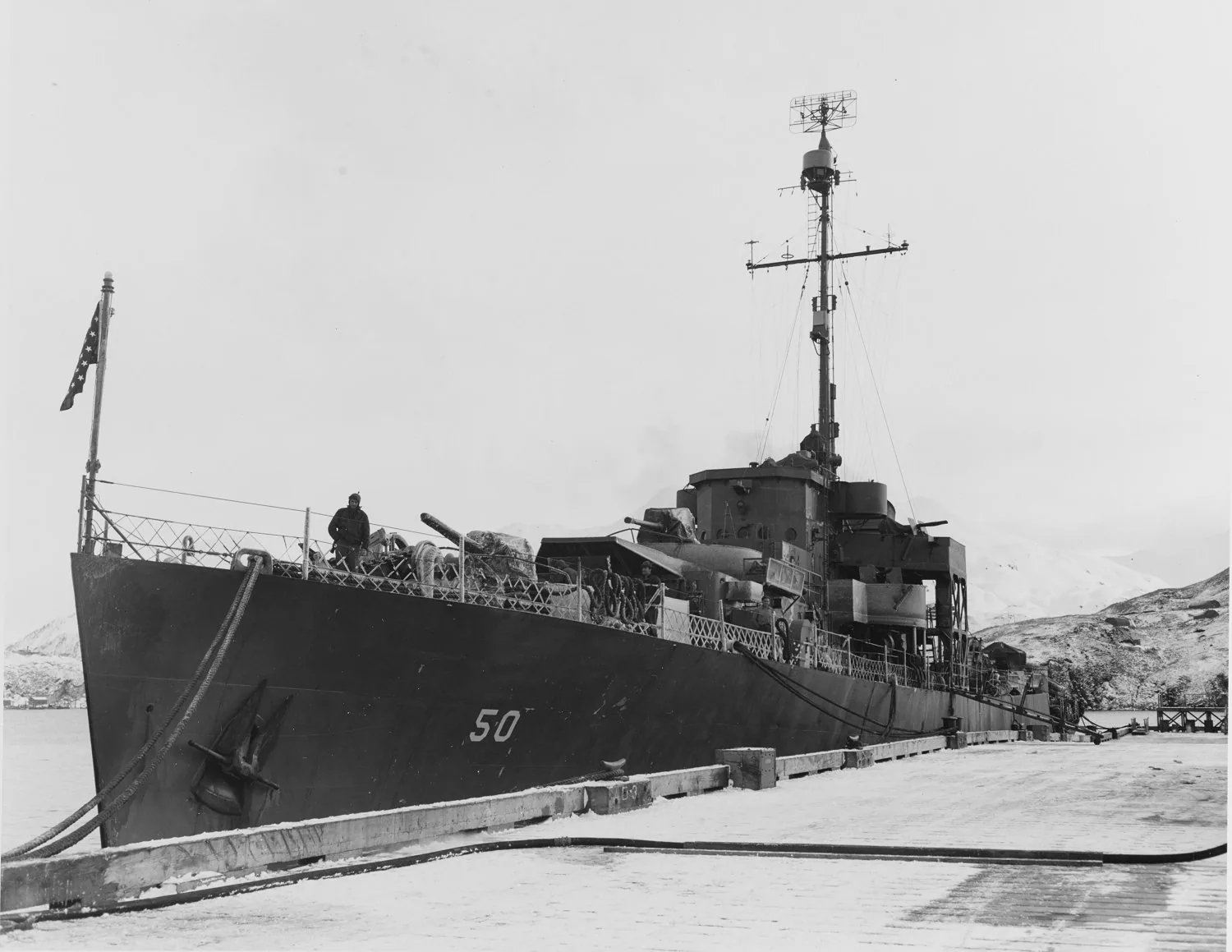
USS Carson City (PF-50)
Service
- as Carson City24 March 1944 — 30 April 1953527 days of the war
- as EK-2026 August 1945 — 31 October 19497 days of the war
- as Sakura30 April 1953 — 31 March 1971
- Name
- USS Carson City
- Pennant / hull number
- PF-50
- Namesake
- Cities of Carson City, Nevada, and
- Laid down
- 28 September 1943
- Launched
- 13 November 1943
- Commissioned
- 24 March 1944
- Decommissioned
- 26 August 1945
- Fate
- Returned to United States, 6 August 1971 (1971)
- Status
- Unknown
Specifications
- Displacement, standard
- 1,264 long tons (1,284 t)
- Length
- 92.35 m (303 ft)
- Beam
- 11.28 m (37 ft)
- Draught
- 3.96 m (13 ft)
- Speed
- 20 knots (37 km/h, 23 mph)
- Complement
- 190
- Main gun
- 76 mm (3 in)
Carson City (PF-50) was launched 13 November 1943 by Consolidated Steel Corp., Wilmington, Calif., under a Maritime Commission contract; sponsored by Mrs. C. B. Austin; and commissioned 24 March 1944, Commander H. B. Roberts, USCG, in command.
Carson City sailed from Los Angeles 19 July 1944 for Espiritu Santo and Milne Bay, where on 13 August she reported for patrol and escort duty in the New Guinea area, with the 7th Fleet. She took part in the unopposed landings on Morotai 16 September, an essential preliminary to the Philippines operation, then took part m guarding ships, men, and supplies being assembled in the intricate plans for the Leyte landings. She herself sailed for Leyte Gulf from Humboldt Bay on 16 October, supporting the first wave of reinforcements for the Northern Attack Force. On 22 October she accompanied her charges into the landing area, and next day escorted the empty ships back to Humboldt Bay.
Carson City resumed convoy escort duty in New Guinea, shuttling to Wakde, Biak, Noemfoor, Sansapor, Morotai, and Mios Woendi until 26 November 1944, when she cleared for overhaul at Pearl Harbor thence for duty with the Alaskan Sea Frontier at Dutch Harbor where she reported 12 January 1945. On 29 August she was transferred at Cold Bay to Russia under lend-lease. Returned to the United States at Yokosuka, Japan, 31 October 1949, Carson City was decommissioned and placed in reserve the same day. On 30 April 1953 she was loaned to Japan, and now serves as Sakura.
From the Dictionary of American Naval Fighting Ships, compiled by the Naval History and Heritage Command (Carson City (PF-50)). A work of the United States Government, in the public domain.
Armament and machinery
Armament and machinery
- Propulsion
- 2 × 5500 shp turbines
- 3 boilers
- 2 shafts
- Armament
- 3 × 3"/50 dual purpose guns (3x1)
- 4 x 40 mm guns (2×2)
- 9 × 20 mm guns (9×1)
- 1 × Hedgehog anti-submarine mortar
- 8 × Y-gun depth charge projectors
- 2 × Depth charge tracks
Sister ships
- Soviet frigate EK-1
- Soviet frigate EK-10
- Soviet frigate EK-11
- Soviet frigate EK-12
- Soviet frigate EK-13
- Soviet frigate EK-14
- Soviet frigate EK-15
- Soviet frigate EK-16
- Soviet frigate EK-17
- Soviet frigate EK-18
- Soviet frigate EK-19
- Soviet frigate EK-2
- Soviet frigate EK-20
- Soviet frigate EK-21
- Soviet frigate EK-22
- Soviet frigate EK-25
- Soviet frigate EK-26
- Soviet frigate EK-27
- Soviet frigate EK-28
- Soviet frigate EK-29
- Soviet frigate EK-3
- Soviet frigate EK-30
- Soviet frigate EK-4
- Soviet frigate EK-5
Sources
- Facts harvested from USS Carson City (PF-50) on Wikipedia. Figures only — no wording is taken from it.
- Service history reproduced verbatim from Carson City (PF-50) , Dictionary of American Naval Fighting Ships — public domain, a work of the United States Government.
- Photograph: National Archives photo 26-G-4810 — https://www.navsource.net/archives/12/08050.htm — Public domain — Wikimedia Commons