HMS Bradford (H72)
Service
- as USS McLanahan5 April 1919 — 8 October 1940403 days of the war
- as HMS Bradford8 October 1940 — 3 May 1943937 days of the war
- Name
- HMS Bradford
- Pennant / hull number
- H72
- Namesake
- Tenant McLanahan
- Builder
- Bethlehem Shipbuilding Corporation, Squantum Victory Yard
- Laid down
- 20 April 1918
- Launched
- 22 September 1918
- Commissioned
- 5 April 1919
- Decommissioned
- 8 October 1940
- Fate
- Sold for scrap, 19 June 1946 (1946)
- Status
- Scrapped
Specifications
- Displacement, standard
- 1,215 long tons (1,234 t)
- Length
- 95.71 m (314 ft)
- Beam
- 9.45 m (31 ft)
- Draught
- 2.74 m (9 ft)
- Speed
- 35 knots (64.8 km/h, 40.3 mph)
- Range
- 4,900 nmi (9,075 km)
- Complement
- 120
- Main gun
- 102 mm (4 in)
Tenant McLanahan, born in Louisiana, was appointed midshipman 12 December 1839 and passed midshipman on 2 July 1845. He served in Preble in the Mediterranean Squadron; in Delaware , Brandywine , and Macedonian in the Brazil, African, and East Indian Squadrons, 1840‑45; and in Shark , Portsmouth and Cyane in the Pacific Squadron, 1846‑48. While attached to the latter he was one of Lieutenant Heywood's party beseiged by Mexican irregulars at San Jose, Baja California, on 24 January to 14 February 1848. He conducted himself in a gallant, unflinching, and devoted manner, until he was killed by a rifle shot in the neck on 11 February 1848.
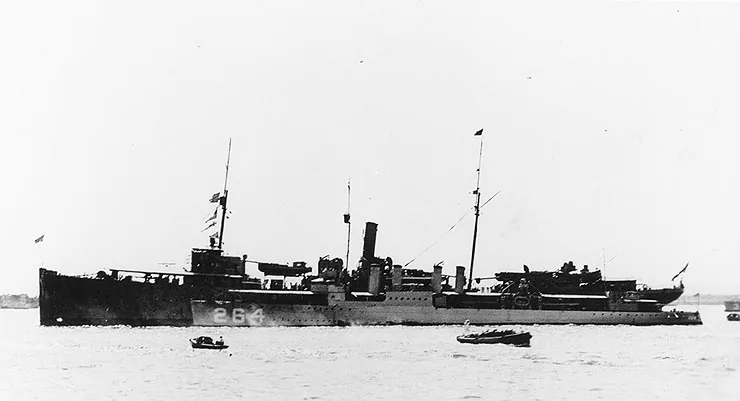
The first McLanahan (Destroyer No. 264) was laid down on 20 April 1918 at Quincy, Mass., by the Bethlehem Shipbuilding Corp., ; launched on 22 September 1918; sponsored by Mrs. Charles M. Howe; and commissioned on 5 April 1919, Cmdr. Reuben B. Coffey in command.
After shakedown off the Massachusetts coast, McLanahan was assigned to the Pacific Fleet. At San Diego in October 1919 she was placed in reserve ; she was reclassified as DD-264 on 17 July 1920, and was decommissioned in June 1922. She remained at the U.S. Destroyer Base, San Diego, until recommissioned on 18 December 1939, Lt. Cmdr. Forrest Close, commanding. Then, following overhaul and fitting out, she steamed to the east coast. On 8 October 1940 she was decommissioned as a U.S. Navy ship at Halifax, Nova Scotia, and commissioned in the Royal Navy, under the terms of the destroyers‑for‑bases agreement, as HMS Bradford (H.72).
As Bradford she performed escort duties in the Atlantic, including convoys to North Africa. for Operation Torch , from 1941 to 1943. On 3 May 1943 she was declared no longer fit for ocean escort work and was ordered decommissioned at Devonport. There, for the remainder of the war, she served as an accommodation ship. She was scrapped at Troon on 19 June 1946.
From the Dictionary of American Naval Fighting Ships, compiled by the Naval History and Heritage Command (McLanahan I (Destroyer No. 264)). A work of the United States Government, in the public domain.
Armament and machinery
Armament and machinery
- Propulsion
- 26500 shp
- geared turbines
- 2 screws
- Armament
- 4 × 4 in guns
- 2 × 3 in guns
- 12 × 21 inch (533 mm) torpedo tubes
Sister ships
- HMCS Buxton (H96)
- HMCS St. Croix (I81)
- HMCS St. Francis (I93)
- HMS Belmont (H46)
- HMS Beverley (H64)
- HMS Broadwater (H81)
- HMS Broadway (H90)
- HMS Burnham (H82)
- HMS Burwell (H94)
- HMS Buxton (H96)
- HMS Cameron (I05)
- HMS Chesterfield (I28)
- HMS Churchill (I45)
- HMS Clare (I14)
- HMS Ramsey (G60)
- HMS Reading (G71)
- HMS Ripley (G79)
- HMS Rockingham (G58)
- HMS Sherwood (I80)
- HMS Stanley (I73)
- Soviet destroyer Dejatelny
- USS Abel P. Upshur
- USS Alden
- USS Aulick (DD-258)
Sources
- Facts harvested from HMS Bradford (H72) on Wikipedia. Figures only — no wording is taken from it.
- Service history reproduced verbatim from McLanahan I (Destroyer No. 264) , Dictionary of American Naval Fighting Ships — public domain, a work of the United States Government.
- Photograph: Unknown author — U.S. Naval History and Heritage Command photo NH 77259 — Public domain — Wikimedia Commons