HMS Broadwater (H81)
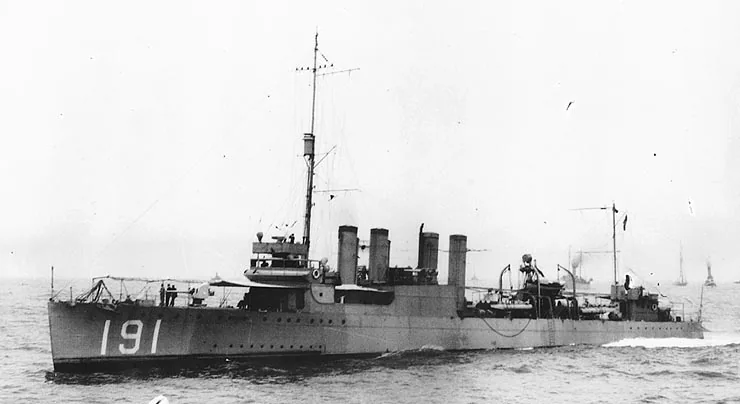
Service
- as USS Mason28 February 1920 — 8 October 1940403 days of the war
- as HMS Broadwater9 October 1940 — 18 October 1941374 days of the war
- Name
- HMS Broadwater
- Pennant / hull number
- H81
- Namesake
- John Y. Mason
- Builder
- Newport News Shipbuilding & Dry Dock Company
- Laid down
- 10 July 1918
- Launched
- 8 March 1919
- Commissioned
- 28 February 1920
- Decommissioned
- 3 July 1922
- Recommissioned
- 4 December 1939
- Struck
- 8 January 1941
- Fate
- Torpedoed and sunk, 18 October 1941
By torpedo (1941) - Status
- Wreck
Specifications
- Displacement, standard
- 1,190 long tons (1,209 t)
- Length
- 95.71 m (314 ft)
- Beam
- 9.45 m (31 ft)
- Draught
- 2.74 m (9 ft)
- Speed
- 35 knots (64.8 km/h, 40.3 mph)
- Range
- 4,900 nmi (9,075 km)
- Complement
- 101
- Main gun
- 102 mm (4 in)
(Destroyer No. 191: dp. 1,190; l. 314'5"; b. 31'9"; dr. 9'3"; s. 35 k.; cpl. 101; a. 4 4", 3 3", 12 21" tt.; cl. Clemson )
The first Mason (Destroyer No. 191) was named for John Young Mason, born 18 April 1799, in Greene County, Va. Both a political leader and a diplomat, he was Secretary of the Navy first for President John Tyler from 1844 to 1845 and then for President James K. Polk from 1846 to 1849. As minister to France from 1853, he joined James Buchanan and Pierre Soul£, ministers, respectively, to Great Britain and Spain, in issuing on 18 October 1854 the famous Ostend Manifesto on the justification of seizing Cuba if Spain would not sell the colony to the United States. Mr. Mason died in Paris, France, 3 October 1859.
The second Mason (DE‑529) was named for Newton Henry Mason, born 24 December 1918 at New York City. He enlisted as a seaman in the Naval Reserve, 7 November 1940 and on 10 February 1941 was appointed an aviation cadet. Assigned to Fighting Squadron 3 in September, he died following aerial combat against Japanese forces in the Battle of the Coral Sea, 8 and 9 May 1942. Ensign Mason was posthumously awarded the Distinguished Flying Cross for his skill and courage in battle.
Continue to the full service history About 490 words
From the Dictionary of American Naval Fighting Ships, compiled by the Naval History and Heritage Command (Mason I (Destroyer No. 191)). A work of the United States Government, in the public domain.
Armament and machinery
Armament and machinery
- Propulsion
- 26500 shp
- geared turbines
- 2 screws
- Armament
- 4 × 4 in/50 cal. guns
- 3 × 3 in/23 cal. guns
- 12 × 21 inch (533 mm) torpedo tubes
Sister ships
- HMCS Buxton (H96)
- HMCS St. Croix (I81)
- HMCS St. Francis (I93)
- HMS Belmont (H46)
- HMS Beverley (H64)
- HMS Bradford (H72)
- HMS Broadway (H90)
- HMS Burnham (H82)
- HMS Burwell (H94)
- HMS Buxton (H96)
- HMS Cameron (I05)
- HMS Chesterfield (I28)
- HMS Churchill (I45)
- HMS Clare (I14)
- HMS Ramsey (G60)
- HMS Reading (G71)
- HMS Ripley (G79)
- HMS Rockingham (G58)
- HMS Sherwood (I80)
- HMS Stanley (I73)
- Soviet destroyer Dejatelny
- USS Abel P. Upshur
- USS Alden
- USS Aulick (DD-258)
Sources
- Facts harvested from HMS Broadwater (H81) on Wikipedia. Figures only — no wording is taken from it.
- Service history reproduced verbatim from Mason I (Destroyer No. 191) , Dictionary of American Naval Fighting Ships — public domain, a work of the United States Government.
- Photograph: Unknown author — U.S. Naval History and Heritage Command photo NH 97969 — Public domain — Wikimedia Commons