HMS Buxton (H96)
Service
- as USS Edwards24 April 1919 — 8 October 1940403 days of the war
- as HMS Buxton8 October 1940 — August 1942689 days of the war
- as HMCS BuxtonAugust 1942 — 21 March 19461,128 days of the war
- Name
- HMS Buxton
- Pennant / hull number
- H96
- Namesake
- William W. Edwards
- Builder
- Bethlehem Shipbuilding Corporation, Squantum Victory Yard
- Laid down
- 3 June 1918
- Launched
- 10 October 1918
- Commissioned
- 24 April 1919
- Decommissioned
- 8 October 1940
- Struck
- 8 January 1941
- Fate
- Sold for scrap, 21 March 1946 (1946)
- Status
- Scrapped
Specifications
- Displacement, standard
- 1,215 long tons (1,234 t)
- Length
- 95.71 m (314 ft)
- Beam
- 9.45 m (31 ft)
- Draught
- 2.74 m (9 ft)
- Speed
- 35 knots (64.8 km/h, 40.3 mph)
- Range
- 4,900 nmi (9,075 km)
- Complement
- 120
- Main gun
- 102 mm (4 in)
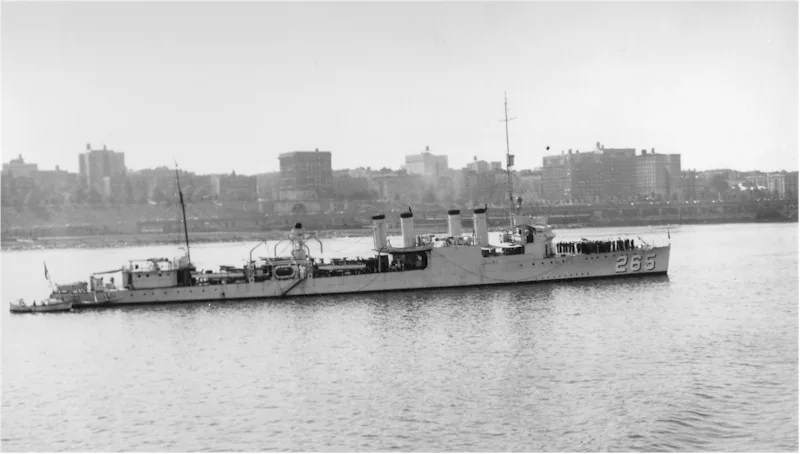
William W. Edwards, born in Petersburg, Va., was appointed a midshipman 1 September 1811. In 1813 he was assigned to Argus, and was killed in the action with HMS Pelican 14 August 1813. Destroyer No. 265 was named in his honor.
Walter Atlee Edwards, born 8 November 1886 at Philadelphia, Pa., graduated from the Naval Academy in 1910. He received the Navy Cross for his distinguished service on the staff of Commander, U.S. Naval Forces in European waters during World War I, and also was awarded the Distinguished Service Order by the King of England. On 16 December 1922 Lieutenant Commander Edwards, in command of Bainbridge (DD-246), lashed his ship to the burning French military transport Vinh-Long in the Sea of Marmora, and rescued 482 men, women, and children, all who remained alive on board. For this heroic action he was awarded the Medal of Honor and the Legion of Honor by the French Government. He died 15 January 1928 at Washington, D.C. DD-619 was named in his honor.
Edwards (Destroyer No. 265) was launched 10 October 1918 by Bethlehem Shipbuilding Corp., Squantum, Mass.; sponsored by Miss Julia Edwards Noyes, whose great-grandfather was the uncle of Midshipman Edwards; and commissioned 24 April 1919 at Boston Navy Yard, Commander P. L. Wilson in command.
Continue to the full service history About 477 words
From the Dictionary of American Naval Fighting Ships, compiled by the Naval History and Heritage Command (Edwards I (Destroyer No. 265)). A work of the United States Government, in the public domain.
Armament and machinery
Armament and machinery
- Propulsion
- 26500 shp
- geared turbines
- 2 screws
- Armament
- 4 × 4"/50 caliber guns
- 1 × 3 in/23 gun
- 12 × 21 inch (533 mm) torpedo tubes
Sister ships
- HMCS Buxton (H96)
- HMCS St. Croix (I81)
- HMCS St. Francis (I93)
- HMS Belmont (H46)
- HMS Beverley (H64)
- HMS Bradford (H72)
- HMS Broadwater (H81)
- HMS Broadway (H90)
- HMS Burnham (H82)
- HMS Burwell (H94)
- HMS Cameron (I05)
- HMS Chesterfield (I28)
- HMS Churchill (I45)
- HMS Clare (I14)
- HMS Ramsey (G60)
- HMS Reading (G71)
- HMS Ripley (G79)
- HMS Rockingham (G58)
- HMS Sherwood (I80)
- HMS Stanley (I73)
- Soviet destroyer Dejatelny
- USS Abel P. Upshur
- USS Alden
- USS Aulick (DD-258)
Sources
- Facts harvested from HMS Buxton (H96) on Wikipedia. Figures only — no wording is taken from it.
- Service history reproduced verbatim from Edwards I (Destroyer No. 265) , Dictionary of American Naval Fighting Ships — public domain, a work of the United States Government.
- Photograph: Naval Historical Center photo NH66796 — https://www.navsource.net/archives/05/265.htm — Public domain — Wikimedia Commons