HMS Sherwood (I80)
Service
- as USS Rodgers22 July 1919 — 23 October 1940418 days of the war
- as HMS Sherwood23 October 1940 — 19451,775 days of the war
- Name
- HMS Sherwood
- Pennant / hull number
- I80
- Namesake
- John Rodgers (1812–1882)
- Builder
- Bethlehem Shipbuilding Corporation, Fore River Shipyard, Quincy
- Laid down
- 25 September 1918
- Launched
- 26 April 1919
- Commissioned
- 22 July 1919
- Decommissioned
- 23 October 1940
- Struck
- 8 January 1941
- Fate
- Sold for scrap, 1945 (1945)
- Status
- Scrapped
Specifications
- Displacement, standard
- 1,190 long tons (1,209 t)
- Length
- 95.71 m (314 ft)
- Beam
- 9.45 m (31 ft)
- Draught
- 2.74 m (9 ft)
- Speed
- 34.4 knots (63.7 km/h, 39.6 mph)
- Range
- 4,900 nmi (9,075 km)
- Complement
- 131
- Main gun
- 102 mm (4 in)
John Rodgers, 1772 to 1838; his son, John Rodgers, 1812 to 1882, and his great grandson, John Rodgers, 1881 to 1926, all served the U.S. Navy with distinction. See, John Rodgers , vol. III, page 545 for biographies.
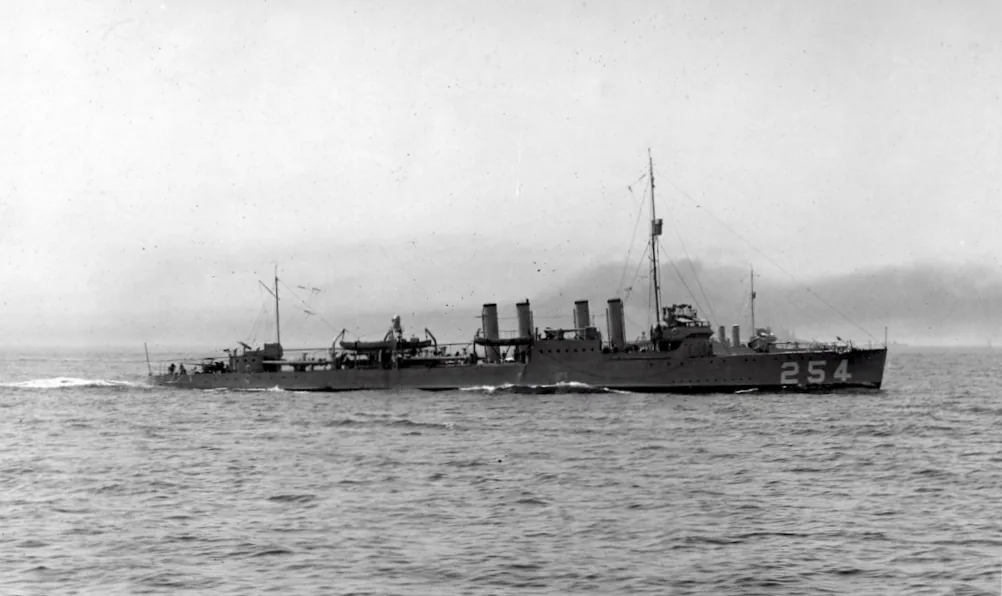
The third Rodgers (Destroyer No. 254) was laid down as Kalk 25 September 1918 by the Bethlehem Shipbuilding Corp., Quincy, Mass.; renamed Rodgers 23 December 1918; launched 26 April 1919; sponsored by Miss Helen T. Rodgers, granddaughter of Commodore John Rodgers; and commissioned 22 July 1919, Lt. Comdr. A. M. Steckel in command.
Rodgers served with Division 28, Destroyers, Atlantic Fleet, until the spring of 1922 when she steamed to Philadelphia for inactivation. Decommissioned 20 July of that year, she remained in reserve until after the outbreak of World War II in Europe.
Rodgers , recommissioned 18 December 1939, again served briefly with the Atlantic Fleet, and in October 1940 moved to Halifax where she joined other "four stackers" being transferred to the United Kingdom in exchange for bases in the Western Hemisphere. She decommissioned 23 October 1940 and was transferred and commissioned the same day for service in the 4th "Town" Flotilla as HMS Sherwood (I. 80).
Sherwood sailed for the United Kingdom 1 November. Diverted en route, she participated in the search for survivors of ships lost from convoy HX-84 and in the subsequent hunt for Admiral Scheer , when returning to Canada for repairs. On the 18th, she arrived at Belfast, continued on to Portsmouth, whence, after overhaul, she sailed to join the 12th Escort Group, Western Approaches Command at Londonderry. Transferred, with her group, to Iceland in April 1941, she joined in the hunt for Bismarck in May and on the 28th, the day after the German battleship had been sunk, assisted in rescue operations for survivors from British destroyer HMS Mashona (F. 59).
During the summer, Sherwood underwent repairs in the Clyde, then returned to Londonderry, whence she operated, first with the 2d Escort Group, then with the 22d, into the new year, 1942. In February and March, she accompanied carriers during trials, and, after another yard period, April to August, served as a target ship for training aircraft from the Royal Naval Air Station at Fearn, Scotland. In the autumn, she again crossed the Atlantic and served with the Newfoundland Command until she returned to Londonderry in February 1943. During March and April she escorted a convoy to Tunisia and back, but by May she again needed major repairs. Worn out, she was paid off at Chatham; stripped of useable parts and ordnance; and towed to the Humber where she was beached in shallow water for use as an aircraft target. Her hulk was scrapped in 1945.
From the Dictionary of American Naval Fighting Ships, compiled by the Naval History and Heritage Command (Rodgers IV (Destroyer No. 254)). A work of the United States Government, in the public domain.
Armament and machinery
Armament and machinery
- Propulsion
- 26500 shp
- geared turbines
- 2 screws
- Armament
- 4 x 4 in guns
- 1 x 3 in gun
- 12 x 21 inch (533 mm) torpedo tubes
Sister ships
- HMCS Buxton (H96)
- HMCS St. Croix (I81)
- HMCS St. Francis (I93)
- HMS Belmont (H46)
- HMS Beverley (H64)
- HMS Bradford (H72)
- HMS Broadwater (H81)
- HMS Broadway (H90)
- HMS Burnham (H82)
- HMS Burwell (H94)
- HMS Buxton (H96)
- HMS Cameron (I05)
- HMS Chesterfield (I28)
- HMS Churchill (I45)
- HMS Clare (I14)
- HMS Ramsey (G60)
- HMS Reading (G71)
- HMS Ripley (G79)
- HMS Rockingham (G58)
- HMS Stanley (I73)
- Soviet destroyer Dejatelny
- USS Abel P. Upshur
- USS Alden
- USS Aulick (DD-258)
Sources
- Facts harvested from HMS Sherwood (I80) on Wikipedia. Figures only — no wording is taken from it.
- Service history reproduced verbatim from Rodgers IV (Destroyer No. 254) , Dictionary of American Naval Fighting Ships — public domain, a work of the United States Government.
- Photograph: U.S. Navy — U.S. Navy Bureau of Ships photo 19-N-3383 from Navsource.org — Public domain — Wikimedia Commons