USS Burlington (PF-51)
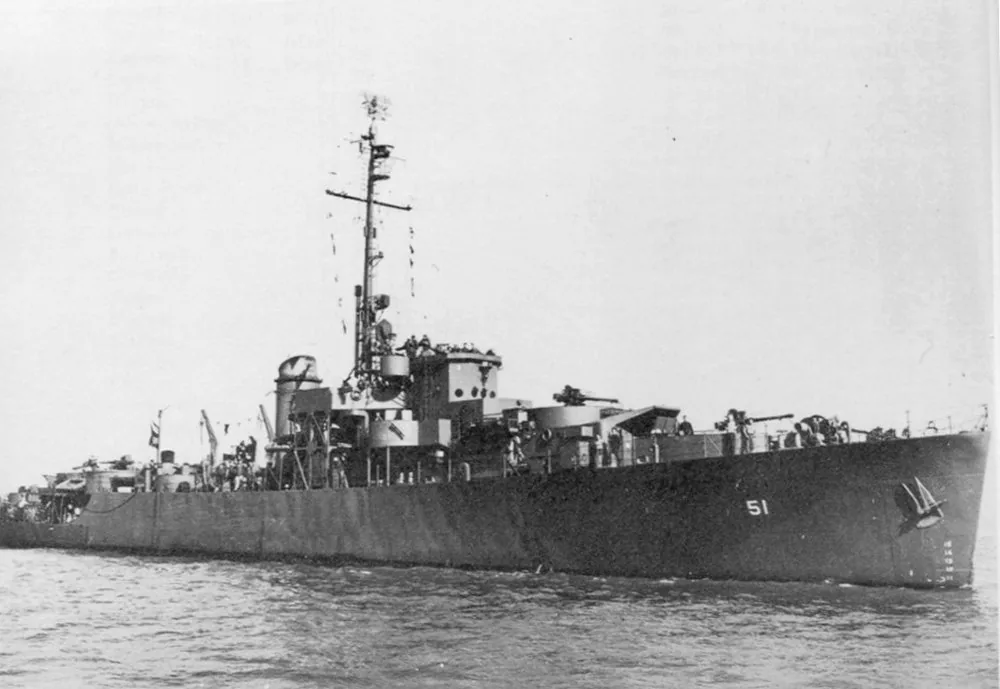
Service
- as Burlington3 April 1944 — 28 May 1953517 days of the war
- as EK-2126 August 1945 — 14 November 19497 days of the war
- as Almirante Brión26 June 1953 — 1968
- Name
- USS Burlington
- Pennant / hull number
- PF-51
- Namesake
- City of Burlington, Iowa
- Laid down
- 19 October 1943
- Launched
- 7 December 1943
- Commissioned
- 3 April 1944
- Decommissioned
- 26 August 1945
- Recommissioned
- 5 January 1951
- Struck
- 28 May 1953
- Fate
- Scrapped 1968 (1968)
- Status
- Scrapped
Specifications
- Displacement, standard
- 1,264 long tons (1,284 t)
- Length
- 92.35 m (303 ft)
- Beam
- 11.28 m (37 ft)
- Draught
- 3.96 m (13 ft)
- Speed
- 20 knots (37 km/h, 23 mph)
- Complement
- 190
- Main gun
- 76 mm (3 in)
The first Burlington (PF-51) was laid down under a Maritime Commission contract (M.C. Hull 1462) on 19 October 1943 at Wilmington, Calif., by Consolidated Steel Corp., Ltd.; launched on 7 December 1943; sponsored by Mrs. Max A. [Florence] Conrad, wife of the Mayor of Burlington, Iowa; acquired by the Navy on 31 March 1944; and commissioned on 3 April 1944, Lt. Cmdr. E. B. Carlson, USCG, in command.
The USCG-manned Burlington got underway from San Pedro, Calif., on 1 August 1944 following shakedown and completion of post-shakedown availability. Her first assignment took her to Espiritu Santo, New Hebrides, then to carry out patrol and escort duties supporting operations in western New Guinea from 21 August. Subsequently, from 16 October until 18 November, Burlington escorted convoys between New Guinea and the Philippine Islands in support of the invasion of Leyte. She departed that area on 3 December and returned to California, arriving at San Francisco on Christmas Day 1944 to begin an availability.
After voyage repairs and preparations for cold weather operations, Burlington sailed on 18 February 1945 for the Aleutian Islands, arriving at Dutch Harbor on 26 February where she was assigned to Escort Division 43 for patrol and escort duty. Between 18 July and 2 August she underwent repairs and alterations at Tacoma, Wash., in preparation for her slated transfer to the Soviet Union in Project Hula . On 8 August, Burlington departed Seattle for Cold Bay, Alaska, where she engaged in training a prospective Soviet crew until 26 August 1945, when she decommissioned and transferred to the Soviet Union under Lend-Lease. Classified as an escort vessel ( storozhevoi korabl ), Burlington was renamed EK-21 .
Continue to the full service history About 525 words
From the Dictionary of American Naval Fighting Ships, compiled by the Naval History and Heritage Command (Burlington I (PF-51)). A work of the United States Government, in the public domain.
Armament and machinery
Armament and machinery
- Propulsion
- 2 × 5500 shp turbines
- 3 boilers
- 2 shafts
- Armament
- 3 × 3"/50 dual purpose guns (3x1)
- 4 x 40 mm guns (2×2)
- 9 × 20 mm guns (9×1)
- 1 × Hedgehog anti-submarine mortar
- 8 × Y-gun depth charge projectors
- 2 × Depth charge tracks
Sister ships
- Soviet frigate EK-1
- Soviet frigate EK-10
- Soviet frigate EK-11
- Soviet frigate EK-12
- Soviet frigate EK-13
- Soviet frigate EK-14
- Soviet frigate EK-15
- Soviet frigate EK-16
- Soviet frigate EK-17
- Soviet frigate EK-18
- Soviet frigate EK-19
- Soviet frigate EK-2
- Soviet frigate EK-20
- Soviet frigate EK-21
- Soviet frigate EK-22
- Soviet frigate EK-25
- Soviet frigate EK-26
- Soviet frigate EK-27
- Soviet frigate EK-28
- Soviet frigate EK-29
- Soviet frigate EK-3
- Soviet frigate EK-30
- Soviet frigate EK-4
- Soviet frigate EK-5
Sources
- Facts harvested from USS Burlington (PF-51) on Wikipedia. Figures only — no wording is taken from it.
- Service history reproduced verbatim from Burlington I (PF-51) , Dictionary of American Naval Fighting Ships — public domain, a work of the United States Government.
- Photograph: U.S. National Archives photograph — https://www.navsource.net/archives/12/08051.htm — Public domain — Wikimedia Commons