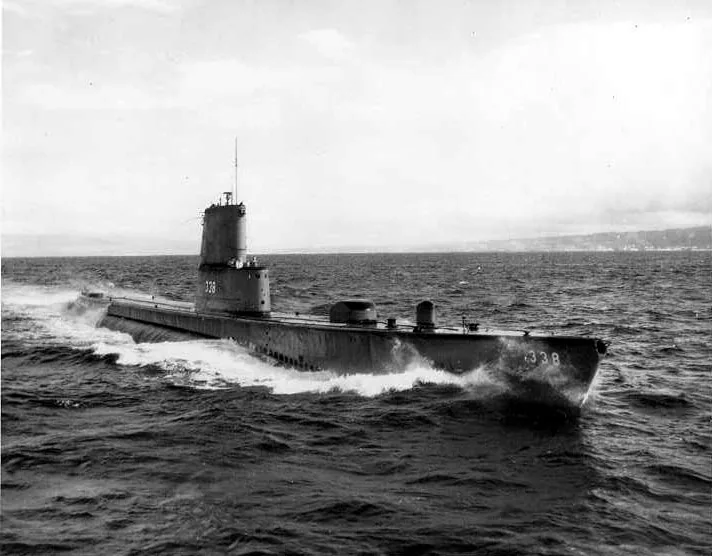
USS Carp (SS-338)
Service
- 28 February 1945 — 18 March 1968186 days of the war
- Name
- USS Carp
- Pennant / hull number
- SS-338
- Builder
- Electric Boat Company, Groton, Connecticut
- Laid down
- 23 December 1943
- Launched
- 12 November 1944
- Commissioned
- 28 February 1945
- Decommissioned
- 18 March 1968
- Struck
- 20 December 1971
- Fate
- Sold for scrap, 26 July 1973 (1973)
- Status
- Scrapped
Specifications
- Displacement, surfaced
- 1,526 long tons (1,550 t)
- Displacement, submerged
- 2,424 long tons (2,463 t)
- Length
- 94.79 m (311 ft)
- Beam
- 8.23 m (27 ft)
- Draught
- 4.88 m (16 ft)
- Speed
- 20.3 knots (37.5 km/h, 23.3 mph)
- Range
- 11,000 nmi (20,372 km)
- Complement
- 10
Carp (SS-338) was launched 12 November 1944 by Electric Boat Co., Groton, Conn.; sponsored by Mrs. W. E. Hess; and commissioned 28 February 1945, Lieutenant Commander J. L. Hunnicutt, USNR, in command.
Carp departed New London 14 April 1945, conducted training at Balboa, and arrived at Pearl Harbor 21 May. On her first and only war patrol (8 June-7 August), Carp cruised off the coast of Honshu, destroying small craft and patrolling for the carriers of the 3d Fleet engaged in air strikes on the mainland. Undergoing refit at Midway when hostilities ended, Carp returned to Seattle 22 September.
Based on San Diego as flagship for Submarine Division 71, Carp operated along the west coast with occasional training cruises to Pearl Harbor. Between 13 February and 15 June 1947 she made a simulated war patrol to the Far East, and in 1948 and 1949 Carp made two exploratory cruises to extreme northern waters, adding to the knowledge of an increasingly important strategic area for submarine operations.
Converted to a guppy-type submarine in February 1952, which added to her submerged speed and endurance, Carp supported United Nations' forces in the Korean War during her cruise of 22 September 1952-April 1953 to the Far East. Arriving at Pearl Harbor, her new home port 15 March 1954, Carp remained on active duty with the fleet from that port through July1959. During this time she continued to make cruises to the Far East, one of which included a good-will visit to Australia and participation in a Southeast Asia Treaty Organization exercise, and to Alaskan waters. On 1 August 1959 Carp departed Pearl Harbor for her new assignment with the Atlantic Fleet. Arriving at Norfolk, Va., 28 August 1959, the submarine has conducted type exercises and training off the east coast and in the Caribbean through 1963.
From the Dictionary of American Naval Fighting Ships, compiled by the Naval History and Heritage Command (Carp (SS-338)). A work of the United States Government, in the public domain.
Armament and machinery
Armament and machinery
- Propulsion
- 4 × General Motors Model 16-278A V16 diesel engines driving electrical generators
- 2 × 126-cell Sargo batteries
- 4 × high-speed General Electric electric motors with reduction gears
- 2 × propellers
- 5,400 shp (4.0 MW) surfaced
- 2,740 shp (2.0 MW) submerged
- Armament
- 2 5”/25 wet mount deck guns
Sister ships
- ARA Santa Fe (S-21)
- USS Apogon
- USS Archerfish (SS-311)
- USS Aspro (SS-309)
- USS Atule
- USS Balao
- USS Bang
- USS Barbel (SS-316)
- USS Barbero
- USS Batfish (SS-310)
- USS Baya
- USS Becuna
- USS Bergall (SS-320)
- USS Besugo
- USS Billfish (SS-286)
- USS Blackfin
- USS Blanquillo (SS-323)
- USS Blenny
- USS Blower
- USS Blueback (SS-326)
- USS Boarfish
- USS Bowfin
- USS Brill
- USS Bugara
Sources
- Facts harvested from USS Carp (SS-338) on Wikipedia. Figures only — no wording is taken from it.
- Service history reproduced verbatim from Carp (SS-338) , Dictionary of American Naval Fighting Ships — public domain, a work of the United States Government.
- Photograph: U.S. Navy — U.S. Navy photo [1] from Navsource.org — Public domain — Wikimedia Commons