USS Charrette
Service
- as Charrette18 May 1943 — 15 January 1947838 days of the war
- as Velos16 June 1959 — 1 September 1975
- Name
- USS Charrette
- Pennant / hull number
- DD-581
- Namesake
- George Charrette
- Builder
- Boston Navy Yard
- Laid down
- 20 February 1942
- Launched
- 3 June 1942
- Commissioned
- 18 May 1943
- Decommissioned
- 15 January 1947
- Struck
- 1 September 1975
- Fate
- Transferred to the Hellenic Royal Navy, 16 June 1959 (1959)
- Status
- Unknown
Specifications
- Displacement, full load
- 2,100 long tons (2,134 t)
- Length
- 114.6 m (376 ft)
- Beam
- 11.89 m (39 ft)
- Draught
- 5.4 m (17.7 ft)
- Speed
- 35 knots (64.8 km/h, 40.3 mph)
- Range
- 6,500 nmi (12,038 km)
- Complement
- 329
- Main gun
- 127 mm (5 in)
George Charrette, born in Lowell, Mass., 6 June 1867, enlisted in the Navy 24 September 1884. As a gunner's mate third class, on 2 June 1898, he volunteered with seven others to sink Merrimac under heavy Spanish fire across the entrance to the harbor of Santiago, Cuba, thus bottling up the enemy fleet. Taken prisoner by the Spanish, Charrette was exchanged 6 July 1898. He was awarded the Congressional Medal of Honor for extraordinary heroism, commissioned lieutenant 3 August 1920, and retired from the Navy in 1925. He died 7 February 1938.
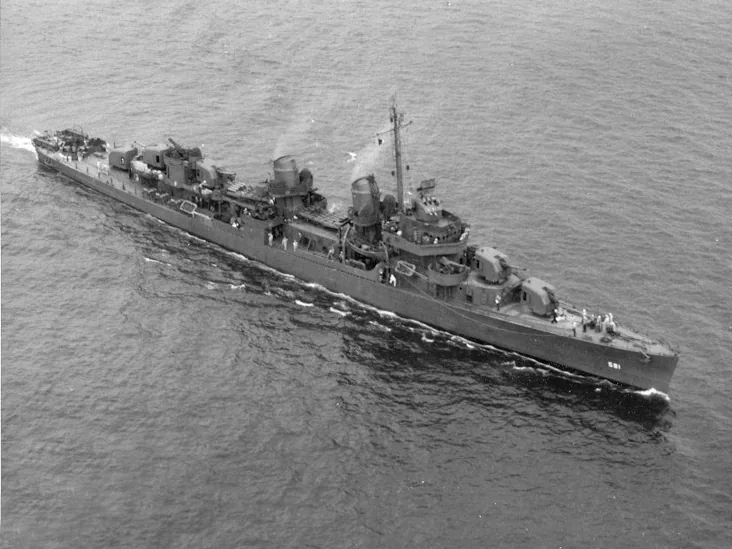
Charrette (DD-581) was launched 3 June 1942 by Boston Navy Yard; sponsored by Mrs. G. Charrette; and commissioned 18 May 1943, Commander E. S. Karpe in command.
Charrette cleared New York 20 September 1943 to escort Monterey (CVL-26) to Pacific service. Arriving at Pearl Harbor 9 October, Charrette took part in training exercises until 10 November, when she put to sea with TF 50, for air raids on Japanese bases in the Marshalls. These strikes neutralized enemy air opposition to the landings at Makin and Tarawa which followed. On 26 November, Charrette joined the screen of the task group assigned to air-cover operations over Makin and Tarawa themselves, providing protection to the assault shipping and support for the Marines ashore. Twelve days later, the destroyer screened battleships in a pounding bombardment on Nauru Island, then rejoined the carriers sailing on to Efate. From this base Charrette sailed on 21 December to screen the carriers as they launched strikes against Kavieng, New Ireland, during the 3 days preceding the assault on Cape Gloucester 26 December. Continuing north, the group arrived at Funafuti 21 January 1944 to prepare for the operations against the Marshall Islands.
Continue to the full service history About 1,256 words
From the Dictionary of American Naval Fighting Ships, compiled by the Naval History and Heritage Command (Charrette (DD-581)). A work of the United States Government, in the public domain.
Armament and machinery
Armament and machinery
- Propulsion
- 60000 shp
- 2 sets of General Electric geared steam turbines, 1 set of 3 for each shaft (cruising, low pressure, high pressure)
- 4 Foster Wheeler boilers (two furnaces each), maximum steam pressure: 525 psi, maximum steam temperature: 825 F
- 2 propellers
- Armament
- 5 × Single 5 in guns
- 4 × 40 mm AA guns
- 4 × 20 mm AA guns
- 10 × 21 inch (533 mm) torpedo tubes
- 6 × depth charge projectors
- 2 × depth charge tracks
- (in Greek service)
- 4 × 127 mm/38 cal. guns
- 3 × twin 3 in/50 RF AA guns
- 2× 12.7 mm M2 Browning machine guns
- 1 × quintuple 533 mm torpedo tubes (for Mk 14 torpedoes)
- 2 × triple 325 mm anti-submarine torpedo tubes (for Mk 44-Mk 46 torpedoes)
- 2 × Hedgehog (weapon) launchers (Mark 11, 24 bombs each)
- 1 × depth charge track for 12 Mk 9 depth charges
- 12 (2×6) Super RBOC chaffs & flares launchers
- 4 FIM-43 Redeye man-portable surface-to-air missiles (after 1976)
Sister ships
- USS Abbot (DD-629)
- USS Abner Read (DD-526)
- USS Albert W. Grant
- USS Ammen (DD-527)
- USS Anthony (DD-515)
- USS Aulick (DD-569)
- USS Bache (DD-470)
- USS Beale (DD-471)
- USS Bearss
- USS Bell (DD-587)
- USS Benham (DD-796)
- USS Bennett
- USS Bennion
- USS Black
- USS Boyd
- USS Bradford
- USS Braine
- USS Brown (DD-546)
- USS Brownson (DD-518)
- USS Bryant
- USS Bullard
- USS Burns (DD-588)
- USS Bush (DD-529)
- USS Callaghan (DD-792)
Sources
- Facts harvested from USS Charrette on Wikipedia. Figures only — no wording is taken from it.
- Service history reproduced verbatim from Charrette (DD-581) , Dictionary of American Naval Fighting Ships — public domain, a work of the United States Government.
- Photograph: U.S. Navy — U.S. Navy photo 80-G-74846 from Navsource.org — Public domain — Wikimedia Commons