USS Farenholt (DD-491)
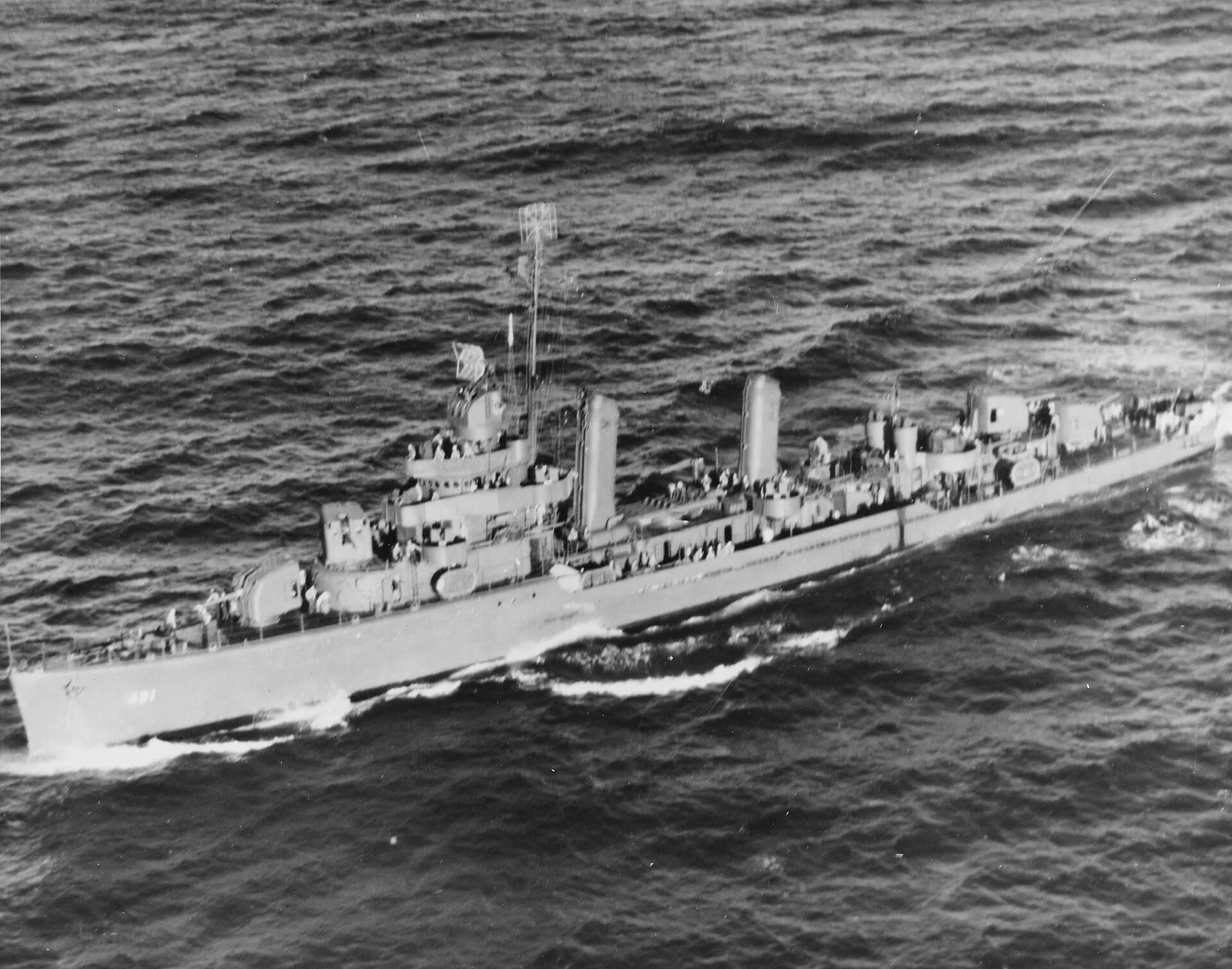
Service
- as Farenholt2 April 1942 — 26 April 19461,249 days of the war
- Name
- USS Farenholt
- Pennant / hull number
- DD-491
- Namesake
- Oscar Farenholt
- Builder
- Bethlehem Mariners Harbor, Staten Island
- Launched
- 19 November 1941
- Commissioned
- 2 April 1942
- Decommissioned
- 26 April 1946
- Struck
- June 1971
- Fate
- Sold for scrap, November 1972 (1972)
- Status
- Scrapped
Specifications
- Displacement, standard
- 1,620 long tons (1,646 t)
- Length
- 106.07 m (348 ft)
- Beam
- 10.97 m (36 ft)
- Draught
- 3.35 m (11 ft)
- Speed
- 38 knots (70.4 km/h, 43.7 mph)
- Complement
- 208
- Main gun
- 127 mm (5 in)
Oscar Walter Farenholt, born 2 May 1843 in San Antonio, Tex., entered the Navy as a seaman 24 April 1861, after 3 years in the merchant service. Distinguished service led to his appointment as acting ensign 19 August 1864, and command of the mortar schooner Henry Janes in the sounds of North Carolina later that year. His last of many important billets at sea was in command of Monocacy, who acted as base of procurement at Shanghai for Dewey's fleet in the Spanish-American War. Rear Admiral Farenholt retired 1 September 1901, and died 30 June 1920 at Mare Island, Calif.
The second Farenholt (DD-491) was launched 19 November 1941 by Bethlehem Steel Co., Staten Island, N.Y.; sponsored by Miss N. L. Garland, great-grand-niece of Admiral Farenholt; and commissioned 2 April 1942, Lieutenant Commander E. T. Seaward in command.
Farenholt sailed from San Diego 1 July 1942 for Tongatabu, Tonga Islands, where between 18 and 23 July she joined in shore bombardment exercises. Sailing in the task force centered around Wasp (CV-7), Farenholt took part in the invasion of Guadalcanal 7 August, the first American land offensive of the war. She screened Wasp as the carrier launched air strikes supporting the Marines in the initial days of this long and bitter struggle, and acted as flagship for Destroyer Squadron 12. After replenishing at Noumea from 3 to 8 September, she returned to the Wasp group, covering the transportation of reinforcements from Espiritu Santo to Guadalcanal. When her force was attacked by two Japanese submarines 15 September, she rescued 143 survivors of torpedoed Wasp, including the task force commander and the commanding officer of the carrier.
Continue to the full service history About 1,198 words
From the Dictionary of American Naval Fighting Ships, compiled by the Naval History and Heritage Command (Farenholt II (DD-491)). A work of the United States Government, in the public domain.
Armament and machinery
Armament and machinery
- Armament
- 4 × single 5 in guns
- 1 × quintuple 21 in (533 mm) torpedo tubes
- 6 × depth charge throwers, 2 × depth charge racks
Sister ships
- USS Bailey (DD-492)
- USS Bancroft (DD-598)
- USS Barton (DD-599)
- USS Benson
- USS Boyle
- USS Caldwell (DD-605)
- USS Champlin (DD-601)
- USS Charles F. Hughes
- USS Coghlan (DD-606)
- USS Frazier
- USS Gansevoort
- USS Gillespie
- USS Hilary P. Jones
- USS Hobby
- USS Kalk (DD-611)
- USS Kendrick
- USS Laffey (DD-459)
- USS Lansdale (DD-426)
- USS Laub (DD-613)
- USS MacKenzie (DD-614)
- USS Madison (DD-425)
- USS Mayo
- USS McLanahan (DD-615)
- USS Meade (DD-602)
Sources
- Facts harvested from USS Farenholt (DD-491) on Wikipedia. Figures only — no wording is taken from it.
- Service history reproduced verbatim from Farenholt II (DD-491) , Dictionary of American Naval Fighting Ships — public domain, a work of the United States Government.
- Photograph: USN — Official U.S. Navy photograph 19-N-45993 — Public domain — Wikimedia Commons