USS Gloucester (PF-22)
Service
- as Gloucester (PG-130)10 December 1943 — 1 December 1961632 days of the war
- as EK-264 September 1945 — 31 October 1949
- as Tsuge1 October 1953 — 31 March 1968
- Name
- USS Gloucester
- Pennant / hull number
- PF-22
- Namesake
- City of Gloucester, Massachusetts
- Builder
- Walter Butler Shipbuilding Company, Superior, Wisconsin
- Laid down
- 4 March 1943
- Launched
- 12 July 1943
- Commissioned
- 10 December 1943
- Decommissioned
- 3 September 1945
- Recommissioned
- 11 October 1950
- Struck
- 1 December 1961
- Fate
- Returned to United States, 31 March 1969 (1969)
- Status
- Unknown
Specifications
- Displacement, standard
- 2,415 long tons (2,454 t)
- Length
- 92.35 m (303 ft)
- Beam
- 11.28 m (37 ft)
- Draught
- 3.96 m (13 ft)
- Speed
- 20 knots (37 km/h, 23 mph)
- Complement
- 190
- Main gun
- 76 mm (3 in)
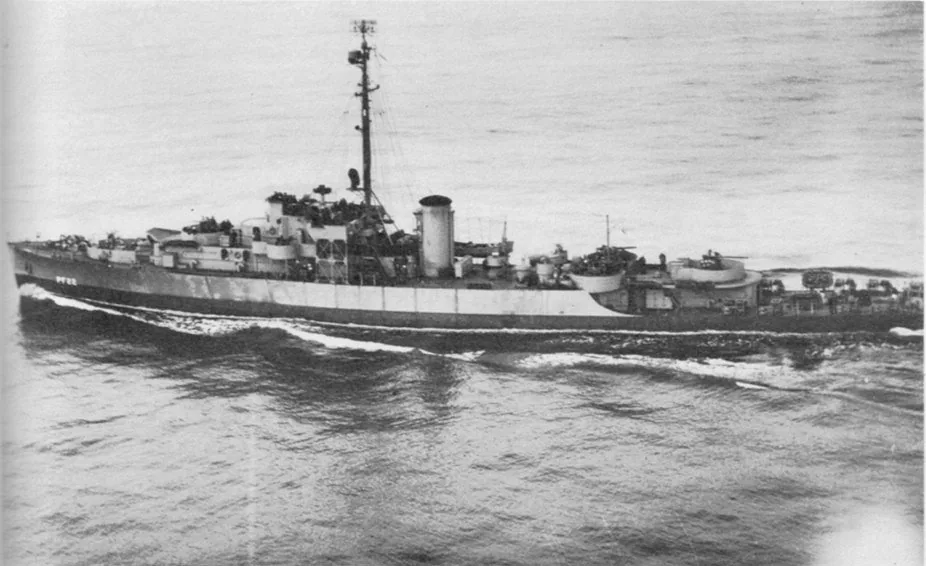
The second Gloucester (PF-22) a frigate, was launched 12 July 1943 by the Walter Butler Shipbuilding Co., Superior, Wis., under a Maritime Commission contract; sponsored by Mrs. Emily K. Ross; acquired and simultaneously commissioned 10 December 1943.
Following shakedown, Gloucester was employed in training frigate crews at Galveston, Texas. On 16 June 1944 she was attached to Escort Division 38 and was later ordered to the Alaskan Sea Frontier for transfer to Russia under lend-lease legislation. Leased to Russia 4 September 1945 and renamed EK-26, she served as a patrol vessel in the Far East. Gloucester was returned to the United States at Yokosuka, Japan, 31 October 1949 and recommissioned 11 October 1950.
She sailed from Yukosuka 27 November 1950 for Korea and conducted patrol and antisubmarine warfare duties at Wonsan, Pusan, Inchon, and Kusan until returning to Yokosuka 21 January 1951. Gloucester subsequently engaged in patrol and escort duties at Wonsan and saw combat 18 June 1951 when with other ships she blasted gun emplacements at Wonsan. She continued her duties in Korean waters through the fall of 1951. On 11 November 1951 while cruising off Kojo in a duel with shore batteries, Gloucester took a direct hit that killed 1 man and wounded 11. Following repairs at Japan, she returned to Korean waters to continue effective support of U.N. forces ashore. Arriving at Yokosuka 5 September 1952, she decommissioned there 15 September 1952. Gloucester was loaned to Japan 1 October 1953, struck from the Navy List 1 December 1961, and transferred to Japan in March 1962 where she serves as Tsuge (PF-292).
From the Dictionary of American Naval Fighting Ships, compiled by the Naval History and Heritage Command (Gloucester II (PF-22)). A work of the United States Government, in the public domain.
Armament and machinery
Armament and machinery
- Propulsion
- 2 × 5500 shp turbines
- 3 boilers
- 2 shafts
- Armament
- 3 × 3"/50 dual purpose guns (3x1)
- 4 x 40 mm guns (2×2)
- 9 × 20 mm guns (9×1)
- 1 × Hedgehog anti-submarine mortar
- 8 × Y-gun depth charge projectors
- 2 × Depth charge tracks
Sister ships
- Soviet frigate EK-1
- Soviet frigate EK-10
- Soviet frigate EK-11
- Soviet frigate EK-12
- Soviet frigate EK-13
- Soviet frigate EK-14
- Soviet frigate EK-15
- Soviet frigate EK-16
- Soviet frigate EK-17
- Soviet frigate EK-18
- Soviet frigate EK-19
- Soviet frigate EK-2
- Soviet frigate EK-20
- Soviet frigate EK-21
- Soviet frigate EK-22
- Soviet frigate EK-25
- Soviet frigate EK-26
- Soviet frigate EK-27
- Soviet frigate EK-28
- Soviet frigate EK-29
- Soviet frigate EK-3
- Soviet frigate EK-30
- Soviet frigate EK-4
- Soviet frigate EK-5
Sources
- Facts harvested from USS Gloucester (PF-22) on Wikipedia. Figures only — no wording is taken from it.
- Service history reproduced verbatim from Gloucester II (PF-22) , Dictionary of American Naval Fighting Ships — public domain, a work of the United States Government.
- Photograph: US Navy — https://www.navsource.net/archives/12/08022.htm — Public domain — Wikimedia Commons