USS Ingersoll (DD-652)
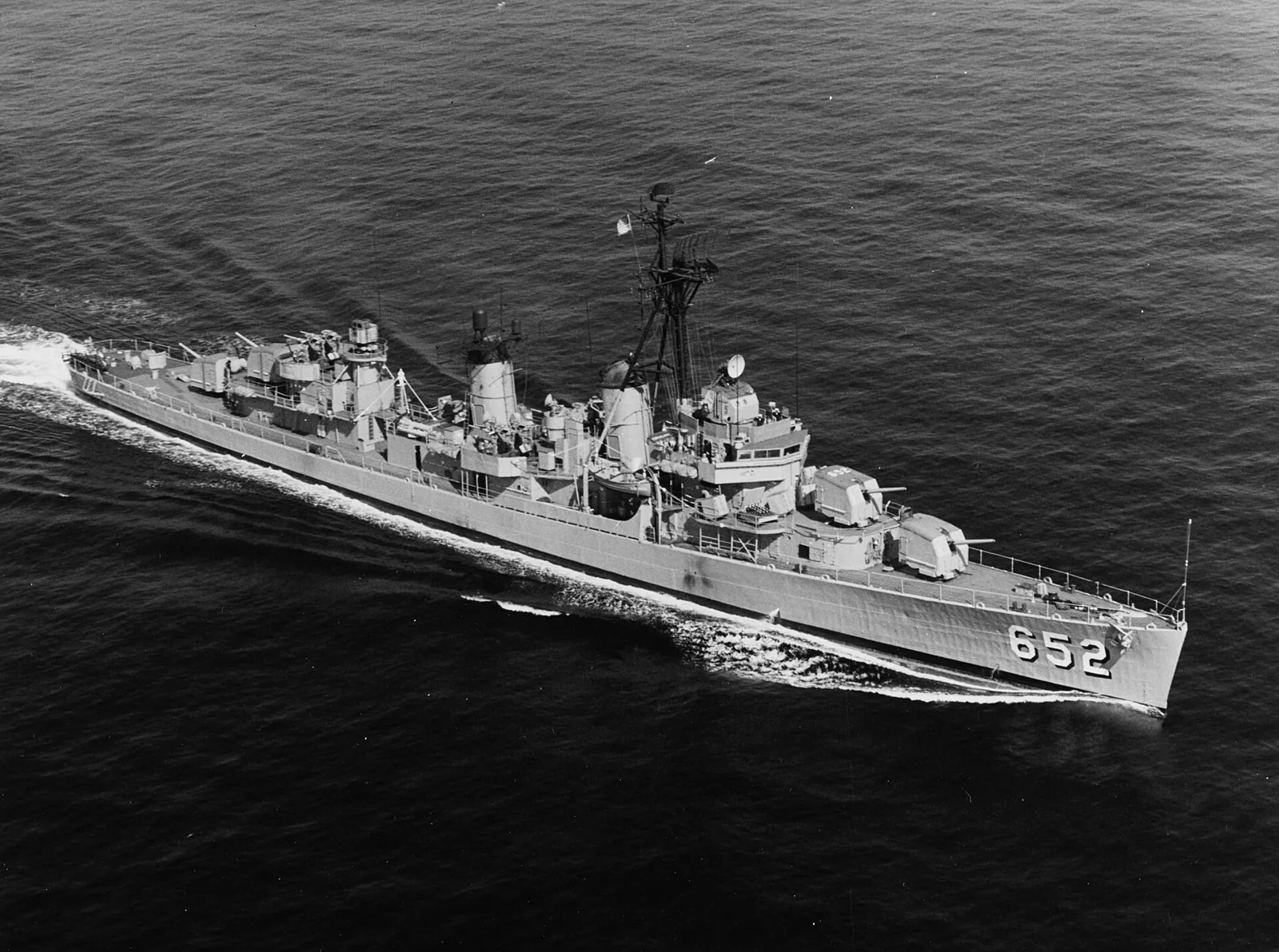
Service
- 31 August 1943 — 20 January 1970736 days of the war
- Name
- USS Ingersoll
- Pennant / hull number
- DD-652
- Namesake
- Royal R. Ingersoll
- Builder
- Bath Iron Works
- Laid down
- 18 February 1943
- Launched
- 28 June 1943
- Commissioned
- 31 August 1943
- Struck
- 20 January 1970
- Fate
- Sunk as a target, 19 May 1974 (1974)
- Status
- Wreck
Specifications
- Displacement, standard
- 2,050 long tons (2,083 t)
- Length
- 114.6 m (376 ft)
- Beam
- 11.89 m (39 ft)
- Draught
- 5.18 m (17 ft)
- Speed
- 35 knots (64.8 km/h, 40.3 mph)
- Range
- 6,500 nmi (12,038 km)
- Complement
- 319
- Main gun
- 127 mm (5 in)
Royal Rodney Ingersoll was born in Niles, Mich., 4 December 1847, and graduated from the Naval Academy in 1868. He served in various ships of the fleet on the European and Asiatic Squadrons until 1876 when he was assigned to the Naval Academy. Ingersoll taught and wrote about Ordnance subjects during several tours at the Academy, and in the early years of the 20th century commanded such ships as Bennington, New Orleans, and Maryland. He was Chief of Staff of the Atlantic Fleet during the first part of its famous cruise around the world, and a member of the General Board in 1908. Rear Admiral Ingersoll retired in 1909, but was called back to duty during World War I as President of the Naval Ordnance Board. In 1919 he returned to his home in Laporte, Ind., where he was active in public affairs until his death 21 April 1931.
Royal Rodney Ingersoll III, the grandson of Admiral Ingersoll, was born at Manila, P.I., 17 December 1913. After graduating from the Naval Academy in 1934, he served in California, Cassin, and other ships during the thirties, and reported on board carrier Hornet during her fitting out period in 1941. Lieutenant Ingersoll served in Hornet during the critical early months of the Pacific war. In the great Battle of Midway 4 to 6 June 1942, in which the U.S. fleet decisively turned back the Japanese threat to the Hawaiian Islands, he was killed at his battle station by machine gun fire from Japanese aircraft.
Ingersoll (DD-652) was launched by Bath Iron Works Corp., Bath, Maine, 28 June 1942; cosponsored by Miss Alice Jean Ingersoll, granddaughter of Admiral Ingersoll, and Mrs. R. R. Ingersoll II, widow of Lieutenant Ingersoll; and commissioned at Boston Navy Yard 31 August 1943, Comdr. A. C. Veasy in command.
Continue to the full service history About 2,047 words
From the Dictionary of American Naval Fighting Ships, compiled by the Naval History and Heritage Command (Ingersoll (DD-652)). A work of the United States Government, in the public domain.
Armament and machinery
Armament and machinery
- Propulsion
- 2 propellers
- Power
- 60,000 shp (45 MW)
- Armament
- 5 × 5 in
- 4 × 40 mm AA guns
- 4 × 20 mm AA guns
- 10 × 21 inch (533 mm) torpedo tubes
- 6 × depth charge projectors
- 2 × depth charge tracks
Sister ships
- USS Abbot (DD-629)
- USS Abner Read (DD-526)
- USS Albert W. Grant
- USS Ammen (DD-527)
- USS Anthony (DD-515)
- USS Aulick (DD-569)
- USS Bache (DD-470)
- USS Beale (DD-471)
- USS Bearss
- USS Bell (DD-587)
- USS Benham (DD-796)
- USS Bennett
- USS Bennion
- USS Black
- USS Boyd
- USS Bradford
- USS Braine
- USS Brown (DD-546)
- USS Brownson (DD-518)
- USS Bryant
- USS Bullard
- USS Burns (DD-588)
- USS Bush (DD-529)
- USS Callaghan (DD-792)
Sources
- Facts harvested from USS Ingersoll (DD-652) on Wikipedia. Figures only — no wording is taken from it.
- Service history reproduced verbatim from Ingersoll (DD-652) , Dictionary of American Naval Fighting Ships — public domain, a work of the United States Government.
- Photograph: PH2 J.V. Cullinan, USN — Official U.S. Navy photo NH 107203 from the U.S. Navy Naval History and Heritage Command — Public domain — Wikimedia Commons