USS Manta (SS-299)
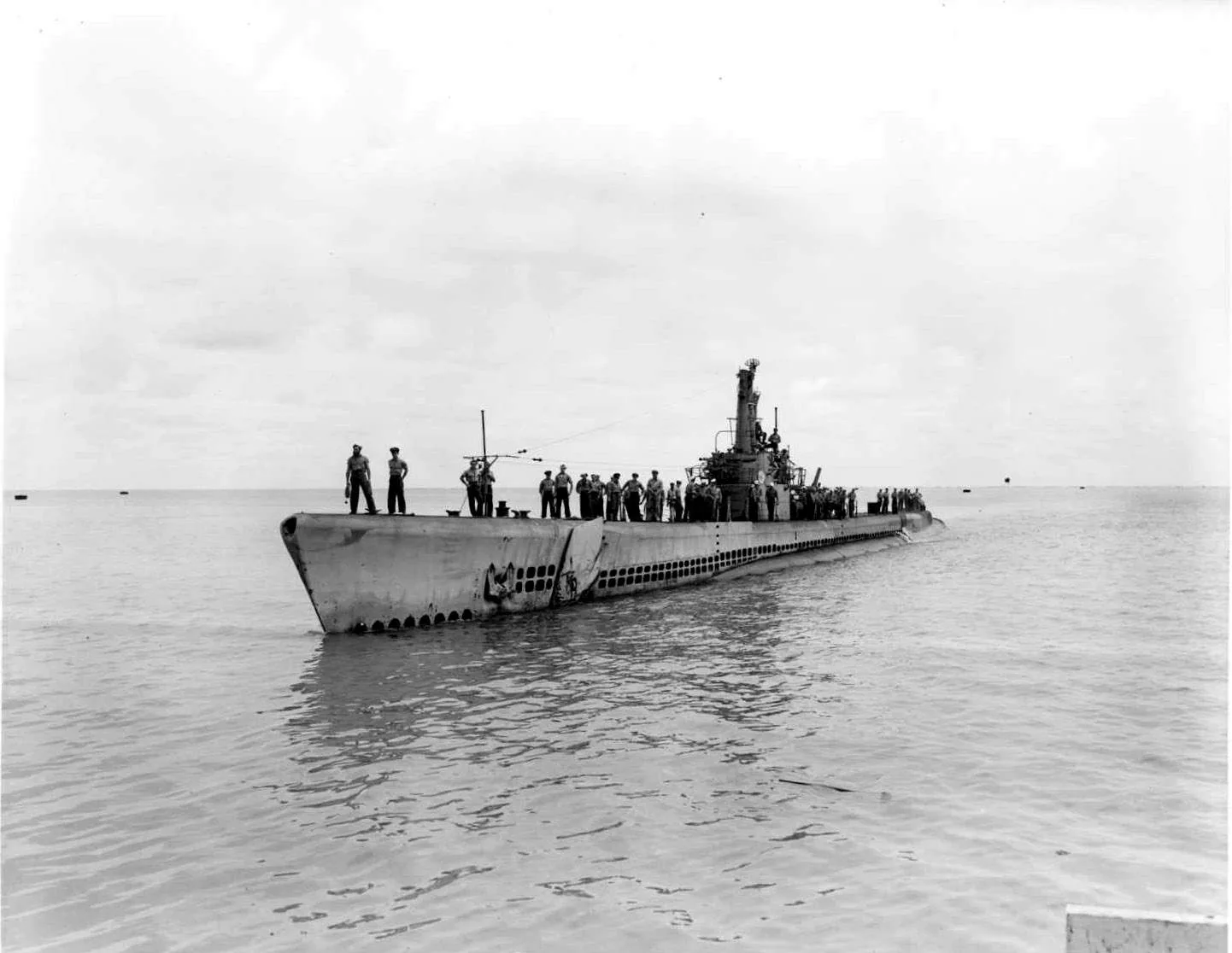
Service
- 18 December 1944 — 6 December 1955258 days of the war
- Name
- USS Manta
- Pennant / hull number
- SS-299
- Builder
- Cramp Shipbuilding Company, Philadelphia, Pennsylvania
- Laid down
- 15 January 1943
- Launched
- 7 November 1943
- Commissioned
- 18 December 1944
- Decommissioned
- 10 June 1946
- Recommissioned
- 2 August 1949
- Struck
- 30 June 1967
- Fate
- Sunk as a target off Hampton, Virginia, 16 July 1969 (1969)
- Status
- Wreck
Specifications
- Displacement, surfaced
- 1,526 long tons (1,550 t)
- Displacement, submerged
- 2,424 long tons (2,463 t)
- Length
- 94.79 m (311 ft)
- Beam
- 8.23 m (27 ft)
- Draught
- 4.88 m (16 ft)
- Speed
- 20.3 knots (37.5 km/h, 23.3 mph)
- Range
- 11,000 nmi (20,372 km)
- Complement
- 10
- Main gun
- 127 mm (5 in)
(SS‑299: dp. 1,525 (surf.), 2,424 (subm.); l. 311'8"; b. 27'3"; dr. 15'8"; s. 20 k. (surf.), 8.75 k. (subm.); cpl. 81; a. 1 5", 1 40mm., 10 tt.; cl. Balao )
The second Manta (SS‑299) was laid down 15 January 1943 by the Cramp Shipbuilding Co., Philadelphia, Pa.; launched 7 November 1943; sponsored by Mrs. Michael J. Bradley; and commissioned 18 December 1944, Lt. Comdr. Edward P. Madley in command.
Upon completion of shakedown, Manta departed New London, Conn., 27 March 1945 for Hawaii via the Panama Canal and sailed from Pearl Harbor 28 May 1945 for her first war patrol, off the Kurile Islands. Returning 16 July, she began her second patrol 8 August and ended it with the cessation of hostilities 15 August. Returning to Pearl Harbor 10 September, Manta engaged in training through December. On 2 January 1946, she sailed for San Francisco and preinactivation overhaul. She was decommissioned 10 June 1946 and placed in the Pacific Reserve Fleet.
Manta recommissioned 2 August 1949, Lt. E. H. Edwards, Jr., in command, as ESS‑299. On 1 September she was redesignated AGSS‑299 and ordered to Key West, Fla. For the next 4 years she operated as a target ship for experimental antisubmarine warfare projects of Operational Development Force, Atlantic Fleet.
On 5 July 1955, Manta departed Key West for Portsmouth, N.H., to prepare for inactivation. Towed to New London, she decommissioned 6 December 1955 and was placed in the Inactive Reserve Fleet. In April 1960 she was assigned to Naval Reserve training duties with the 3d Naval District. Declared as excess to the needs of the Navy, she was struck from the Navy list 30 June 1967 and scrapped in September.
From the Dictionary of American Naval Fighting Ships, compiled by the Naval History and Heritage Command (Manta II (SS-299)). A work of the United States Government, in the public domain.
Armament and machinery
Armament and machinery
- Propulsion
- 4 × Fairbanks-Morse Model 38D8-<templatestyles src="Fraction/styles.css" />1⁄8 9-cylinder opposed-piston diesel engines driving electrical generators
- 2 × 126-cell Sargo batteries
- 4 × high-speed Elliott electric motors with reduction gears
- 2 × propellers
- 5,400 shp (4.0 MW) surfaced
- 2,740 shp (2.04 MW) submerged
- Armament
- 10 × 21-inch (533 mm) torpedo tubes
- 6 forward, 4 aft
- 24 torpedoes
- 1 × 5-inch (127 mm) / 25 caliber deck gun
- Bofors 40 mm and Oerlikon 20 mm cannon
Sister ships
- ARA Santa Fe (S-21)
- USS Apogon
- USS Archerfish (SS-311)
- USS Aspro (SS-309)
- USS Atule
- USS Balao
- USS Bang
- USS Barbel (SS-316)
- USS Barbero
- USS Batfish (SS-310)
- USS Baya
- USS Becuna
- USS Bergall (SS-320)
- USS Besugo
- USS Billfish (SS-286)
- USS Blackfin
- USS Blanquillo (SS-323)
- USS Blenny
- USS Blower
- USS Blueback (SS-326)
- USS Boarfish
- USS Bowfin
- USS Brill
- USS Bugara
Sources
- Facts harvested from USS Manta (SS-299) on Wikipedia. Figures only — no wording is taken from it.
- Service history reproduced verbatim from Manta II (SS-299) , Dictionary of American Naval Fighting Ships — public domain, a work of the United States Government.
- Photograph: U.S. Navy — U.S. Navy photo [1] from Navsource.org — Public domain — Wikimedia Commons