USS Pillsbury (DE-133)
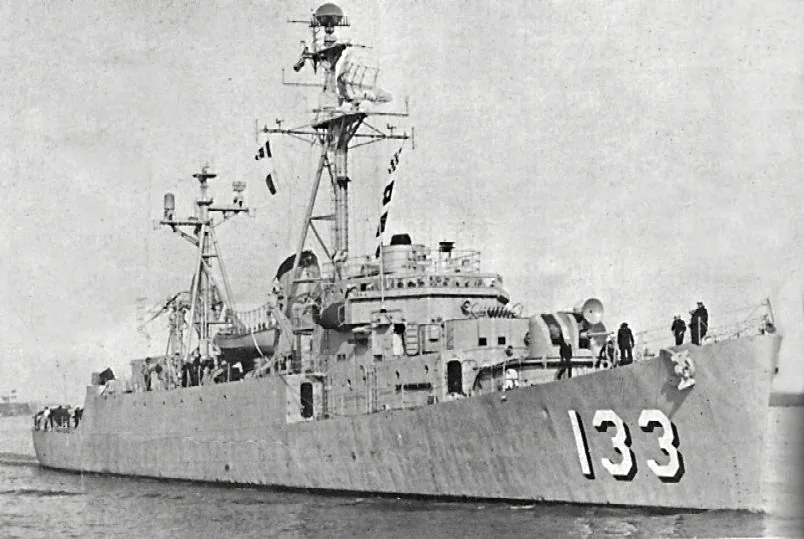
Service
- 7 June 1943 — 1 July 1965818 days of the war
- Name
- USS Pillsbury
- Pennant / hull number
- DE-133
- Namesake
- John E. Pillsbury
- Builder
- Consolidated Steel Corporation, Orange, Texas
- Laid down
- 18 July 1942
- Launched
- 10 January 1943
- Commissioned
- 7 June 1943
- Struck
- 1 July 1965
- Fate
- Sold for scrapping, 1966 (1966)
- Status
- Scrapped
Specifications
- Displacement, standard
- 1,253 long tons (1,273 t)
- Displacement, full load
- 1,590 long tons (1,616 t)
- Length
- 93.27 m (306 ft)
- Beam
- 11.15 m (36.6 ft)
- Draught
- 3.18 m (10.4 ft)
- Speed
- 21 knots (38.9 km/h, 24.2 mph)
- Range
- 9,100 nmi (16,853 km)
- Complement
- 209
- Main gun
- 76 mm (3 in)
John E. Pillsbury, born in Lowell, Mass. 15 December 1846, was appointed Midshipman in 1862 and commissioned an Ensign in 1868. After serving on various stations afloat and ashore, he commanded the coast steamer Blake from 1884 to 1891 and did excellent scientific work, using in some of his research instruments of his own invention. In the Spanish-American War he commanded the dynamite cruiser Vesuvius, operating around the island of Cuba and in the vicinity of Morro Castle. In 1905 he served as Chief of Staff of the North Atlantic Fleet and in 1908-09, was Chief of the Bureau of Navigation. Although Rear Admiral Pillsbury's attainments as a Sailor and a fighting man were noteworthy, he is perhaps best known as having been one of the world's foremost geographers and as an authority of the Gulf stream. Actively identified with the National Geographic Society for many years, he was president of the society at the time of his death, 30 December 1919.
The second Pillsbury (DE-133) was laid down by the Consolidated Steel Corp., Orange, Tex., 18 July 1942; launched 10 January 1943; sponsored by Mrs. Elsie G. Richardson; and commissioned 7 June 1943, Lt. Comdr. W. Parker, USNR, in command.
After shakedown Pillsbury's first duty was as flagship for Escort Division 4 escorting convoys into Casablanca and Gibraltar. Pillsbury then reported to Task Group 21.12, consisting of CVE Guadalcanal and four DE's, on "hunter-killer" patrol to seek out and destroy enemy submarines operating along or near convoy routes from the United States to Europe.
Continue to the full service history About 651 words
From the Dictionary of American Naval Fighting Ships, compiled by the Naval History and Heritage Command (Pillsbury II (DE-133)). A work of the United States Government, in the public domain.
Armament and machinery
Armament and machinery
- Propulsion
- 4 FM diesel engines
- 4 diesel-generators
- 6,000 shp (4.5 MW)
- 2 screws
- Armament
- 3 × single 3 in (76 mm)/50 guns
- 1 × twin 40 mm AA guns
- 8 × single 20 mm AA guns
- 1 × triple 21 in (533 mm) torpedo tubes
- 8 × depth charge projectors
- 1 × depth charge projector (hedgehog)
- 2 × depth charge tracks
Sister ships
- USS Blair
- USS Brister
- USS Brough
- USS Calcaterra
- USS Camp
- USS Chambers
- USS Chatelain
- USS Cockrill
- USS Dale W. Peterson
- USS Daniel
- USS Douglas L. Howard
- USS Falgout
- USS Farquhar (DE-139)
- USS Fessenden
- USS Fiske (DE-143)
- USS Flaherty
- USS Forster
- USS Frederick C. Davis
- USS Frost
- USS Hammann (DE-131)
- USS Harveson
- USS Haverfield
- USS Herbert C. Jones
- USS Hill
Sources
- Facts harvested from USS Pillsbury (DE-133) on Wikipedia. Figures only — no wording is taken from it.
- Service history reproduced verbatim from Pillsbury II (DE-133) , Dictionary of American Naval Fighting Ships — public domain, a work of the United States Government.
- Photograph: U.S. Navy — Official U.S. Navy photo [1] from "Jane's Fighting Ships, 1958-59", available on Navsource.org — Public domain — Wikimedia Commons