USS Robert E. Peary (DE-132)
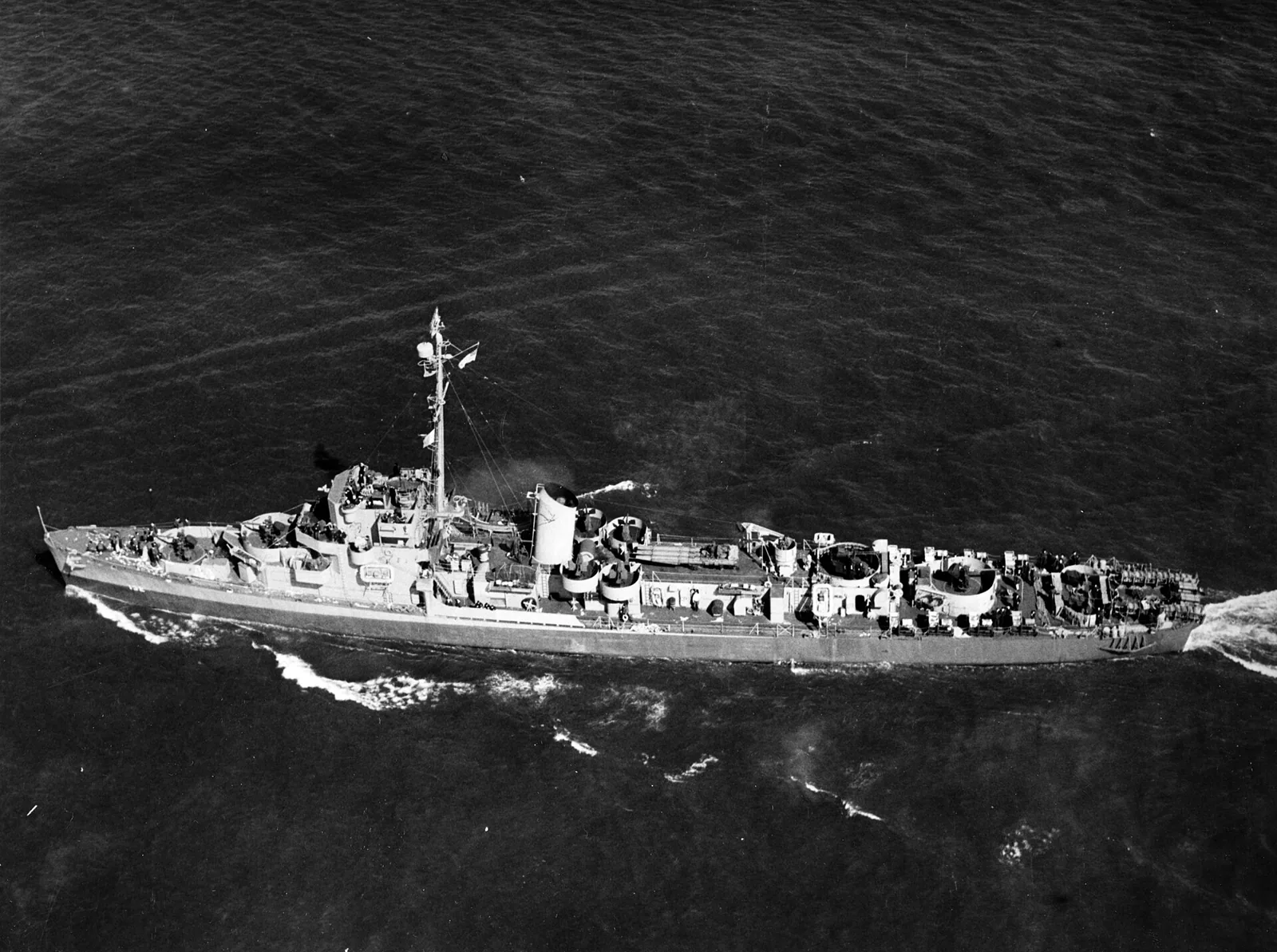
Service
- 31 May 1943 — 13 June 1947828 days of the war
- Name
- USS Robert E. Peary
- Pennant / hull number
- DE-132
- Namesake
- Robert E. Peary
- Builder
- Consolidated Steel Corporation, Orange, Texas
- Laid down
- 30 June 1942
- Launched
- 3 January 1943
- Commissioned
- 31 May 1943
- Decommissioned
- 13 June 1947
- Struck
- 1 July 1966
- Fate
- Sold 6 September 1967, scrapped (1967)
- Status
- Scrapped
Specifications
- Displacement, standard
- 1,253 long tons (1,273 t)
- Displacement, full load
- 1,590 long tons (1,616 t)
- Length
- 93.27 m (306 ft)
- Beam
- 11.15 m (36.6 ft)
- Draught
- 3.18 m (10.4 ft)
- Speed
- 21 knots (38.9 km/h, 24.2 mph)
- Range
- 9,100 nmi (16,853 km)
- Complement
- 209
- Main gun
- 76 mm (3 in)
Robert E. Peary (DE-132) was laid down 30 June 1942 by the Consolidated Steel Co., Orange, Tex.; launched 3 January 1943; sponsored by Mrs. Robert Edwin Peary; and commissioned 31 May 1943, Lt. Comdr. Kerfoot B. Smith in command.
Following shakedown off Bermuda, Robert E. Peary made her first run as a convoy escort to North Africa, arriving at Casablanca 13 August. By the end of the year, she had made two more runs to Casablanca, and was returning to New York with her third westbound convoy.
Early in 1944, Robert E. Peary crossed the Atlantic with a "hunter-killer" group, and upon returning to the United States shifted to the northern sealanes. Between 28 March 1944 and 7 June 1945, she escorted 10 convoys to the United Kingdom and, after June 1944, to France.
While returning to New York on 2 March 1945, Robert E. Peary and Hammann (DE-131) were diverted to aid two merchant ships which had collided. After the destroyer escorts rescued survivors, Hammann stood by SS Lone Jack , while Robert E. Peary escorted SS Frontenac Victory to New York, arriving on the 6th.
Ordered to the Pacific Fleet on completion of her last Atlantic run on 7 June 1945, Robert E. Peary underwent overhaul and was en route to the Pacific when the war with Japan ended. Redirected to New London for duty with the Medical Research Department, she conducted binocular experiments, then, proceeded to Green Cove Springs, Fla., where she arrived on 11 January 1946 and decommissioned 13 June 1947. Transferred to the Norfolk berthing area in 1959, she remained in the Atlantic Reserve Fleet until struck from the Navy list 1 July 1966. She was sold to Lipsett, Inc., New York, N.Y., 6 September 1967.
From the Dictionary of American Naval Fighting Ships, compiled by the Naval History and Heritage Command (Robert E. Peary I (DE-132)). A work of the United States Government, in the public domain.
Armament and machinery
Armament and machinery
- Propulsion
- 4 FM diesel engines
- 4 diesel-generators
- 6,000 shp (4.5 MW)
- 2 screws
- Armament
- 3 × single 3 in (76 mm)/50 guns
- 1 × twin 40 mm AA guns
- 8 × single 20 mm AA guns
- 1 × triple 21 in (533 mm) torpedo tubes
- 8 × depth charge projectors
- 1 × depth charge projector (hedgehog)
- 2 × depth charge tracks
Sister ships
- USS Blair
- USS Brister
- USS Brough
- USS Calcaterra
- USS Camp
- USS Chambers
- USS Chatelain
- USS Cockrill
- USS Dale W. Peterson
- USS Daniel
- USS Douglas L. Howard
- USS Falgout
- USS Farquhar (DE-139)
- USS Fessenden
- USS Fiske (DE-143)
- USS Flaherty
- USS Forster
- USS Frederick C. Davis
- USS Frost
- USS Hammann (DE-131)
- USS Harveson
- USS Haverfield
- USS Herbert C. Jones
- USS Hill
Sources
- Facts harvested from USS Robert E. Peary (DE-132) on Wikipedia. Figures only — no wording is taken from it.
- Service history reproduced verbatim from Robert E. Peary I (DE-132) , Dictionary of American Naval Fighting Ships — public domain, a work of the United States Government.
- Photograph: Unknown author — U.S. Navy Bureau of Ships photo 19-N-63081 — Public domain — Wikimedia Commons