USS Roberts (DE-749)
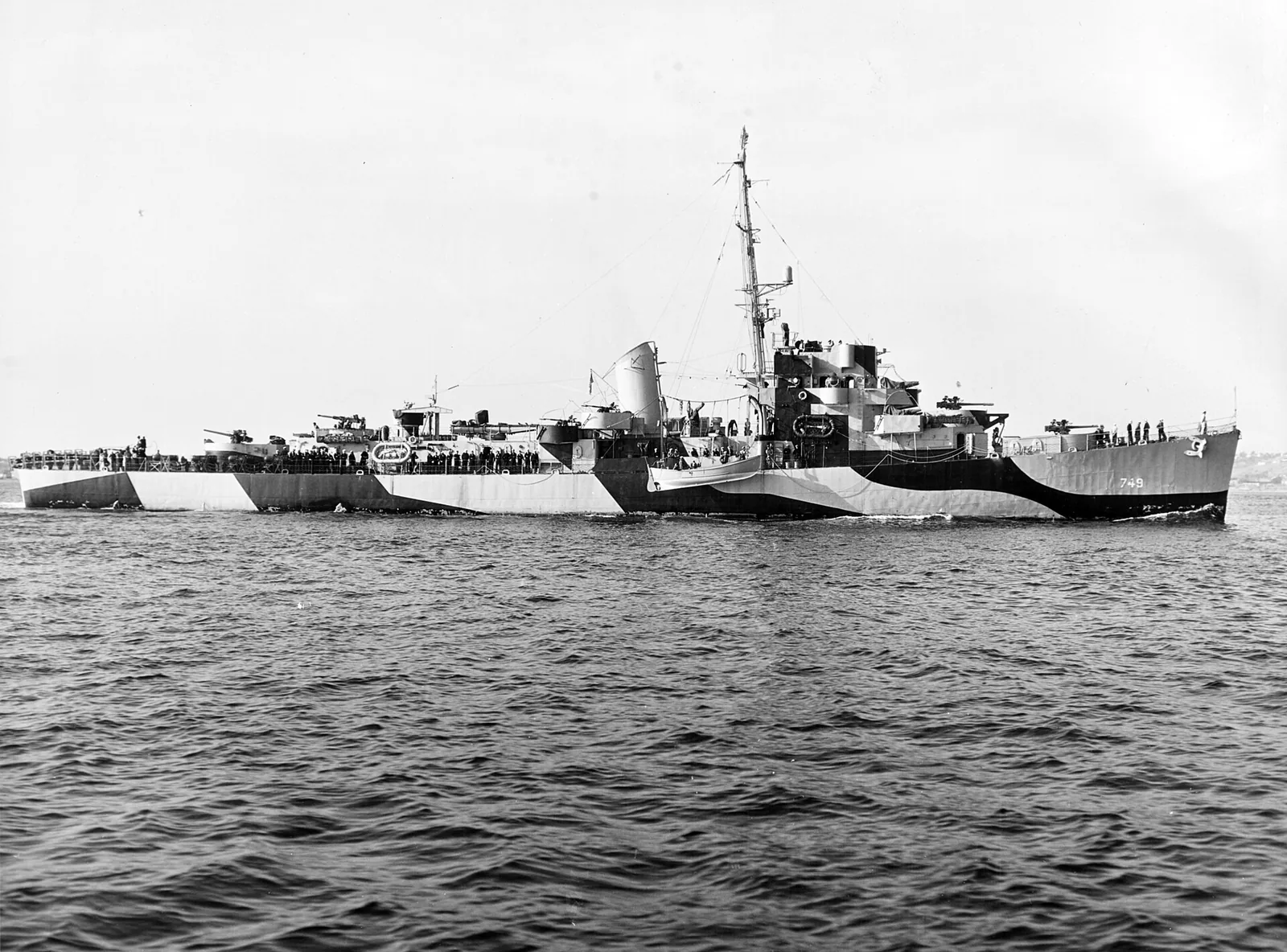
Service
- as USS Roberts2 September 1944 — 21 September 1968365 days of the war
- Name
- USS Roberts
- Pennant / hull number
- DE-749
- Namesake
- Arthur John Roberts, Jr.
- Builder
- Western Pipe and Steel Company, Los Angeles, California
- Laid down
- 7 July 1943
- Launched
- 14 November 1943
- Commissioned
- 2 September 1944
- Decommissioned
- 21 September 1968
- Struck
- 23 September 1968
- Fate
- Sunk as target, November 1971 (1971)
- Status
- Wreck
Specifications
- Displacement, standard
- 1,240 long tons (1,260 t)
- Length
- 93.27 m (306 ft) OA
- Beam
- 10.97 m (36 ft)
- Draught
- 3.35 m (11 ft)
- Speed
- 21 knots (38.9 km/h, 24.2 mph)
- Range
- 10,800 nmi (20,002 km)
- Complement
- 216
- Main gun
- 76 mm (3 in)
Arthur John Roberts, Jr., born 14 January 1920 in Chicago, Ill., was commissioned ensign in the U.S. Naval Reserve 20 July 1942 and, after instruction at the Midshipmen's School Northwestern University, he was assigned to Pensacola (CA-24) then operating in the Solomons. Ensign Roberts was killed in the Battle of Tassafaronga, Guadalcanal, 30 November-1 December 1942.
Roberts (DE-749) was laid down 11 February 1943 by the Western Pipe & Steel Co., San Pedro, Calif.; launched 14 November 1943; sponsored by Mrs. Ruth Marohn; and commissioned 2 September 1944, Lt. Comdr. Robert M. Catharine, Jr., USNR, in command.
Following shakedown off southern California, Roberts sailed for Pearl Harbor on 30 November. On her arrival 10 December, she joined a hunter-killer (HUK) group operating with Corregidor (CVE-58); and, for the next 3 weeks, patrolled to the north and east of Hawaii. During January and early February 1945, her group operated to the west, primarily in the Marshalls, then returned to Pearl Harbor. From 1 to 18 March, the group searched, unsuccessfully, between Johnston Island and Kwajalein for an overdue Army Air Corps transport carrying Lt. Gen. M. F. Harmon, USA. Toward the end of the month the ships replenished at Majuro, then resumed HUK operations, this time in the Marshalls.
Continue to the full service history About 631 words
From the Dictionary of American Naval Fighting Ships, compiled by the Naval History and Heritage Command (Roberts (DE-749)). A work of the United States Government, in the public domain.
Armament and machinery
Armament and machinery
- Propulsion
- 4 × GM Mod. 16-278A diesel engines with electric drive, 6000 shp, 2 screws
- Armament
- 3 × single Mk.22 3"/50 caliber guns
- 1 × twin 40 mm Mk.1 AA gun
- 8 × 20 mm Mk.4 AA guns
- 3 × 21-inch (533 mm) torpedo tubes
- 1 × Hedgehog Mk.10 anti-submarine mortar (144 rounds)
- 8 × Mk.6 depth charge projectors
- 2 × Mk.9 depth charge tracks
Sister ships
- Brazilian destroyer Babitonga
- Brazilian destroyer Baependi
- Brazilian destroyer Bauru
- Brazilian destroyer Beberibe
- Brazilian destroyer Benevente
- Brazilian destroyer Bertioga
- Brazilian destroyer Bocaina
- Brazilian destroyer Bracui
- French frigate Algérien
- French frigate Hova
- French frigate Marocain
- French frigate Sénégalais
- French frigate Somali
- French frigate Tunisien
- USS Acree
- USS Alger
- USS Amick
- USS Atherton
- USS Baker (DE-190)
- USS Bangust
- USS Baron
- USS Booth
- USS Bostwick
- USS Breeman
Sources
- Facts harvested from USS Roberts (DE-749) on Wikipedia. Figures only — no wording is taken from it.
- Service history reproduced verbatim from Roberts (DE-749) , Dictionary of American Naval Fighting Ships — public domain, a work of the United States Government.
- Photograph: Unknown author — U.S. Navy photo NH 107524 — Public domain — Wikimedia Commons