USS Sea Poacher
Service
- as USS Sea Poacher31 July 1944 — 15 November 1969401 days of the war
- as Initially BAP Pabellón de Pica, changed a few weeks later to La Pedrera1 July 1974 — 1995
- Name
- USS Sea Poacher
- Pennant / hull number
- SS-406
- Builder
- Portsmouth Naval Shipyard, Kittery, Maine
- Laid down
- 23 February 1944
- Launched
- 20 May 1944
- Commissioned
- 31 July 1944
- Decommissioned
- 15 November 1969
- Struck
- 15 August 1973
- Fate
- Transferred to Peru, 1 July 1974 (1974)
- Status
- Unknown
Specifications — As built
- Displacement, surfaced
- 1,526 long tons (1,550 t)
- Displacement, submerged
- 2,401 long tons (2,440 t)
- Length
- 94.79 m (311 ft)
- Beam
- 8.23 m (27 ft)
- Draught
- 4.88 m (16 ft)
- Speed
- 20.3 knots (37.5 km/h, 23.3 mph)
- Range
- 11,000 nmi (20,372 km)
- Complement
- 10
- Main gun
- 127 mm (5 in)
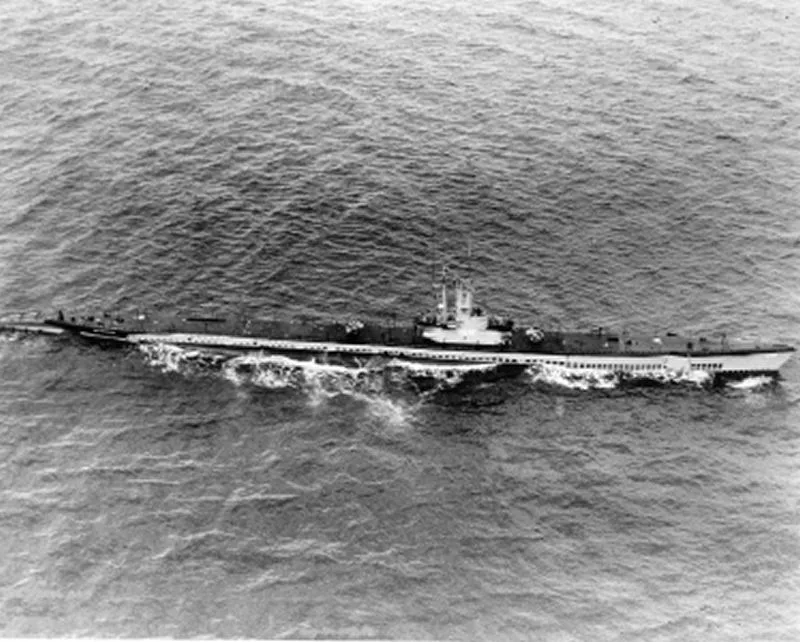
Sea Poacher (SS-406) was laid down by the Portsmouth (N.H.) Navy Yard on 23 February 1944; launched on 20 May 1944; sponsored by Mrs. J. H. Spiller, wife of Comdr. Spiller, hull superintendent at the Navy Yard; and commissioned on 31 July 1944, Comdr. F. M. Gambacorta in command.
Following underway trials, training, and shakedown in the Portsmouth, N.H., and New London, Conn., areas, Sea Poacher transited the Panama Canal and arrived at Pearl Harbor on 25 October 1944. Although her first two war patrols were unproductive, during the third, conducted in the Kuril Islands area, Sea Poacher torpedoed and sank a Japanese trawler and, four days later, sent two fishing boats to the bottom in a surface attack. During the latter action, three crewmen were injured when the 20 millimeter gun exploded. Due to the seriousness of their injuries, the patrol was terminated ahead of schedule, and the submarine returned to Midway.
After conducting her fourth war patrol off the eastern coast of Honshu and Hokkaido, Sea Poacher was undergoing refitting at Pearl Harbor when the war ended on 15 August 1945.
Continue to the full service history About 505 words
From the Dictionary of American Naval Fighting Ships, compiled by the Naval History and Heritage Command (Sea Poacher (SS-406)). A work of the United States Government, in the public domain.
Armament and machinery
This vessel is recorded in 2 configurations. Wartime refits changed armament and complement substantially, so each is kept separately rather than averaged into one set of figures. The figures above are as built.
As built
- Propulsion
- 4 × Fairbanks-Morse Model 38D8-⅛ 10-cylinder opposed piston diesel engines driving electrical generators
- 2 × 126-cell Sargo batteries
- 4 × high-speed Elliott electric motors with reduction gears
- two propellers
- 5,400 shp (4.0 MW) surfaced
- 2,740 shp (2.0 MW) submerged
- Armament
- 10 × 21-inch (533 mm) torpedo tubes
- 6 forward, 4 aft
- 24 torpedoes
- 1 × 5-inch (127 mm) / 25 caliber deck gun
- Bofors 40 mm and Oerlikon 20 mm cannon
Guppy IA
- Displacement, surfaced
- 1,830 long tons (1,859 t)
- Displacement, submerged
- 2,440 long tons (2,479 t)
- Length
- 93.57 m (307 ft)
- Beam
- 8.23 m (27 ft)
- Draught
- 5.18 m (17 ft)
- Speed
- 17.3 knots (32 km/h, 19.9 mph)
- Range
- 17,000 nmi (31,484 km)
- Complement
- 10
- Propulsion
- Snorkel added
- Batteries upgraded to Sargo II
- Armament
- 10 × 21 inch (533 mm) torpedo tubes
- (six forward, four aft)
- all guns removed
Sister ships
- ARA Santa Fe (S-21)
- USS Apogon
- USS Archerfish (SS-311)
- USS Aspro (SS-309)
- USS Atule
- USS Balao
- USS Bang
- USS Barbel (SS-316)
- USS Barbero
- USS Batfish (SS-310)
- USS Baya
- USS Becuna
- USS Bergall (SS-320)
- USS Besugo
- USS Billfish (SS-286)
- USS Blackfin
- USS Blanquillo (SS-323)
- USS Blenny
- USS Blower
- USS Blueback (SS-326)
- USS Boarfish
- USS Bowfin
- USS Brill
- USS Bugara
Sources
- Facts harvested from USS Sea Poacher on Wikipedia. Figures only — no wording is taken from it.
- Service history reproduced verbatim from Sea Poacher (SS-406) , Dictionary of American Naval Fighting Ships — public domain, a work of the United States Government.
- Photograph: Unknown author — Public domain — Wikimedia Commons