USS Spadefish (SS-411)
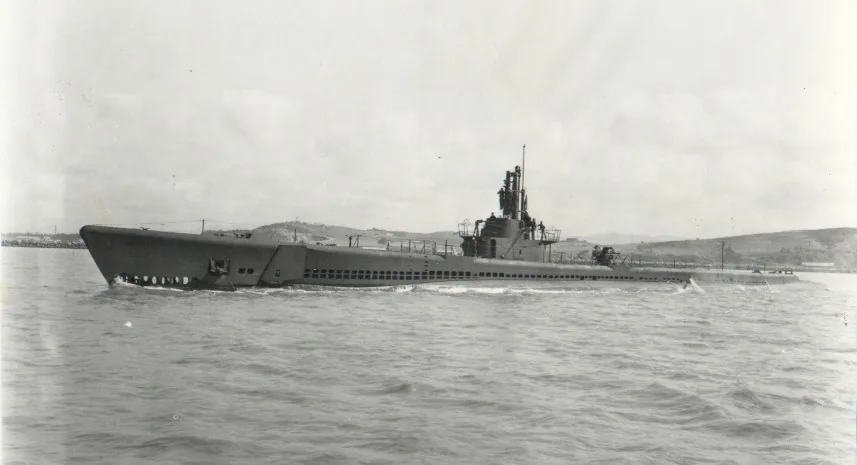
Service
- as Spadefish9 March 1944 — 3 May 1946542 days of the war
- Name
- USS Spadefish
- Pennant / hull number
- SS-411
- Namesake
- Spadefish
- Builder
- Mare Island Naval Shipyard
- Laid down
- 27 May 1943
- Launched
- 8 January 1944
- Commissioned
- 9 March 1944
- Decommissioned
- 3 May 1946
- Struck
- 1 April 1967
- Fate
- Sold for scrap, 17 October 1969 (1969)
- Status
- Scrapped
Specifications
- Displacement, surfaced
- 1,526 long tons (1,550 t)
- Displacement, submerged
- 2,424 long tons (2,463 t)
- Length
- 94.79 m (311 ft)
- Beam
- 8.23 m (27 ft)
- Draught
- 4.88 m (16 ft)
- Speed
- 20.3 knots (37.5 km/h, 23.3 mph)
- Range
- 11,000 nmi (20,372 km)
- Complement
- 10
- Main gun
- 127 mm (5 in)
The first Spadefish (SS-411) was laid down on 27 May 1943 by the Mare Island Navy Yard, Vallejo, Calif.; launched on 8 January 1944; sponsored by Mrs. Francis W. Scanland; and commissioned on 9 March 1944, Cmdr. G. W. Underwood in command.
Fallowing shakedown training along the coast of California, Spadefish departed San Francisco on 14 June and arrived at Pearl Harbor on 22 June. On 23 July, she got underway from Pearl Harbor for her maiden war patrol, as a member of a coordinated attack group with Picuda (SS-382) and Redfish (SS-395). Although she was commissioned late in the war and spent only one year in the Pacific war zone, she was to run up a record of 21 ships and numerous trawlers sunk and many others damaged.
On 19 August, while patrolling in Philippine water off the northwest coast of Luzon, Spadefish got off to a resounding start by torpedoing and sinking Japan's 9,589-ton, passenger-cargo ship Tamatsu Maru. Three days later, she trailed three large tankers through Babuyan Channel along the northern Luzon coast; closed range; and fired two spreads of torpedoes, sinking the 10,023-ton tanker Hakko Maru No. 2, and damaging a second tanker that, protected by a destroyer, limped back to a shallow cove off Luzon. For several hours into the next day, Spadefish attempted to get around the escort to attack the damaged ship anchored in the cove. The submarine finally let go with four stern torpedoes at the destroyer, but the enemy zigged clear and proceeded to depth charge the entire area. Having only three torpedoes remaining, Spadefish set course for Tanapag Harbor, Saipan, to replenish her supply.
Continue to the full service history About 1,088 words
From the Dictionary of American Naval Fighting Ships, compiled by the Naval History and Heritage Command (Spadefish I (SS-411)). A work of the United States Government, in the public domain.
Armament and machinery
Armament and machinery
- Propulsion
- 4 × Fairbanks-Morse Model 38D8-⅛ 10-cylinder opposed piston diesel engines driving electrical generators
- 2 × 126-cell Sargo batteries
- 4 × high-speed General Electric electric motors with reduction gears
- two propellers
- 5,400 shp (4.0 MW) surfaced
- 2,740 shp (2.0 MW) submerged
- Armament
- 10 × 21-inch (533 mm) torpedo tubes
- 6 forward, 4 aft
- 24 torpedoes
- 1 × 5-inch (127 mm) / 25 caliber deck gun
- Bofors 40 mm and Oerlikon 20 mm cannon
Sister ships
- ARA Santa Fe (S-21)
- USS Apogon
- USS Archerfish (SS-311)
- USS Aspro (SS-309)
- USS Atule
- USS Balao
- USS Bang
- USS Barbel (SS-316)
- USS Barbero
- USS Batfish (SS-310)
- USS Baya
- USS Becuna
- USS Bergall (SS-320)
- USS Besugo
- USS Billfish (SS-286)
- USS Blackfin
- USS Blanquillo (SS-323)
- USS Blenny
- USS Blower
- USS Blueback (SS-326)
- USS Boarfish
- USS Bowfin
- USS Brill
- USS Bugara
Sources
- Facts harvested from USS Spadefish (SS-411) on Wikipedia. Figures only — no wording is taken from it.
- Service history reproduced verbatim from Spadefish I (SS-411) , Dictionary of American Naval Fighting Ships — public domain, a work of the United States Government.
- Photograph: Unknown author — Unknown source — Public domain — Wikimedia Commons