USS Springer
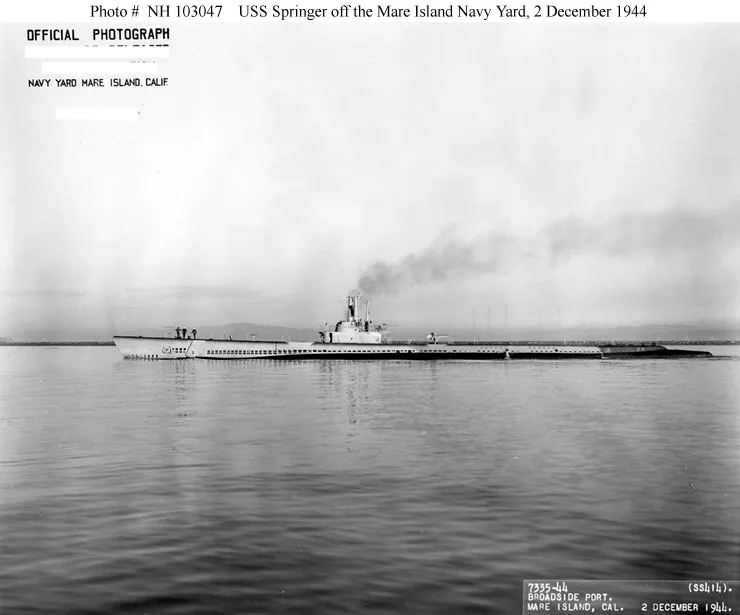
Service
- as Springer18 October 1944 — 23 January 1961319 days of the war
- as Thomson23 January 1961 — 1 September 1972
- Name
- USS Springer
- Pennant / hull number
- SS-414
- Builder
- Mare Island Naval Shipyard
- Laid down
- 30 October 1943
- Launched
- 3 August 1944
- Commissioned
- 18 October 1944
- Decommissioned
- January 1947
- Recommissioned
- 24 September 1960
- Struck
- 1 September 1972
- Fate
- Stripped for spare parts and sold for scrapping after 1 September 1972 (1972)
- Status
- Scrapped
Specifications
- Length
- 94.79 m (311 ft)
- Beam
- 8.23 m (27 ft)
- Draught
- 4.88 m (16 ft)
- Speed
- 20.3 knots (37.5 km/h, 23.3 mph)
- Range
- 11,000 nmi (20,372 km)
- Complement
- 10
- Main gun
- 127 mm (5 in)
Springer (SS-414) was laid down on 3 October 1943 at Vallejo, Calif., by the Mare Island Navy Yard; launched on 3 August 1944; sponsored by Mrs. M. S. Tisdale; and commissioned on 18 October 1944, Comdr. Russell Kefauver in command.
Springer sailed for San Diego on 3 December to conduct sea trials and shakedown training. After availability, she departed Mare Island for Hawaii on 8 January 1945 and arrived at Pearl Harbor the following week. On 4 February, she steamed to Guam; topped off her stores and oil; and, on the 17th, sailed for the Ryukyus to begin her first war patrol.
Springer rode out several heavy storms and was driven down many times by enemy aircraft, but she finally spotted two Japanese warships on 11 March. The ships were at a range of 22,000 yards, steaming at 17 knots, so the submarine surfaced to give chase. She was forced to submerge immediately by planes, and the pursuit was abandoned. Later in the month, the submarine made radar contact with three ships, and she tracked the largest for three hours. When it was within torpedo range, she made a surface attack with four torpedoes. She scored two hits and the target began to burn. An hour later, Transport No. 18 was still afloat so she sank it with another torpedo. The submarine returned to Guam on 25 March and was refitted by Proteus (AS-19).
Continue to the full service history About 865 words
From the Dictionary of American Naval Fighting Ships, compiled by the Naval History and Heritage Command (Springer (SS-414)). A work of the United States Government, in the public domain.
Armament and machinery
Armament and machinery
- Propulsion
- 4 × Fairbanks-Morse Model 38D8-⅛ 10-cylinder opposed piston diesel engines driving electrical generators
- 2 × 126-cell Sargo batteries
- 4 × high-speed General Electric electric motors with reduction gears
- two propellers
- 5,400 shp (4.0 MW) surfaced
- 2,740 shp (2.0 MW) submerged
- Armament
- 10 × 21-inch (533 mm) torpedo tubes
- 6 forward, 4 aft
- 24 torpedoes
- 1 × 5-inch (127 mm) / 25 caliber deck gun
- Bofors 40 mm and Oerlikon 20 mm cannon
Sister ships
- ARA Santa Fe (S-21)
- USS Apogon
- USS Archerfish (SS-311)
- USS Aspro (SS-309)
- USS Atule
- USS Balao
- USS Bang
- USS Barbel (SS-316)
- USS Barbero
- USS Batfish (SS-310)
- USS Baya
- USS Becuna
- USS Bergall (SS-320)
- USS Besugo
- USS Billfish (SS-286)
- USS Blackfin
- USS Blanquillo (SS-323)
- USS Blenny
- USS Blower
- USS Blueback (SS-326)
- USS Boarfish
- USS Bowfin
- USS Brill
- USS Bugara
Sources
- Facts harvested from USS Springer on Wikipedia. Figures only — no wording is taken from it.
- Service history reproduced verbatim from Springer (SS-414) , Dictionary of American Naval Fighting Ships — public domain, a work of the United States Government.
- Photograph: Unknown author — Public domain — Wikimedia Commons