USS Trumpeter (DE-180)
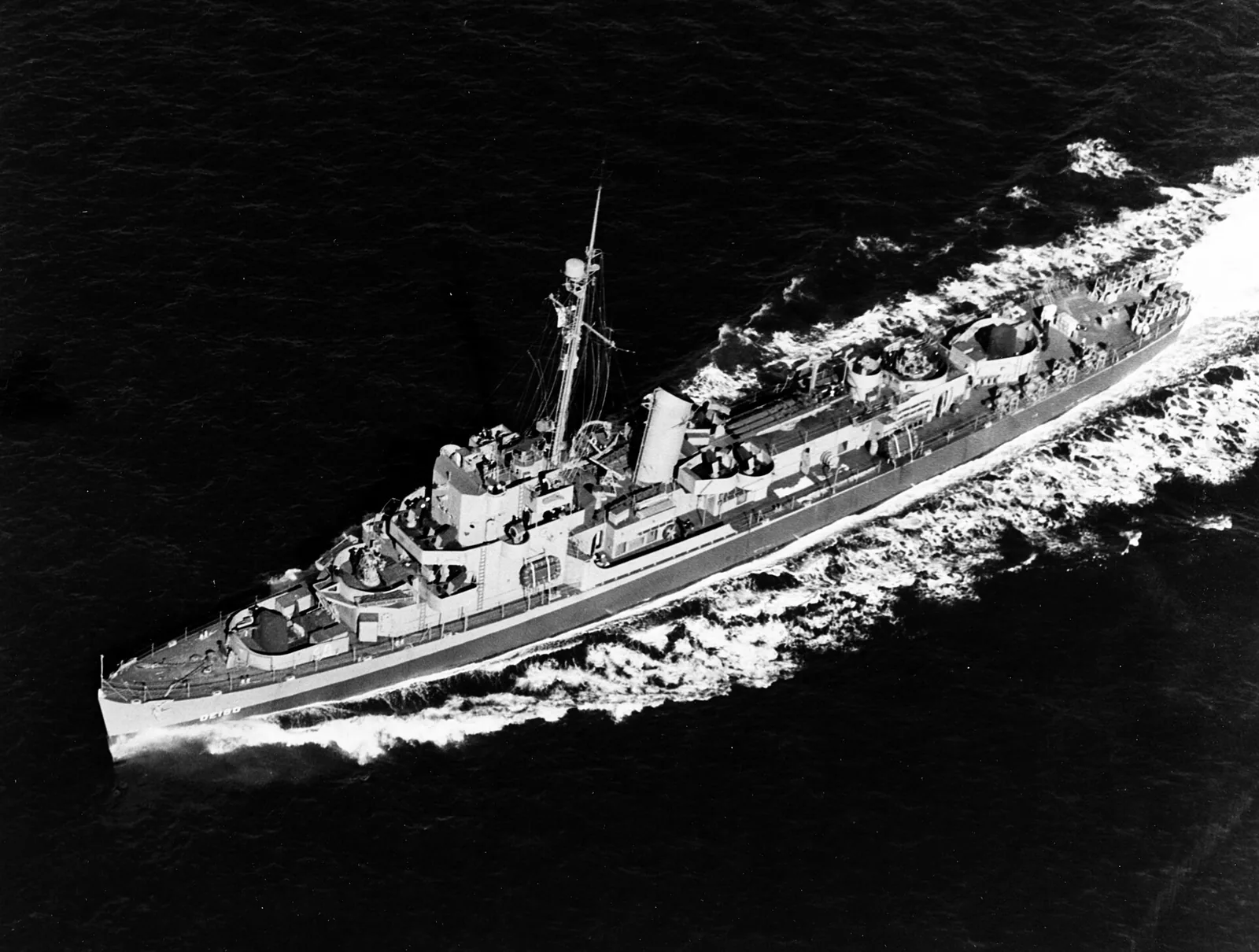
Service
- as USS Trumpeter16 October 1943 — 5 December 1947687 days of the war
- Name
- USS Trumpeter
- Pennant / hull number
- DE-180
- Namesake
- George Nelson Trumpeter
- Builder
- Federal Shipbuilding and Drydock Company, Newark, New Jersey
- Laid down
- 7 June 1943
- Launched
- 19 September 1943
- Commissioned
- 16 October 1943
- Decommissioned
- 5 December 1947
- Struck
- 1 August 1973
- Fate
- Sold for scrapping 18 June 1974 (1974)
- Status
- Scrapped
Specifications
- Displacement, standard
- 1,240 long tons (1,260 t)
- Length
- 93.27 m (306 ft) OA
- Beam
- 10.97 m (36 ft)
- Draught
- 3.35 m (11 ft)
- Speed
- 21 knots (38.9 km/h, 24.2 mph)
- Range
- 10,800 nmi (20,002 km)
- Complement
- 216
- Main gun
- 76 mm (3 in)
George Nelson Trumpeter, born on 2 September 1919 in Monaco, Pa., enrolled in 1938 at the Carnegie Institute of Technology College of Engineering and, during, his three years there, participated in the Reserve Officer Training Program. On 5 March 1941, he enlisted in the Naval Reserve as a seaman second class and within two weeks began elimination flight training at Naval Reserve Aviation Base, Philadelphia. In April, he was transferred to the Naval Air Station,Jacksonville, Fla.; and, in May, he received an appointment as an Aviation Cadet. In October, he became a naval aviator and, on 5 December 1941, was commissioned an ensign and assigned to Advanced Carrier Training Group, Atlantic Fleet, Norfolk. On 1 October 1942, he was promoted to the rank of Lt. (j.g.) A-V(N), USNR.
Assigned for duty with the Southern Attack Force of Operation Torch, Lt. Trumpeter flew his Grumman F4F-4 Wildcat (BuNo 11767) from the deck of escort carrier Santee (CVE-29) on the morning of D-day, 8 November 1942. Taking off in light winds at 0545 in Santee's first launch of the day, he joined a flight of six Wildcats for combat air patrol over the transport and carrier areas off Safi. When near the carrier, he left the formation with an engine oil leak and was last heard from over the radio at 0910. He was never heard from again.
Originally, Trumpeter (CVE-37) was to be built under a Maritime Commission contract (M.C.Hull 248), but the supervision of the contract for her construction was reassigned to the Navy on 30 April 1942. First classified as an aircraft escort vessel, AVG-37, the ship was redesignated an auxiliary aircraft carrier, ACV-37, only five days before her keel was laid down on 25 August 1942 at Tacoma, Wash., by the Seattle-Tacoma Shipbuilding Corp. Launched on 15 December 1942, the ship was again redesignated on 15 July 1943. this time as CVE-37.
Continue to the full service history About 1,806 words
From the Dictionary of American Naval Fighting Ships, compiled by the Naval History and Heritage Command (Trumpeter (DE-180)). A work of the United States Government, in the public domain.
Armament and machinery
Armament and machinery
- Propulsion
- 4 × GM Mod. 16-278A diesel engines with electric drive, 6000 shp, 2 screws
- Armament
- 3 × single Mk.22 3"/50 caliber guns
- 1 × twin 40 mm Mk.1 AA gun
- 8 × 20 mm Mk.4 AA guns
- 3 × 21-inch (533 mm) torpedo tubes
- 1 × Hedgehog Mk.10 anti-submarine mortar (144 rounds)
- 8 × Mk.6 depth charge projectors
- 2 × Mk.9 depth charge tracks
Sister ships
- Brazilian destroyer Babitonga
- Brazilian destroyer Baependi
- Brazilian destroyer Bauru
- Brazilian destroyer Beberibe
- Brazilian destroyer Benevente
- Brazilian destroyer Bertioga
- Brazilian destroyer Bocaina
- Brazilian destroyer Bracui
- French frigate Algérien
- French frigate Hova
- French frigate Marocain
- French frigate Sénégalais
- French frigate Somali
- French frigate Tunisien
- USS Acree
- USS Alger
- USS Amick
- USS Atherton
- USS Baker (DE-190)
- USS Bangust
- USS Baron
- USS Booth
- USS Bostwick
- USS Breeman
Sources
- Facts harvested from USS Trumpeter (DE-180) on Wikipedia. Figures only — no wording is taken from it.
- Service history reproduced verbatim from Trumpeter (DE-180) , Dictionary of American Naval Fighting Ships — public domain, a work of the United States Government.
- Photograph: Unknown author — U.S. Navy photo 80-G-87232 — Public domain — Wikimedia Commons