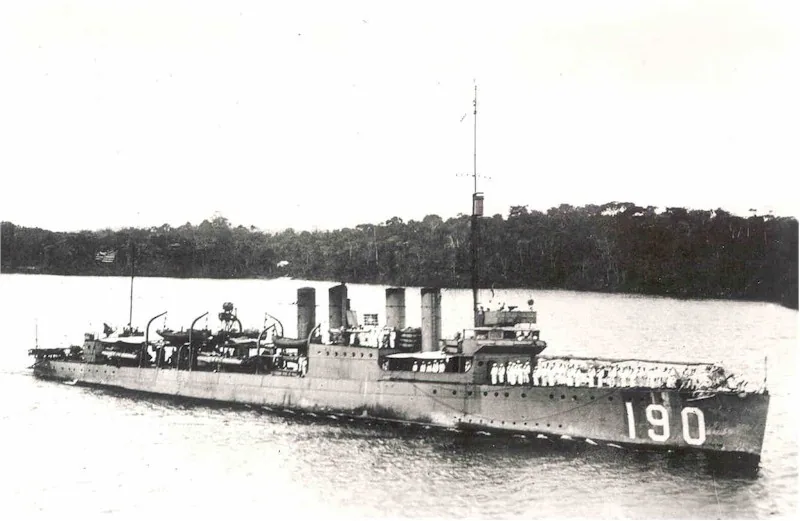
USS Satterlee (DD-190)
Service
- as USS Satterlee23 December 1919 — 8 October 1940403 days of the war
- as HMS Belmont8 October 1940 — 31 January 1942477 days of the war
- Name
- USS Satterlee
- Pennant / hull number
- DD-190
- Namesake
- Charles Satterlee
- Builder
- Newport News Shipbuilding & Dry Dock Company
- Laid down
- 10 July 1918
- Launched
- 21 December 1918
- Commissioned
- 23 December 1919
- Decommissioned
- 11 July 1922
- Recommissioned
- 18 December 1939
- Struck
- 8 June 1941
- Fate
- Torpedoed and sunk, 31 January 1942
By torpedo (1942) - Status
- Wreck
Specifications
- Displacement, standard
- 1,215 long tons (1,234 t)
- Length
- 95.71 m (314 ft)
- Beam
- 9.14 m (30 ft)
- Draught
- 2.74 m (9 ft)
- Speed
- 35 knots (64.8 km/h, 40.3 mph)
- Range
- 4,900 nmi (9,075 km)
- Complement
- 122
- Main gun
- 102 mm (4 in)
Charles Satterlee, born on 14 September 1875 in Essex, Conn., was appointed a cadet in the Revenue Cutter Service on 19 November 1895. In 1908, he was assigned as supervisor of anchorages at Sault Ste. Marie, Mich. This duty included command of the cutter Machinate. In 1909, he was ordered to Tahoma, then fitting out at Baltimore, Md., for a cruise to the Pacific. From 1910 to 1913, he was assistant inspector of lifesaving stations; and, on 1 September 1915, he was promoted to Captain in the Coast Guard. Capt. Satterlee was in command of the cutter Tampa, when that warship was torpedoed by the German submarine UB-91 ( Kapitanleutnant Wolf Hans Hertwig, commanding) and sunk with all hands (131 men) on 26 September 1918 in the Bristol Channel while escorting a convoy.
The first Satterlee (Destroyer No. 190) was laid down on 10 July 1918 at Newport News, Va., by the Newport News Shipbuilding Co.; launched on 21 December 1918; sponsored by Miss Rebecca E. Satterlee, niece of Capt. Satterlee; and commissioned on 23 December 1919, Cmdr. Reed M. Fawell in command.
Satterlee joined her destroyer flotilla at Manzanillo, Cuba, on 27 January 1920 and conducted training in the Caribbean until 26 April. After repairs and trials, she rejoined the flotilla at Newport, R.I., on 11 June. She was present at the America's Cup races off New York between 9 and 26 July 1920, and visited Miami from 2 to 28 August before resuming training off Newport. The destroyer joined the Atlantic Fleet at Guantanamo on 10 January 1921 and participated in fleet maneuvers until 24 April. She then resumed training and upkeep along the Atlantic coast until she was decommissioned on 11 July 1922 and placed in reserve at Philadelphia.
With war breaking out in Europe, Satterlee was recommissioned at Philadelphia on 18 December 1939, Lt. Cmdr. Harold R. Demarest in command, and assigned to duty on the Neutrality Patrol. She arrived in the Caribbean on 2 February 1940 for patrol duty and training. The ship departed the Caribbean on 15 April, and underwent overhaul at Norfolk from 19 April to 5 July. She then operated along the east coast until decommissioned on 8 October 1940. Satterlee was transferred to the United Kingdom on the same day and served the Royal Navy as HMS Belmont, one of fifty overage U.S. destroyers exchanged for bases in British Colonies in the western Atlantic.
Belmont (H. 46) was commissioned on 8 October 1940, Cmdr. Peter J. Fitzgerald, RN (Ret.) commanding, and arrived at Belfast, Northern Ireland, on 24 October. She joined the Third Escort Group in the Western Approaches Command and performed valuable work escorting Atlantic convoys, broken only for repairs of collision damage between March and July 1941.
On 31 January 1942, Belmont (Lt. Cmdr. Geoffrey B. O. Harding, RN) was torpedoed and sunk with loss of all 138 souls by the German submarine U-82 ( Kapitanleutnant Siegfried Rollman) in the North Atlantic (42°02'N., 57°18'W.) while escorting a Canadian troop convoy (NA-2). Soon thereafter, on 7 February 1942, U-82 herself was sunk north of the Azores by depth charges from the sloop HMS Rochester (L.50) (Lt. Cmdr. Conway B. Allen, RN) and corvette HMS Tamarisk (K.216) (Lt. Sydney Ayles, RNR) going to the bottom with her entire 45-man crew.
From the Dictionary of American Naval Fighting Ships, compiled by the Naval History and Heritage Command (Satterlee I (Destroyer No. 190)). A work of the United States Government, in the public domain.
Armament and machinery
Armament and machinery
- Propulsion
- 2 × geared steam turbines
- 2 × shafts
- Power
- 26500 shp
- Armament
- 4 × 4 in/50 cal guns
- 1 × 3 in/23 cal anti-aircraft gun
- 12 × 21 inch (533 mm) torpedo tubes
Sister ships
- HMCS Buxton (H96)
- HMCS St. Croix (I81)
- HMCS St. Francis (I93)
- HMS Belmont (H46)
- HMS Beverley (H64)
- HMS Bradford (H72)
- HMS Broadwater (H81)
- HMS Broadway (H90)
- HMS Burnham (H82)
- HMS Burwell (H94)
- HMS Buxton (H96)
- HMS Cameron (I05)
- HMS Chesterfield (I28)
- HMS Churchill (I45)
- HMS Clare (I14)
- HMS Ramsey (G60)
- HMS Reading (G71)
- HMS Ripley (G79)
- HMS Rockingham (G58)
- HMS Sherwood (I80)
- HMS Stanley (I73)
- Soviet destroyer Dejatelny
- USS Abel P. Upshur
- USS Alden
Sources
- Facts harvested from USS Satterlee (DD-190) on Wikipedia. Figures only — no wording is taken from it.
- Service history reproduced verbatim from Satterlee I (Destroyer No. 190) , Dictionary of American Naval Fighting Ships — public domain, a work of the United States Government.
- Photograph: U.S. Navy — U.S. Navy photo [1] from Navsource.org . Transferred from en.wikipedia to Commons. Original uploader was ScottyBoy900Q at en.wikipedia — Public domain — Wikimedia Commons