HMCS Assiniboine (I18)
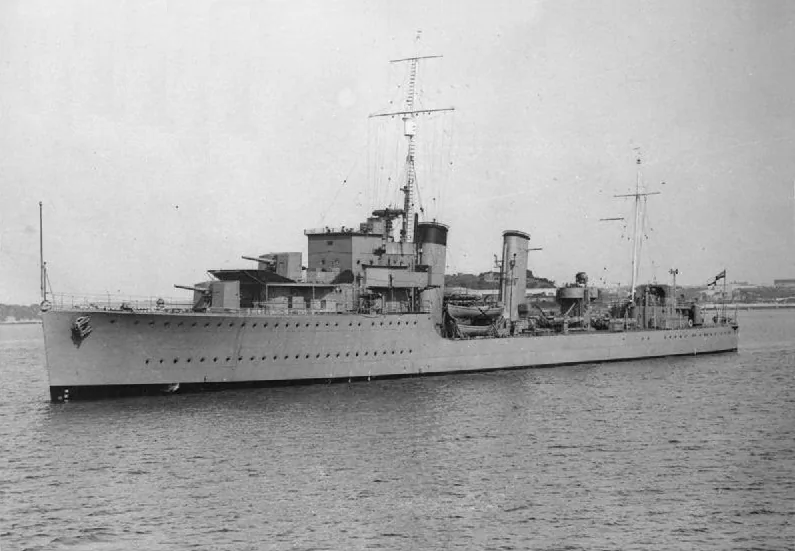
Service
- as Kempenfelt? — 19 October 193948 days of the war
- as Assiniboine19 October 1939 — 8 August 19452,120 days of the war
- Name
- HMCS Assiniboine
- Pennant / hull number
- I18
- Namesake
- Rear Admiral Richard Kempenfelt
- Builder
- J. Samuel White, Cowes
- Laid down
- 18 October 1930
- Launched
- 29 October 1931
- Commissioned
- 19 October 1939
- Decommissioned
- 8 August 1945
- Fate
- Sold for scrapping but wrecked en route to breakers on 10 November 1945
Wreck broken up in situ in 1952 (1945) - Status
- Scrapped
Specifications
- Displacement, standard
- 1,390 long tons (1,412 t)
- Displacement, full load
- 1,901 long tons (1,932 t)
- Length
- 100.28 m (329 ft) OA
- Beam
- 10.06 m (33 ft)
- Draught
- 3.66 m (12 ft)
- Speed
- 36 knots (66.7 km/h, 41.4 mph)
- Range
- 5,500 nmi (10,186 km)
- Complement
- 145
HMCS Assiniboine was a C-class destroyer built for the Royal Navy. She carried the pennant number I18. The ship was named after Rear Admiral Richard Kempenfelt. Her keel was laid at J. Samuel White, Cowes on 18 October 1930. She entered service on 19 October 1939, having been launched on 29 October 1931.
40 ships of the class were built. The class followed the W and Z-class destroyer and was succeeded by the Weapon-class destroyer.
Displacement was 1,390 long tons standard and 1,901 long tons at full load. She measured 100.3 m (329 ft) long with a beam of 10.1 m (33 ft). Her designed speed was 36 knots, and she carried a complement of 145.
Her machinery developed 36,000 shp.
She served with the Royal Navy as Kempenfelt until 19 October 1939. She then passed to the Royal Canadian Navy, serving as Assiniboine from 19 October 1939. She was in commission for 2,168 days of the Second World War. She was decommissioned on 8 August 1945.
She was broken up for scrap on 10 November 1945.
Written from the harvested record. Every figure above is sourced; the wording is this site's own.
Armament and machinery
Armament and machinery
- Propulsion
- 2 × shafts
- 2 × Parsons geared steam turbines
- 3 × Yarrow water-tube boilers
- Power
- 36000 shp
- Armament
- 4 × 1 - QF 4.7-inch Mark IX guns
- 1 × 1 - QF 3-inch 20 cwt anti-aircraft gun
- 2 × 1 - QF 2-pounder Mk II AA guns
- 2 × 4 - 21 inch (533 mm) torpedo tubes
- 6 × depth charges, 3 chutes
Sister ships
- HMCS Crescent
- HMCS Fraser (H48)
- HMCS Ottawa (H60)
- HMCS Restigouche (H00)
- HMCS St. Laurent (H83)
- HMS Caesar (R07)
- HMS Cairo
- HMS Calcutta (D82)
- HMS Caledon (D53)
- HMS Calypso (D61)
- HMS Cambrian (R85)
- HMS Capetown
- HMS Caprice
- HMS Caradoc (D60)
- HMS Cardiff (D58)
- HMS Carlisle (D67)
- HMS Carron (R30)
- HMS Carysfort (R25)
- HMS Cassandra (R62)
- HMS Cavalier
- HMS Cavendish (R15)
- HMS Ceres (D59)
- HMS Chaplet
- HMS Charity (R29)
Sources
- Facts harvested from HMCS Assiniboine (I18) on Wikipedia. Figures only — no wording is taken from it.
- Photograph: Royal Navy official photographer — This photograph FL 14307 comes from the collections of the Imperial War Museums (collection no. 8308-29) — Public domain — Wikimedia Commons