USS Boxer (CV-21)
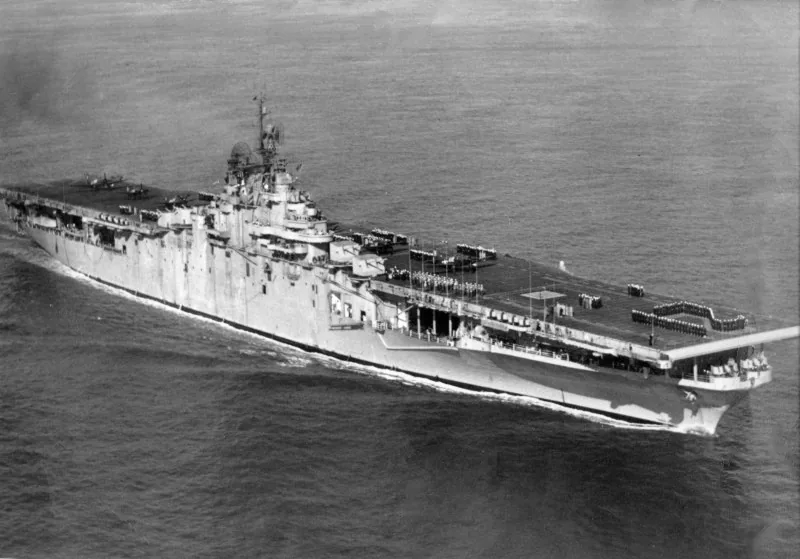
Service
- as Boxer16 April 1945 — 1 December 1969139 days of the war
- Name
- USS Boxer
- Pennant / hull number
- CV-21
- Namesake
- HMS Boxer
- Builder
- Newport News Shipbuilding
- Ordered
- 1943
- Laid down
- 13 September 1943
- Launched
- 14 December 1944
- Commissioned
- 16 April 1945
- Decommissioned
- 1 December 1969
- Struck
- 1 December 1969
- Fate
- Scrapped at Kearny, February 1971 (1971)
- Status
- Scrapped
Specifications
- Displacement, standard
- 27,100 long tons (27,535 t)
- Length
- 270.66 m (888 ft) OA
- Beam
- 28.35 m (93 ft)
- Draught
- 8.53 m (28 ft)
- Speed
- 33 knots (61.1 km/h, 38 mph)
- Complement
- 3,448
- Main gun
- 127 mm (5 in)
The name Boxer comes from His Majesty’s Brig Boxer (Capt. Samuel Blyth, RN), 14 guns, encountered and captured by the U.S. brig Enterprise (Lt. William Burrows), 12 guns, off Portland, Maine, on 5 September 1813.
Enterprise , patrolling the New England coast to “protect the coasting trade to the eastward which has been so much interrupted by small cruisers of the enemy,” was searching the bay around Pemaquid Point when she discovered a brig getting underway that appeared to be a vessel of war, and immediately gave chase. Boxer , however, fired several rounds, and stood for the fight. Lt. Burrows, having identified the stranger’s strength and enemy character, ordered Enterprise to stand out to allow room to maneuver. Boxer gave chase, following Enterprise into open waters. At 3:00 that afternoon, Enterprise shortened sail and ran down, intending to draw in her enemy. At twenty minutes past three o’clock that afternoon with the ships within half pistol shot, both ships opened their batteries. The first broadside proved costly to both vessels: Capt. Blyth fell almost immediately when a shot struck nearby. Not long after, Burrows fell mortally wounded by a cannon shot to the chest. The fighting raged for over an hour, with both ships exchanging volleys and suffering great damage. By 4:00 p.m., Boxer was a complete wreck, all of her braces and rigging shot away, her main topmast and topgallant mast hanging over the side, fore and main masts virtually gone, three feet of water in her hold, and no surgeon to tend to her wounded. As Enterprise maneuvered for a raking position, Lt. McCrery, having assumed command, conferred with his officers and decided to hail Enterprise and concede the battle. The ensigns, having been nailed to the masts by Capt. Blyth, could not be hauled down.
The U.S. Navy never put Boxer into service. Sold in Portland, Maine, she sailed from that port for many years as a merchantman.
Continue to the full service history About 752 words
From the Dictionary of American Naval Fighting Ships, compiled by the Naval History and Heritage Command (Boxer V (CV-21)). A work of the United States Government, in the public domain.
Armament and machinery
Armament and machinery
- Propulsion
- 4 × geared steam turbines
- 4 × shafts
- Power
- 8 × boilers
- 150000 shp
- Armament
- 12 × 5 inch (127 mm)/38 caliber guns
- 32 × Bofors 40 mm guns
- 46 × Oerlikon 20 mm cannons
- Armour
- Belt: 4 in
- Hangar deck: 2.5 in
- Deck: 1.5 in
- Conning tower: 1.5 inch
- Aircraft
- 90–100 aircraft
Sister ships
- USS Antietam (CV-36)
- USS Bennington (CV-20)
- USS Bon Homme Richard (CV-31)
- USS Bunker Hill (CV-17)
- USS Essex (CV-9)
- USS Franklin (CV-13)
- USS Hancock (CV-19)
- USS Hornet (CV-12)
- USS Intrepid (CV-11)
- USS Kearsarge (CV-33)
- USS Lake Champlain (CV-39)
- USS Lexington (CV-16)
- USS Leyte (CV-32)
- USS Oriskany
- USS Philippine Sea (CV-47)
- USS Princeton (CV-37)
- USS Randolph (CV-15)
- USS Shangri-La
- USS Ticonderoga (CV-14)
- USS Wasp (CV-18)
- USS Yorktown (CV-10)
Sources
- Facts harvested from USS Boxer (CV-21) on Wikipedia. Figures only — no wording is taken from it.
- Service history reproduced verbatim from Boxer V (CV-21) , Dictionary of American Naval Fighting Ships — public domain, a work of the United States Government.
- Photograph: Dana White — www.navsource.org [1] — Public domain — Wikimedia Commons