USS Kearsarge (CV-33)
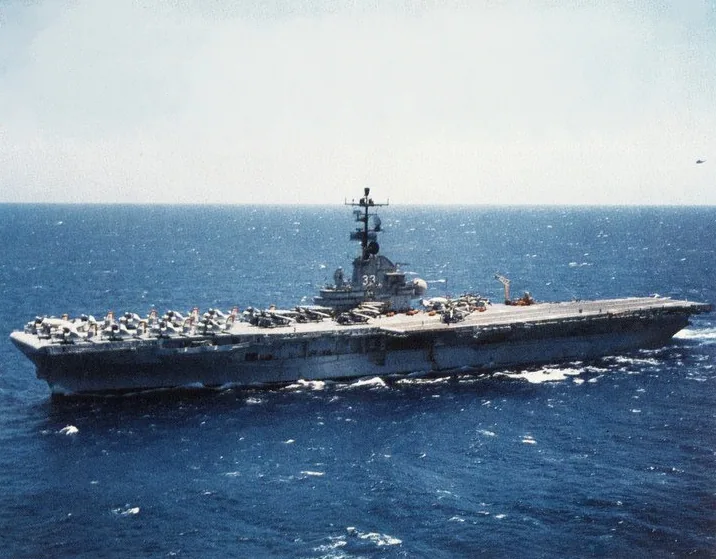
Service
- as Kearsarge2 March 1946 — 13 February 1970
- Name
- USS Kearsarge
- Pennant / hull number
- CV-33
- Namesake
- USS Kearsarge (1861)
- Builder
- New York Naval Shipyard
- Laid down
- 1 March 1944
- Launched
- 5 May 1945
- Commissioned
- 2 March 1946
- Decommissioned
- 16 June 1950
- Recommissioned
- 15 February 1952
- Struck
- May 1973
- Fate
- Scrapped, February 1974 (1974)
- Status
- Scrapped
Specifications
- Displacement, standard
- 27,100 long tons (27,535 t)
- Length
- 270.66 m (888 ft) OA
- Beam
- 28.35 m (93 ft)
- Draught
- 8.53 m (28 ft)
- Speed
- 33 knots (61.1 km/h, 38 mph)
- Complement
- 3,448
- Main gun
- 127 mm (5 in)
The third Kearsarge (CV-33) was laid down on 1 March 1944 at Brooklyn, N.Y., by the New York Navy Yard; launched on 5 May 1945; sponsored by Mrs. Gwyneth C. Fitch, née Conger, wife of Vice Adm. Aubrey W. Fitch, Deputy Chief of Naval Operations (Air); and commissioned on 2 March 1946, Capt. Francis J. McKenna in command.
Kearsarge arrived at her homeport of Norfolk, Va., on 21 April 1946, and for the next year trained along the east coast. The ship cleared Norfolk on a midshipman training cruise into the North Atlantic that carried her to the United Kingdom and also into the Caribbean (7 June–11 August 1947). Kearsarge embarked Attack Carrier Air Group (CVAG) 3, consisting of 18 Grumman F8F-1 Bearcat s of Fighting Squadron (VF) 4A, 24 Curtiss SB2C-5 Helldiver s of Attack Squadron (VA) 3A, and nine Eastern TBM-3E, three TBM-3J, and a trio of TBM-3Q Avenger s of VA-4A, along with a single North American SNJ-5C Texan and an SNJ-4. Upon the carrier’s return to the United States, she engaged in maneuvers for ten months.
As she prepared to deploy to the Mediterranean, however, a 50-foot open launch carrying 90 men back to the ship from liberty capsized in heavy surf off Hampton Roads, Va., on 31 May 1948. At 2000 Liberty Call expired and launches began to shuttle men from ashore to the anchored ship, but at about 2045 the pounding swells swamped the boat not far from the carrier. The Officer of the Deck sounded general quarters, and the signalmen used searchlights to illumine the exceptionally dark night. Few of the passengers wore life vests, and although many men bravely attempted to battle the swells and reach the ship’s gangway, the strong current swept some of them away. Rescuers saved 68 men from the tragedy, but altogether 18 sailors and ten marines died.
Continue to the full service history About 15,163 words
From the Dictionary of American Naval Fighting Ships, compiled by the Naval History and Heritage Command (Kearsarge III (CV-33)). A work of the United States Government, in the public domain.
Armament and machinery
Armament and machinery
- Propulsion
- 4 × General Electric geared steam turbines
- 4 × shafts
- Power
- 8 × boilers
- 150000 shp
- Armament
- 12 × 5 inch (127 mm)/38 caliber guns
- 32 × Bofors 40 mm guns
- 46 × Oerlikon 20 mm cannons
- Armour
- Belt: 4 in
- Hangar deck: 2.5 in
- Deck: 1.5 in
- Conning tower: 1.5 inch
- Aircraft
- 90–100 aircraft
Sister ships
- USS Antietam (CV-36)
- USS Bennington (CV-20)
- USS Bon Homme Richard (CV-31)
- USS Boxer (CV-21)
- USS Bunker Hill (CV-17)
- USS Essex (CV-9)
- USS Franklin (CV-13)
- USS Hancock (CV-19)
- USS Hornet (CV-12)
- USS Intrepid (CV-11)
- USS Lake Champlain (CV-39)
- USS Lexington (CV-16)
- USS Leyte (CV-32)
- USS Oriskany
- USS Philippine Sea (CV-47)
- USS Princeton (CV-37)
- USS Randolph (CV-15)
- USS Shangri-La
- USS Ticonderoga (CV-14)
- USS Wasp (CV-18)
- USS Yorktown (CV-10)
Sources
- Facts harvested from USS Kearsarge (CV-33) on Wikipedia. Figures only — no wording is taken from it.
- Service history reproduced verbatim from Kearsarge III (CV-33) , Dictionary of American Naval Fighting Ships — public domain, a work of the United States Government.
- Photograph: U.S. Navy — U.S. Navy photo [1] from the USS Kearsarge (CVS-33) 1966 cruise book available at Navysite.de — Public domain — Wikimedia Commons