USS Randolph (CV-15)
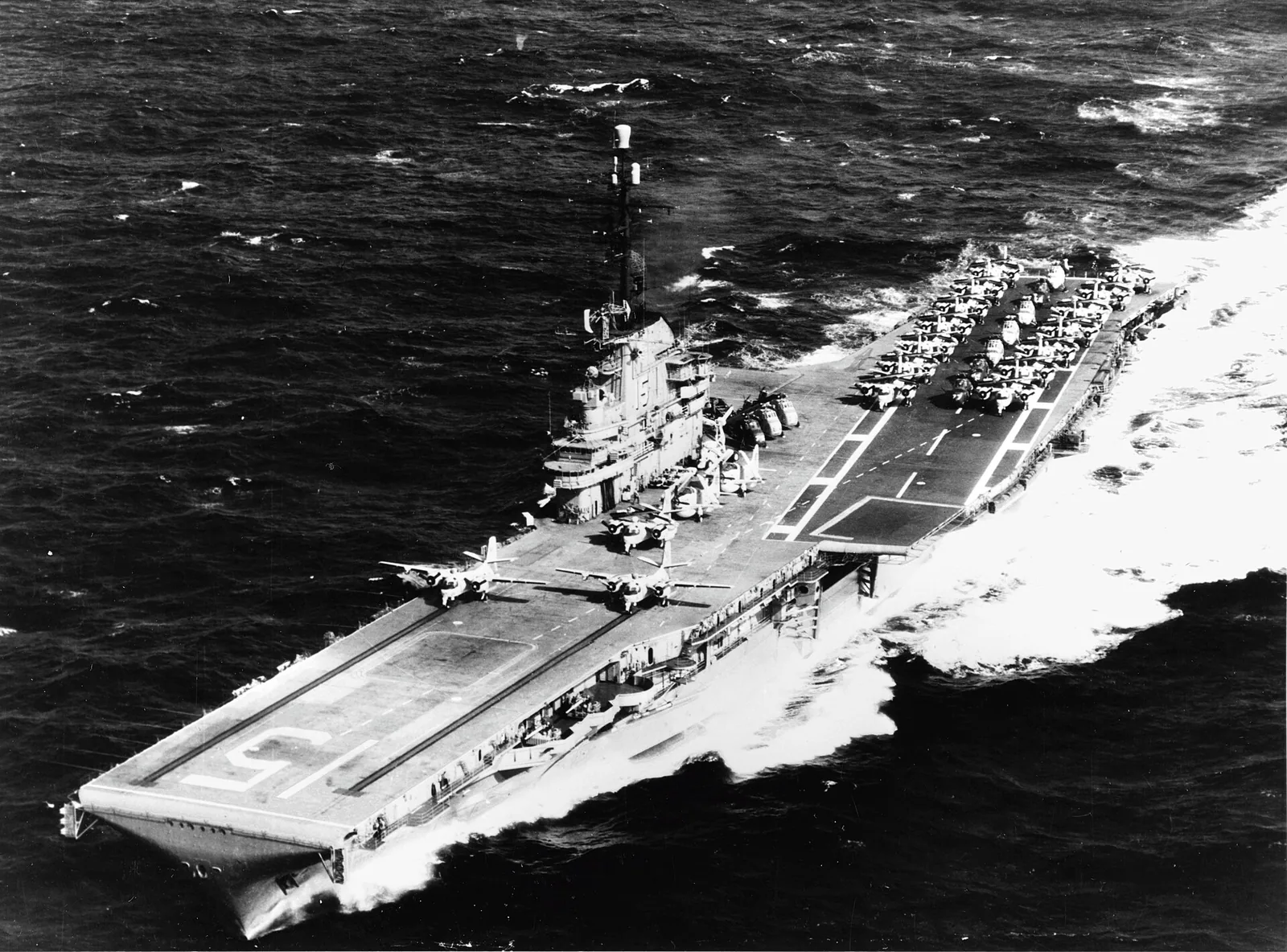
Service
- as Randolph9 October 1944 — 13 February 1969328 days of the war
- Name
- USS Randolph
- Pennant / hull number
- CV-15
- Namesake
- Peyton Randolph
- Builder
- Newport News Shipbuilding and Drydock Company
- Laid down
- 10 May 1943
- Launched
- 28 June 1944
- Commissioned
- 9 October 1944
- Decommissioned
- 25 February 1948
- Recommissioned
- 1 July 1953
- Struck
- 1 June 1973
- Fate
- Scrapped, 24 May 1975 (1975)
- Status
- Scrapped
Specifications
- Displacement, standard
- 27,100 long tons (27,535 t)
- Length
- 270.66 m (888 ft) OA
- Beam
- 28.35 m (93 ft)
- Draught
- 8.53 m (28 ft)
- Speed
- 33 knots (61.1 km/h, 38 mph)
- Complement
- 3,448
- Main gun
- 127 mm (5 in)
Peyton Randolph, born at Tazewell Hall, Williamsburg, Va. in September 1721, graduated from William and Mary College and studied law in England at Inner Temple, London. He was appointed King's Attorney for Virginia in 1748 and served in the House of Burgesses from that year to 1774, becoming speaker in 1766. His conservative temperament was balanced by a deep concern for colonial liberty.
During the Stamp Act crisis, Randolph wrote a remonstrance to the King in 1764 opposing suggested stamp duties, but the following year opposed Patrick Henry's radical "Stamp Act Resolutions." In the ensuing decade, he led the patriotic movement in Virginia, presiding over every revolutionary assemblage in the colony, especially the Committee of Correspondence, formed in 1773, and the Conventions of 1774 and 1775.
A member of the First Continental Congress, he was chosen as its first president on 5 September, 1774. He died of apoplexy in Philadelphia on the 22d of October, 1775.
Continue to the full service history About 1,210 words
From the Dictionary of American Naval Fighting Ships, compiled by the Naval History and Heritage Command (Randolph II (CV-15)). A work of the United States Government, in the public domain.
Armament and machinery
Armament and machinery
- Propulsion
- 4 × geared steam turbines
- 4 × shafts
- Power
- 8 × boilers
- 150000 shp
- Armament
- 12 × 5 inch (127 mm)/38 caliber guns
- 32 × Bofors 40 mm guns
- 46 × Oerlikon 20 mm cannons
- Armour
- Belt: 4 in
- Hangar deck: 2.5 in
- Deck: 1.5 in
- Conning tower: 1.5 inch
- Aircraft
- 90–100 aircraft
Sister ships
- USS Antietam (CV-36)
- USS Bennington (CV-20)
- USS Bon Homme Richard (CV-31)
- USS Boxer (CV-21)
- USS Bunker Hill (CV-17)
- USS Essex (CV-9)
- USS Franklin (CV-13)
- USS Hancock (CV-19)
- USS Hornet (CV-12)
- USS Intrepid (CV-11)
- USS Kearsarge (CV-33)
- USS Lake Champlain (CV-39)
- USS Lexington (CV-16)
- USS Leyte (CV-32)
- USS Oriskany
- USS Philippine Sea (CV-47)
- USS Princeton (CV-37)
- USS Shangri-La
- USS Ticonderoga (CV-14)
- USS Wasp (CV-18)
- USS Yorktown (CV-10)
Sources
- Facts harvested from USS Randolph (CV-15) on Wikipedia. Figures only — no wording is taken from it.
- Service history reproduced verbatim from Randolph II (CV-15) , Dictionary of American Naval Fighting Ships — public domain, a work of the United States Government.
- Photograph: Unknown author — U.S. Navy photo USN 1059601 — Public domain — Wikimedia Commons