USS Ticonderoga (CV-14)
Service
- as Ticonderoga8 May 1944 — 1 September 1973482 days of the war
- Name
- USS Ticonderoga
- Pennant / hull number
- CV-14
- Namesake
- Battle of Ticonderoga
- Builder
- Newport News Shipbuilding
- Laid down
- 1 February 1943
- Launched
- 7 February 1944
- Commissioned
- 8 May 1944
- Decommissioned
- 9 January 1947
- Recommissioned
- 1 October 1954
- Struck
- 16 November 1973
- Fate
- Scrapped, 15 August 1974 (1974)
- Status
- Scrapped
Specifications
- Displacement, standard
- 27,100 long tons (27,535 t)
- Length
- 270.66 m (888 ft) OA
- Beam
- 28.35 m (93 ft)
- Draught
- 8.53 m (28 ft)
- Speed
- 33 knots (61.1 km/h, 38 mph)
- Complement
- 3,448
- Main gun
- 127 mm (5 in)
A village in Essex County , N.Y. , on La Chute River, 100 miles north of Albany . The name is an Iroquois Indian term which means "between two lakes" and refers to Lake George and Lake Champlain . Here, the French built a fort called Carillon in 1755, but it was captured four years later by British troops under General Amherst. Early in the American Revolution, on 10 May 1775, Ethan Allen and his "Green Mountain Boys" captured the fort from the British. General Sir John Burgoyne recaptured the fort in May 1777, holding it until his surrender at Saratoga, N.Y., on 17 October 1777.
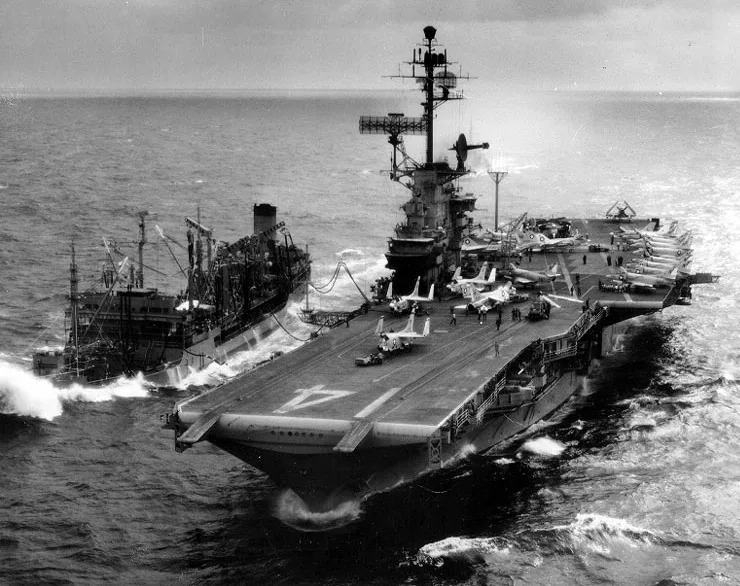
The fourth Ticonderoga (CV-14) was laid down as Hancock on 1 February 1943 at Newport News, Va., by the Newport News Shipbuilding & Dry Dock Co.; renamed Ticonderoga on 1 May 1943; launched on 7 February 1944; sponsored by Miss Stephanie Sarah Pell; and commissioned at the Norfolk Navy Yard on 8 May 1944, Capt. Dixie Kiefer in command.
Ticonderoga remained at Norfolk for almost two months outfitting and embarking Air Group 80. On 26 June, the carrier shaped a course for the British West Indies. She conducted air operations and drills en route and reached Port of Spain, Trinidad, on the 30th. For the next 15 days, Ticonderoga trained intensively to weld her air group and crew into an efficient wartime team. She departed the West Indies on 16 July and headed back to Norfolk where she arrived on the 22d for post-shakedown repairs and alterations. On 30 August, the carrier headed for Panama. She transited the canal on 4 September and steamed up the coast to San Diego the following day. On the 13th, the carrier moored at San Diego where she loaded provisions, fuel, aviation gas, and an additional 77 planes, as well as the Marine Corps aviation and defense units that went with them. On the 19th, she sailed for Hawaii where she arrived five days later.
Continue to the full service history About 4,996 words
From the Dictionary of American Naval Fighting Ships, compiled by the Naval History and Heritage Command (Ticonderoga IV (CV-14)). A work of the United States Government, in the public domain.
Armament and machinery
Armament and machinery
- Propulsion
- 4 × geared steam turbines
- 4 × shafts
- Power
- 8 × boilers
- 150000 shp
- Armament
- 12 × 5 inch (127 mm)/38 caliber guns
- 32 × Bofors 40 mm guns
- 46 × Oerlikon 20 mm cannons
- Armour
- Belt: 4 in
- Hangar deck: 2.5 in
- Deck: 1.5 in
- Conning tower: 1.5 inch
- Aircraft
- 90–100 aircraft
Sister ships
- USS Antietam (CV-36)
- USS Bennington (CV-20)
- USS Bon Homme Richard (CV-31)
- USS Boxer (CV-21)
- USS Bunker Hill (CV-17)
- USS Essex (CV-9)
- USS Franklin (CV-13)
- USS Hancock (CV-19)
- USS Hornet (CV-12)
- USS Intrepid (CV-11)
- USS Kearsarge (CV-33)
- USS Lake Champlain (CV-39)
- USS Lexington (CV-16)
- USS Leyte (CV-32)
- USS Oriskany
- USS Philippine Sea (CV-47)
- USS Princeton (CV-37)
- USS Randolph (CV-15)
- USS Shangri-La
- USS Wasp (CV-18)
- USS Yorktown (CV-10)
Sources
- Facts harvested from USS Ticonderoga (CV-14) on Wikipedia. Figures only — no wording is taken from it.
- Service history reproduced verbatim from Ticonderoga IV (CV-14) , Dictionary of American Naval Fighting Ships — public domain, a work of the United States Government.
- Photograph: U.S. Navy — Official U.S. Navy photograph NH 97487 , from the U.S. Naval History and Heritage Command . The original print was received by the "All Hands" magazine Editorial Department on 14 February 1966 — Public domain — Wikimedia Commons